Signals, creative system, and measurement eCommerce directors can actually trust
It’s early 2026, and I keep hearing the same sentence from eCommerce directors: “Meta feels broken again.”
I’m Maria, Head of Marketing at Fourmeta, and last year we saw this pattern on repeat: stable account → sudden traffic quality drop → panic cuts → performance gets even worse.
This post is the playbook we use to protect performance when the algorithm shifts (or when Meta has real delivery issues).
Let’s name the problem properly.
On Reddit, advertisers are describing sharp drops in traffic quality over a week with “no major changes,” which is exactly how it shows up in real life.
And sometimes it’s not “your account” at all — there have been moments where Meta acknowledged ad delivery disruptions publicly.
This is director-level painful because it hits your three scariest dashboards at once: CAC, MER, and forecast.
It also wrecks creative planning, because the team starts producing random assets instead of a system.
So let’s build that system.

The keywords your team is searching in 2026
These are the exact queries I see behind the calls: “Meta ads traffic quality drop,” “Advantage+ stopped working,” “Meta conversions estimated meaning,” and “Conversions API Gateway vs server-side.”
If you’re searching these, you’re not behind — you’re just in the real world.
Step 1: First check if it’s a platform issue, not a performance issue

Before you touch budgets, check the Meta status page and any official status updates.
There were recent discussions where advertisers referenced a confirmed disruption window, and you don’t want to “optimize” during an outage.
If delivery is unstable, your best move is to pause major restructuring and protect what’s already learning.
What we do in practice: we freeze big changes for 24–48 hours, and we focus on creative rotation only.
This prevents the classic mistake: resetting learning while the platform is wobbling.
Step 2: Separate two different problems that feel identical
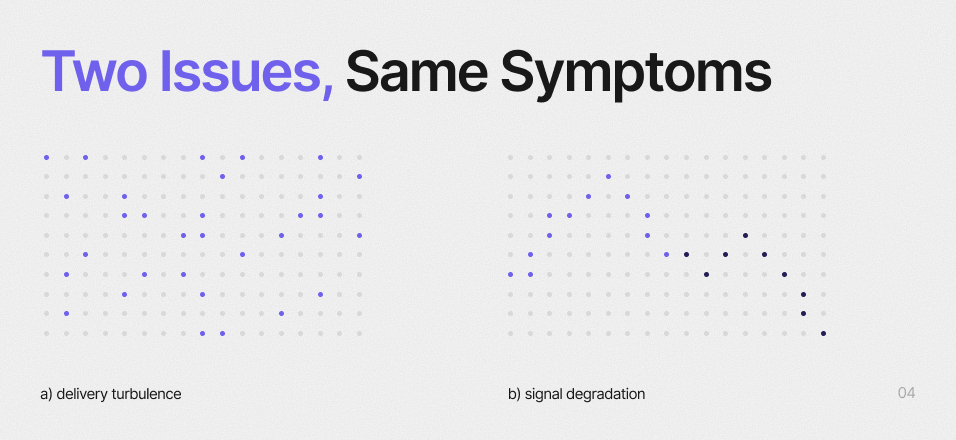
Problem A: delivery disruption / auction turbulence (looks like chaos across many accounts).
Problem B: signal degradation (your tracking/attribution got weaker, so Meta optimizes on worse feedback).
The fix for A is patience and protection; the fix for B is signals.
Step 3: Fix signals like an adult (Pixel + CAPI, with deduplication)
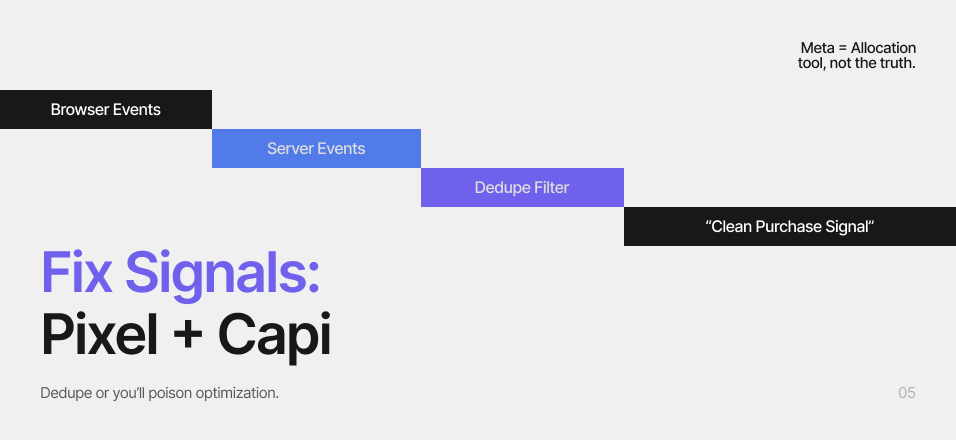
Meta’s official position is clear: Conversions API creates a direct connection between your marketing data and Meta’s ad optimization systems.
If you rely on browser-only signals, you’ll always have blind spots from consent, blockers, and browser behavior.
This is why “server-side” keeps coming up in 2026 discussions.
If you want the simplest on-ramp, Meta positions Conversions API Gateway as a codeless, self-serve setup path inside Events Manager.
If you want more control (and cleaner governance), teams often compare Gateway vs server-side GTM infrastructure.
Either way, your non-negotiable is deduplication, so you don’t inflate conversions and confuse optimization.
Example we see a lot: a brand adds a new app that fires purchase events twice, Meta thinks performance improved, then everything collapses a week later.
That’s not “the algorithm hates us,” that’s dirty signals.
Step 4: Understand “Estimated” conversions before you panic
Meta labels some metrics as estimated, meaning they’re derived via sampling or modeling, not a straight count.
So if your team is arguing about “confirmed vs estimated,” you’re not crazy — you’re just looking at different categories of data.
Our rule: use estimated metrics for directional decisioning, but validate profitability with Shopify net sales and blended MER.
Step 5: Advantage+ isn’t magic, but fighting automation usually loses
A lot of advertisers are debating whether Advantage+ is “the only way now,” especially after major updates like Andromeda.
There are also threads specifically on creative strategy inside Advantage+ Shopping and how to scale without resetting delivery.
The pattern we see: consolidated structure + broader targeting tends to be more stable than micro-segmented accounts when signals are imperfect.
What this looks like for ecommerce:
- Fewer campaigns, fewer ad sets, cleaner creative testing loops.
- A clear segmentation only when pricing, language, or geo truly requires it.
- Retargeting that’s based on real intent (view content / add to cart / high LTV audiences), not “everyone who breathed near the site.”
Step 6: Build a creative system that survives algorithm swings
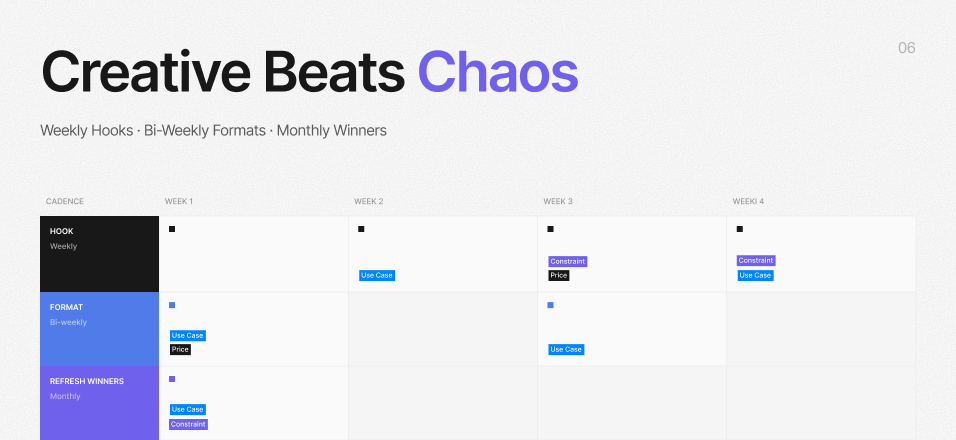
When traffic quality drops, teams often respond by launching “more creatives,” but with no logic.
The creative system that holds up in 2026 is a cadence: new hooks weekly, new formats bi-weekly, and a monthly refresh of winners.
And you need creative that filters out bad clicks by being specific (price range, use case, constraints).
Simple example:
Instead of “New collection is here,” use “Waterproof trail runner under €120 (wide fit)” if that’s your buyer.
The more specific your creative, the more you repel low-intent traffic and attract the right click.
Step 7: Measure what you can control, not what looks pretty
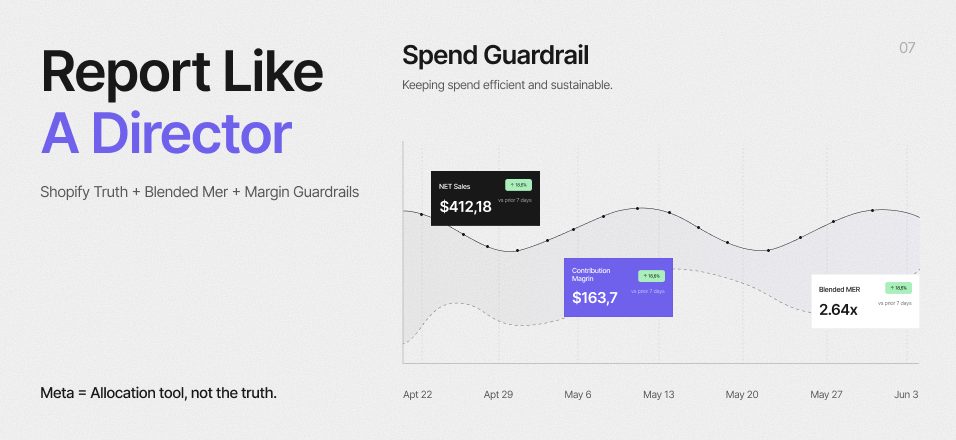
If Meta’s numbers swing, don’t let the team spiral inside Ads Manager.
We anchor performance to three metrics: Shopify net sales, blended MER, and contribution margin, then we use Meta to allocate spend inside that guardrail.
That’s how you protect the business when the platform gets moody.
If you’re running experiments, do it clean: holdout tests, geo splits, or offer-based splits.
If you’re not set up for that, at least run a weekly “sanity dashboard” where GA4 is directional and Shopify is the truth.
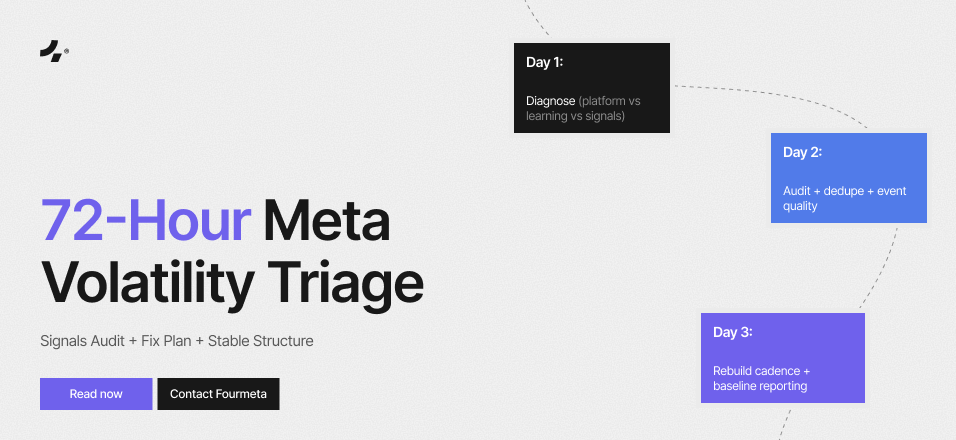
The 72-hour “Meta Volatility Triage” we run at Fourmeta
Day 1: confirm whether it’s platform disruption, learning reset, or signal degradation.
Day 2: audit Pixel + CAPI event quality, deduplication, and conversion prioritization (and fix the top breakpoints).
Day 3: rebuild a stable structure + creative cadence + measurement baseline your team can actually report.
A small CTA, because yes, we’re an agency
If Meta volatility is messing with your CAC targets or forecast, we can help you stabilize it without overreacting.
We’ll validate your signals and tracking in 72 hours, and give you a one-page plan: what to change, what to stop changing, and what to measure.