
The rules of discoverability have changed. If you're still optimizing only for Google's blue links, you're already behind and it's costing you revenue.
Let's be honest, the way buyers find products online is undergoing the most significant structural shift since Google displaced the directory web in the early 2000s. AI search engines, such asPerplexity, ChatGPT Search, Google AI Overviews, and Microsoft Copilot, are no longer novelties. They are active, growing channels where your customers are already getting answers, comparing products, and making purchase decisions. The difference is that in this new world, your brand may not even appear on the screen at all, unless you understand how AI search works and optimize for it deliberately.
This is not a technical deep-dive for your engineering team. This is a strategic briefing for you, the CEO, the founder, the marketing director making decisions about where to invest and what to protect. Let's break it down clearly.
How traditional search engines work (and why that model is shifting)
Traditional search engines, primarily Google and Bing, operate on a crawl-index-rank model. A user types a query, the engine matches it against a massive index of web pages, and returns a ranked list of links. Your job, as a brand, has been to earn a place on that list through a combination of technical SEO, keyword targeting, backlink authority, and content volume.
The entire paradigm is built around clicks. You compete for a position on the results page, the user clicks through to your site, and from there you try to convert them. AI search visibility, by contrast, doesn't necessarily involve a click at all.
For more than two decades, traditional SEO has been the dominant framework for digital discoverability. Brands invested in backlinks, domain authority, structured data, and keyword-mapped content hierarchies. It worked because search engines were, fundamentally, referral machines, they sent traffic to you, and you did the rest.
How AI search engines actually work
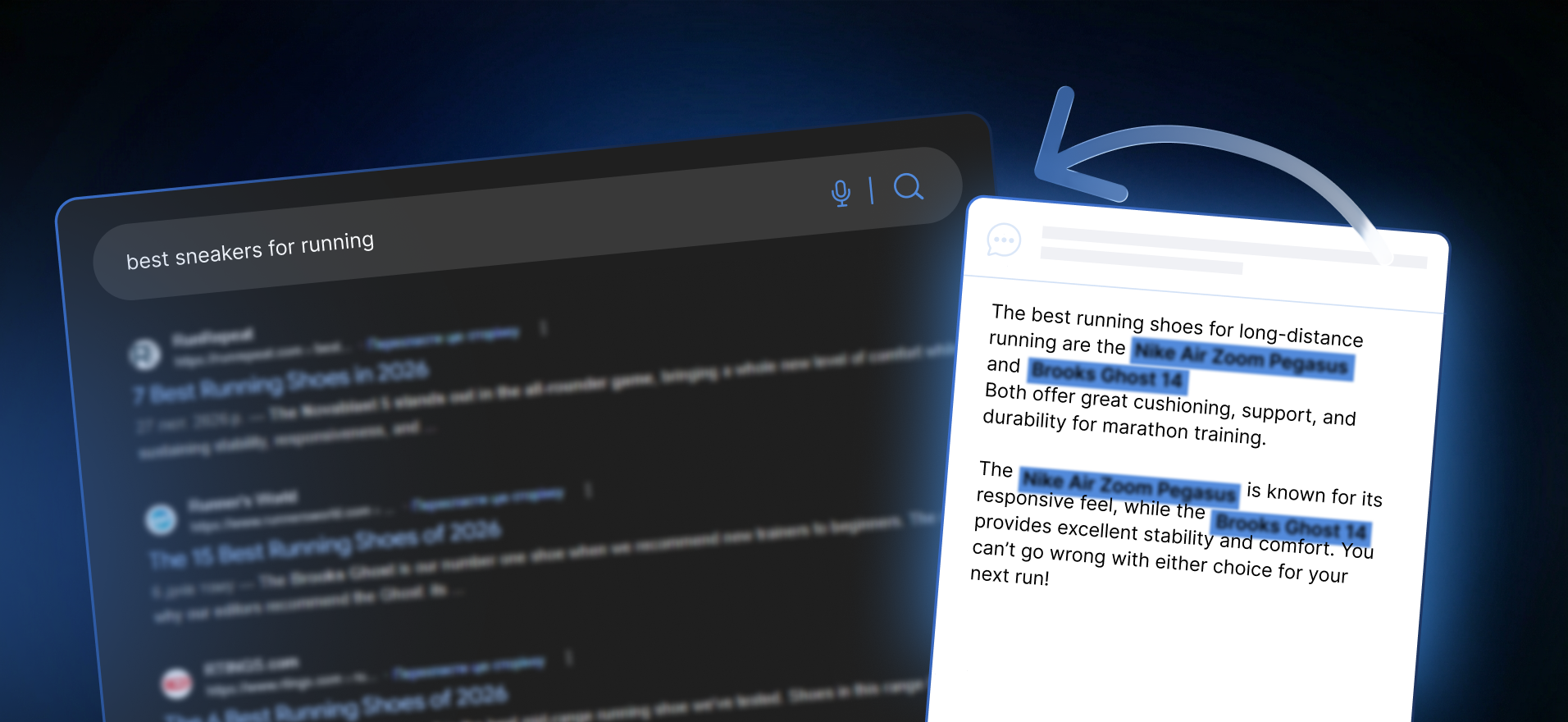
AI search engines don't rank links, they generate answers. When a user asks Perplexity "What's the best sustainable black dress under £100?" they don't receive ten blue links. They receive a synthesized answer, written in natural language, often with two to four cited sources embedded inline. The AI has read the web, processed the information, and composed a response on the user's behalf.
The implications for ecommerce brands are profound. In traditional search, you needed to rank in the top three positions to capture meaningful traffic. In AI search vs traditional search terms, the equation flips: instead of competing for position among ten results, you are competing to be cited within a single synthesized answer. Often, only one or two brands get named. If it's not you, it's your competitor.
Here's what AI search engines actually evaluate when generating a response:
- Trustworthiness and authority of your domain in the context of the query topic
- Clarity and specificity of your content — can it be reliably quoted or summarized?
- Whether your brand is mentioned and validated by third-party sources (reviews, press, editorial coverage)
- How well your structured data helps machines understand your product catalog and brand context
- Recency and freshness signals — AI models favor sources that are regularly updated and authoritative over time

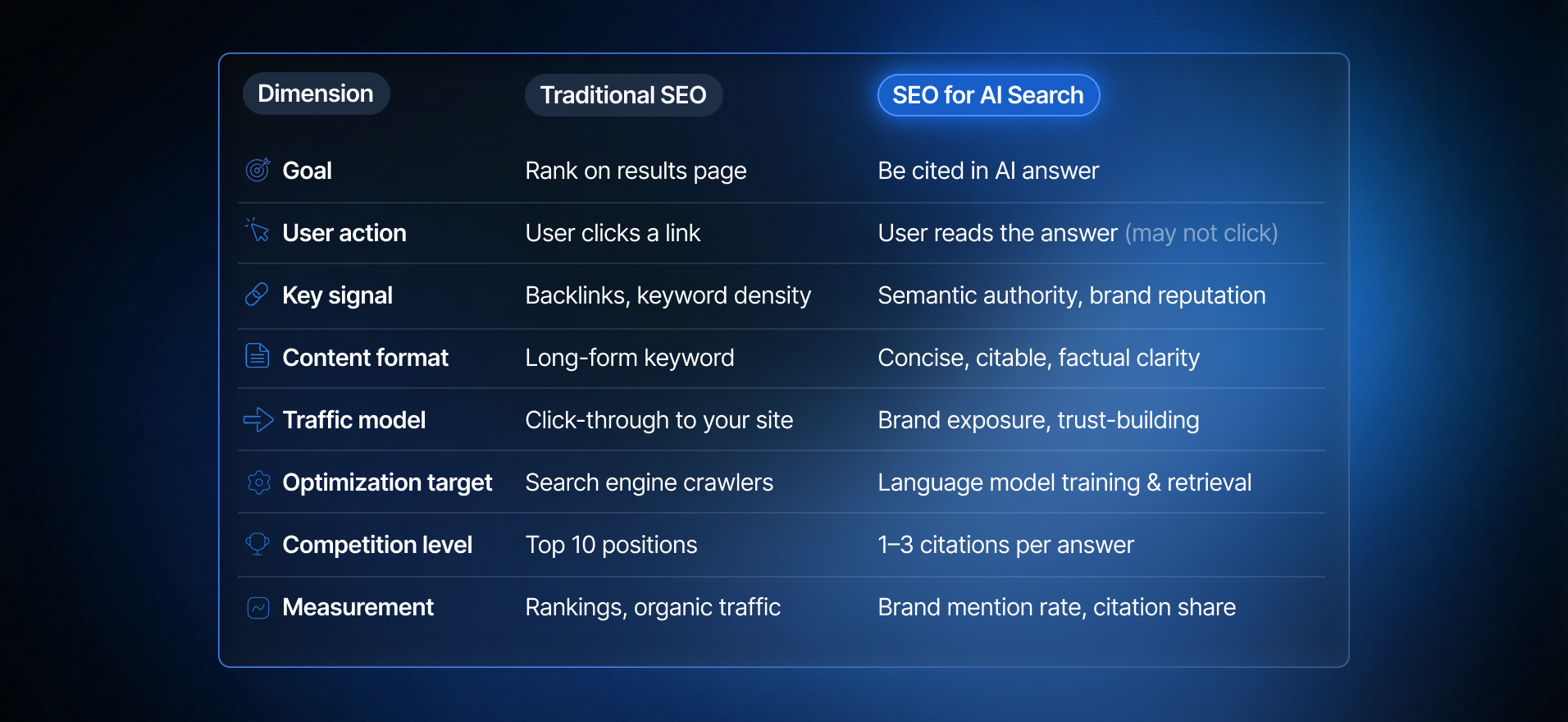
AI search optimization vs traditional SEO: a side-by-side view
Understanding AI search optimization vs traditional SEO requires rethinking your entire mental model of what "winning" looks like online. Here is the clearest way to see the contrast:
What this means for your ecommerce brand right now
If you run an ecommerce brand, here's the uncomfortable reality: a significant and growing portion of your addressable customers are starting their purchase journeys inside AI search engines. They're asking conversational, specific questions, like "What's a good protein powder for women over 40 with no artificial sweeteners?" and getting answers that either include your brand or don't. There's no page two. There's no paid slot. There's just the answer.
AI search visibility is therefore not just an SEO problem. It is a brand equity problem. Brands that are consistently cited in AI-generated answers build a layer of implied third-party endorsement that compounds over time. Brands that aren't cited lose consideration at the very top of the funnel before the user ever visits a website, reads a review, or opens an email.
This is the AI search visibility gap, and it's widening every quarter.

How to win in AI search: the strategic priorities
Adapting your SEO for AI search doesn't mean abandoning your traditional SEO investment. It means layering a new discipline on top of it, that's called GEO. The brands that will dominate the next five years are those that understand both games and play them simultaneously. Here's where to focus:
1. Build semantic authority, not just keyword density
AI search engines are not matching keywords, they are building a contextual model of who is authoritative about a given topic. Your content strategy must shift from "how many times do I include this keyword" to "am I the most credible, comprehensive, and clearly positioned source on this topic area?" Write for subject matter depth. Structure content so that key claims are immediately clear and quotable. Eliminate filler.
2. Earn third-party brand mentions aggressively
AI search models are trained on the web and rely heavily on how your brand is discussed across independent sources. Press coverage, editorial reviews, expert recommendations, and high-quality affiliate content all contribute to the signal that your brand is legitimate and worth citing. If your current PR and content partnership strategy is underfunded, that is now a direct AI search visibility problem, not just a brand awareness problem.
3. Optimize your structured data and product information
AI search engines that pull product information, Google's AI Overviews in particular, rely on machine-readable signals to understand your catalog. Schema markup, clear product descriptions, accurate specifications, and well-structured FAQ content all help AI models understand and surface your products in relevant queries. Audit your structured data implementation as you would any technical SEO task: rigorously and regularly.
4. Track brand citation rate as a primary KPI
Traditional SEO metrics, like rankings, organic sessions, click-through rates, don't capture AI search visibility at all. You need a new measurement layer. Start tracking how often your brand is cited in AI-generated responses across the queries that matter most to your category. Tools specifically built for AI search monitoring are emerging rapidly in 2026. Early investment in measurement gives you a competitive intelligence advantage: you'll know what's working before most of your competitors have even started asking the question.

The bottom line for ecommerce leaders
AI search vs traditional search is not a binary choice between old and new. It is an expanding map of how your customers navigate toward purchase and you need to be visible across all of it. Traditional search still drives enormous volume and will continue to for years. But the marginal growth in discoverability for well-established categories is increasingly happening inside AI search engines, where the competitive landscape is still early and the first movers have a durable advantage.
The brands that win the next chapter of ecommerce will not be the ones with the biggest SEO budgets. They will be the ones that recognized the shift early, adapted their content and brand strategy to be AI-legible, and built the measurement infrastructure to know where they stand in AI search visibility before everyone else caught up.
That time is now. The gap between knowing this and acting on it is where your next competitive advantage either gets built or gets lost to someone else.
KEY TAKEAWAYS FOR ECOMMERCE BRANDS
- AI search engines generate synthesized answers, not ranked link lists. Being cited requires a fundamentally different strategy than ranking.
- AI search optimization vs traditional SEO is not either/or, it requires layering a new discipline on top of your existing investment.
- Semantic authority, third-party brand mentions, and structured data are the core levers for AI search visibility.
- Brand citation rate is the new ranking position and most brands aren't measuring it yet.
- SEO for AI search rewards clarity, credibility, and consistent brand presence across independent sources.