Custom ecommerce development services in the UK: pricing, process & proven results

If you're a founder, ecommerce director, or marketing lead at a DTC brand, you already know that off-the-shelf platforms only take you so far. At some point, the limitations of a templated Shopify theme start costing you revenue in conversion rate, in average order value, in the operational hours spent on workarounds your platform was never built to handle.
That's the moment most growth-stage brands start asking serious questions about custom ecommerce development services. This guide answers the ones we hear most often: what it actually costs, how the process works, what separates a good agency from a great one, and how to find a UK partner you can trust with your most important digital asset.
Why custom ecommerce development? The business case
There's a reason the fastest-scaling DTC brands in the UK eventually move beyond plug-and-play solutions. Custom ecommerce web development services give you something templated platforms cannot: a store built around how your customers buy, not around how your platform was designed.
The commercial benefits are well-documented among brands that have made the transition:
Conversion optimisation baked into architecture
A bespoke checkout flow, a product page built around your specific catalogue structure, and a mobile experience designed for your customer demographic, these aren't nice-to-haves. For a brand doing £2M+ in annual revenue, a 0.5% lift in conversion rate is material. Custom development makes that precision possible.
Scalability without compromise
Peak trading, like Black Friday, product launches, influencer moments, exposes the ceiling of shared-infrastructure platforms fast. Custom-built ecommerce solutions are engineered for your traffic profile, not an average across thousands of merchants.
Ownership and flexibility
When your roadmap requires a novel subscription model, a complex B2B portal, or a deeply integrated loyalty programme, you are not waiting for your platform to release a feature. You build it.
Integration depth
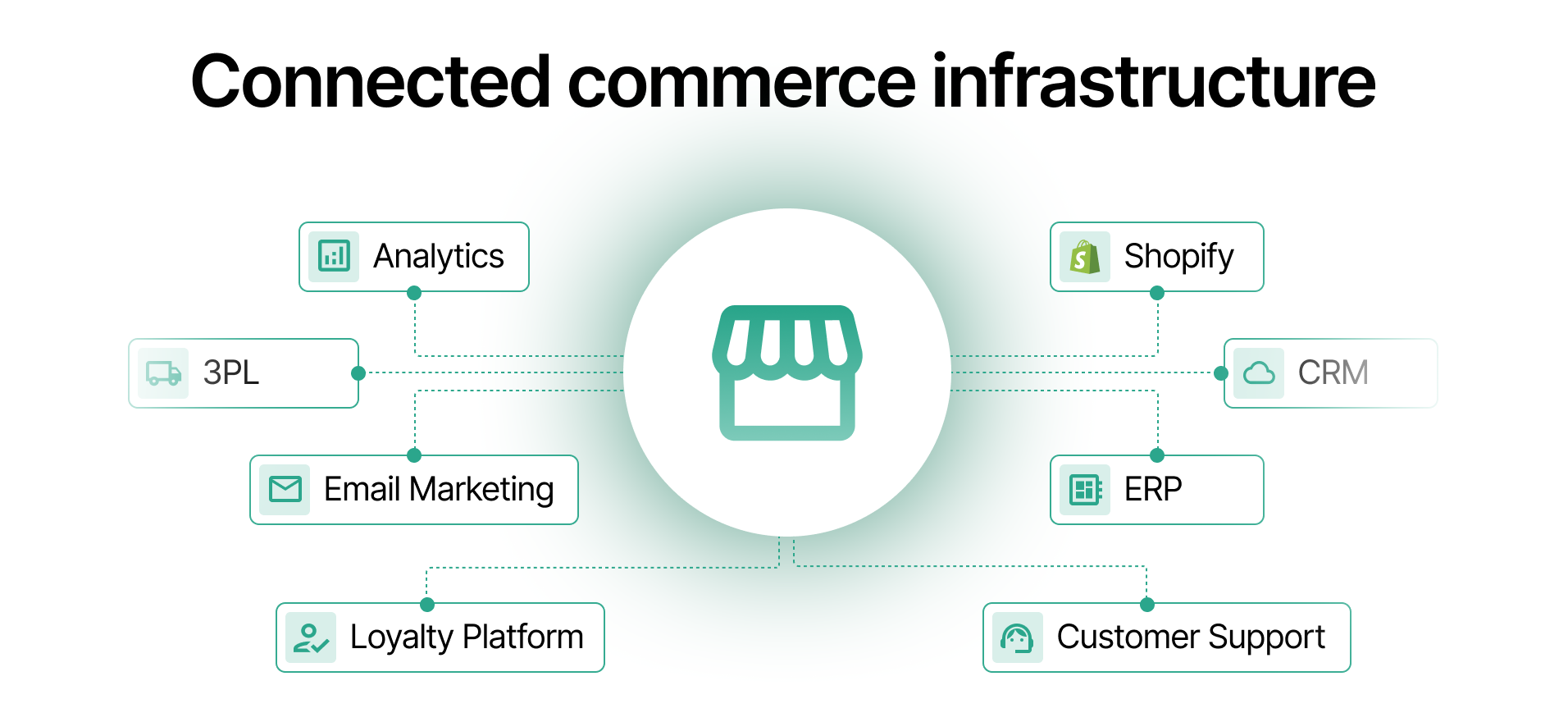
ERP systems, 3PLs, bespoke PIM setups, custom analytics stacks, ecommerce development services that are truly custom connect your store to your operational infrastructure cleanly, rather than forcing data through mismatched APIs and brittle middleware.
What do custom ecommerce development services actually include?
The scope of ecommerce website development services varies significantly depending on the agency and the brief. Here is what a comprehensive engagement typically covers:
- Discovery and strategy
Before a line of code is written, a reputable ecommerce development agency will invest time understanding your customer journey, your commercial goals, your existing tech stack, and your competitive landscape. This phase produces a specification that drives every subsequent decision.
- UX design and prototyping
Wireframes, user flows, and interactive prototypes are validated before development begins. For brands with existing customer data, this stage often incorporates conversion research, like heatmaps, session recordings, and customer interviews, to inform design decisions with evidence rather than assumption.
- Frontend development
The visible layer of your store: product listing pages, product detail pages, checkout, account portals, content pages. A strong frontend team builds for speed (Core Web Vitals matter for both SEO and conversion), accessibility, and the nuanced interactions that create a premium brand experience.
- Backend and platform development
Whether that means a headless Shopify build, a custom build, a bespoke Node or Laravel application, or a composable commerce architecture, the backend is where business logic lives. Custom pricing rules, inventory logic, subscription engines, and customer segmentation all live here.
- Systems integration
Connecting the store to your wider business: payment gateways, fulfilment platforms, CRM, ERP, email marketing, analytics, and customer support tooling.
- Quality assurance and testing
Load testing, cross-device testing, accessibility audits, and UAT cycles before launch.
- Post-launch support and iteration
The best agencies don't disappear after go-live. Ongoing retainers for performance monitoring, iterative development, and technical support are standard for brands serious about continuous improvement.
How much does custom eCommerce development cost in the UK?
This is the question every founder and ecommerce director asks first and the honest answer is: it depends on scope. But here are realistic benchmarks for the UK market in 2026.
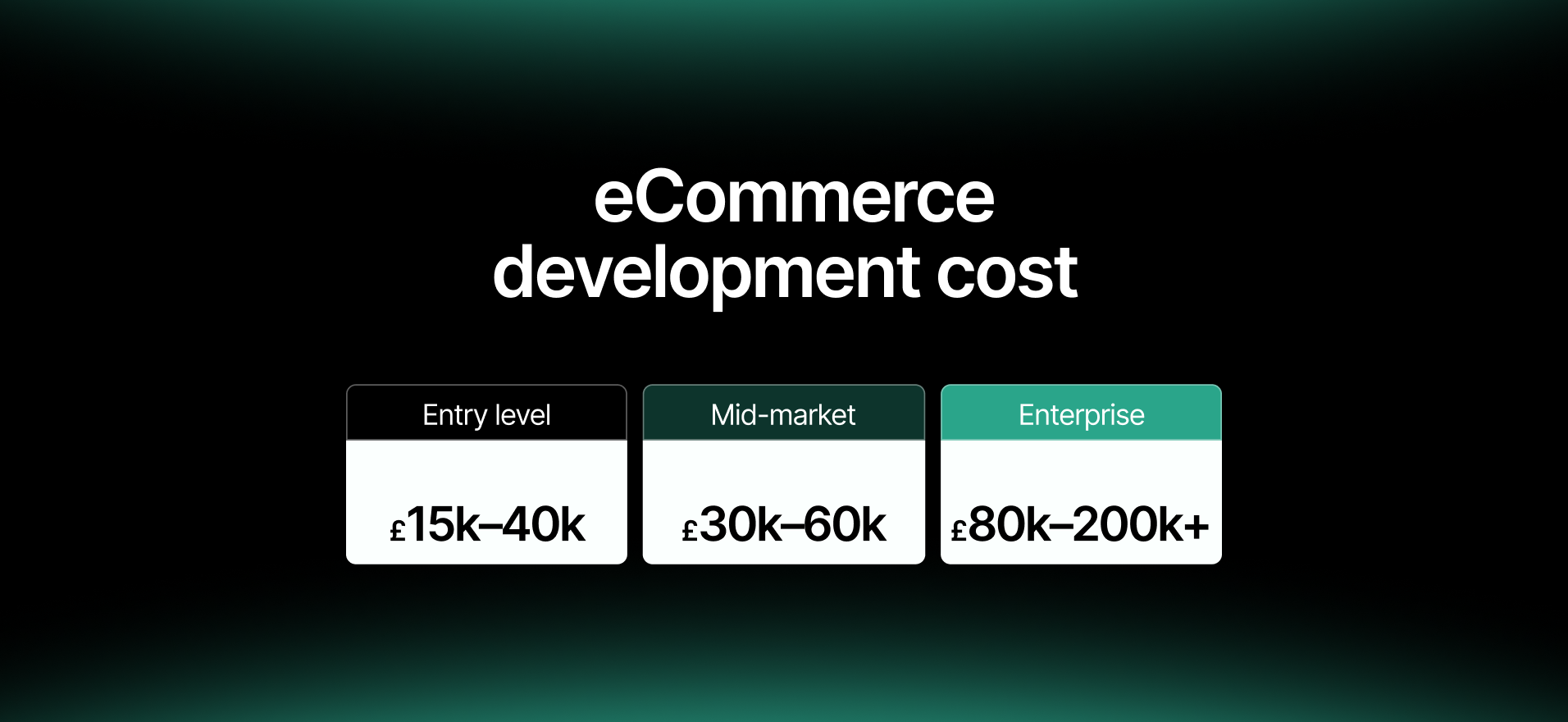
Entry-level custom builds: £15,000 – £40,000
Typically applies to brands moving from a basic Shopify template to a properly engineered, custom-designed Shopify or Shopify Plus store. Includes bespoke design, custom theme development, core integrations, and launch support. Right for brands with straightforward catalogue structures and well-defined requirements.
Mid-market custom builds: £30,000 – £60,000
The most common tier for established DTC brands. Covers more complex catalogue requirements, richer customer account functionality, deeper integrations, and more involved UX research and design. May include headless architecture where performance or content flexibility demands it.
Enterprise and fully bespoke builds: £80,000 – £200,000+
Applies to multi-market builds, complex B2B/B2C hybrid experiences, heavily custom backend logic, or large composable commerce platforms. Also relevant when replacing legacy systems at scale.
Ongoing retainer support: Most brands engage their development partner on a monthly retainer post-launch, typically ranging from £3,000 to £15,000 per month depending on the volume and complexity of ongoing development work.
One important note for UK buyers: day rates for senior ecommerce developers in London and major UK cities typically range from £500 to £900 per day. Agencies outside London often offer equivalent technical quality at meaningfully lower rates. Always ask for a detailed breakdown of how project costs are structured.
How to evaluate UK eCommerce development agencies
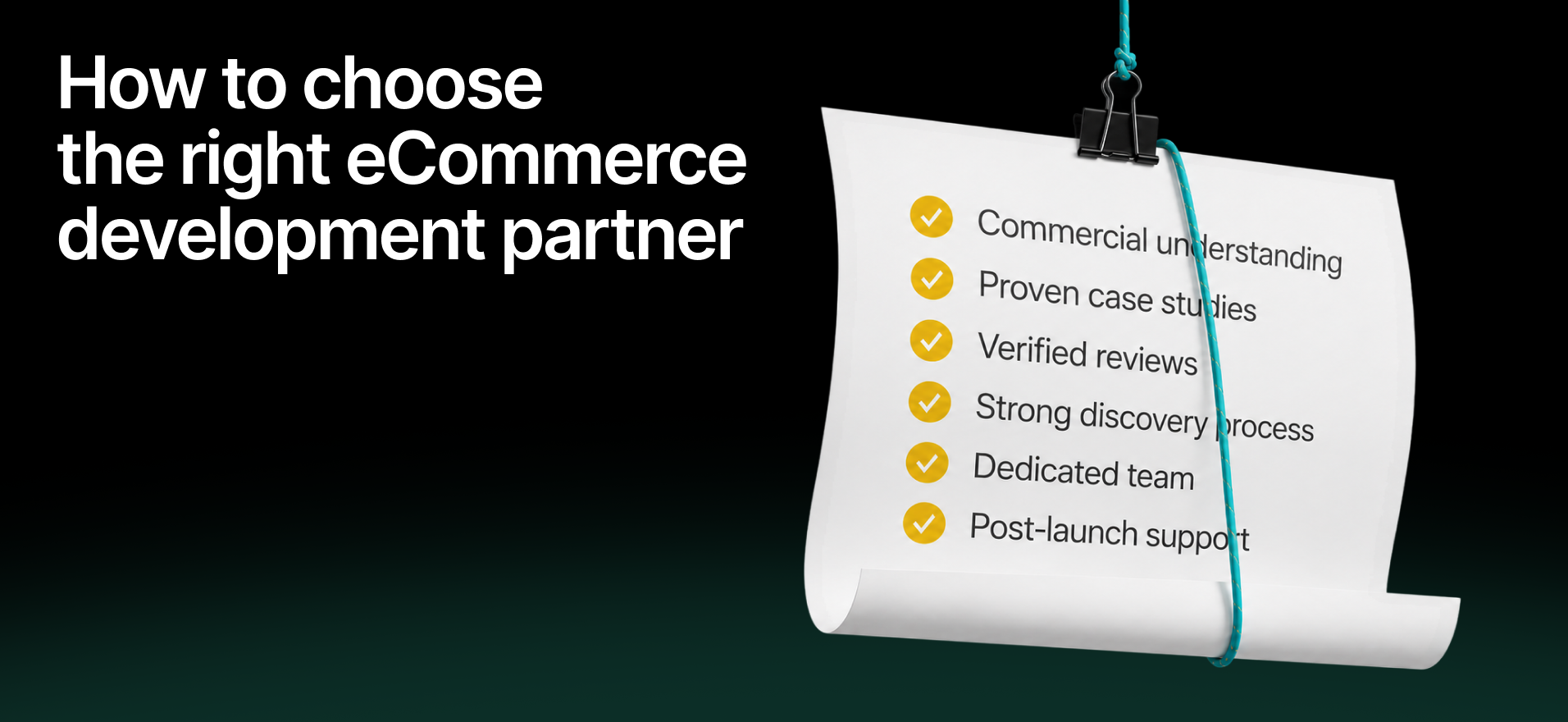
The UK market for custom ecommerce development services is mature and genuinely competitive. These criteria will help you separate agencies that will deliver commercial outcomes from those that will deliver beautiful websites that don't move the needle.
Look for commercial fluency, not just technical skill. The best agencies talk about revenue, conversion rate, and customer lifetime value before they talk about technology. If a discovery call is dominated by platform evangelism rather than questions about your business, that tells you something important.
Ask to see relevant case studies with real numbers. Not just "we rebuilt Brand X's store", but what happened to conversion rate, revenue, or page performance after launch. Agencies with genuine track records share specific outcomes. Those without them offer vague testimony.
Check reviews on independent platforms. Clutch, Google, and DesignRush all carry verified client reviews for UK ecommerce agencies. Look for patterns across multiple reviews, not just the strongest testimonials on an agency's own website. Pay attention to what clients say about communication, project management, and post-launch support, not just the quality of the final build.
Evaluate the discovery process. How an agency scopes your project tells you a great deal about how they'll manage it. A rigorous discovery process with clear questions, structured outputs, and a willingness to push back on your assumptions is a positive signal. A rapid quote based on a brief email is not.
Ask about team structure and continuity. Who will actually work on your project? Will you have a named project manager and lead developer? What is the agency's policy on subcontracting? Knowing who is accountable matters enormously when you're a year into a relationship and things need to move fast.
The development process: what to expect
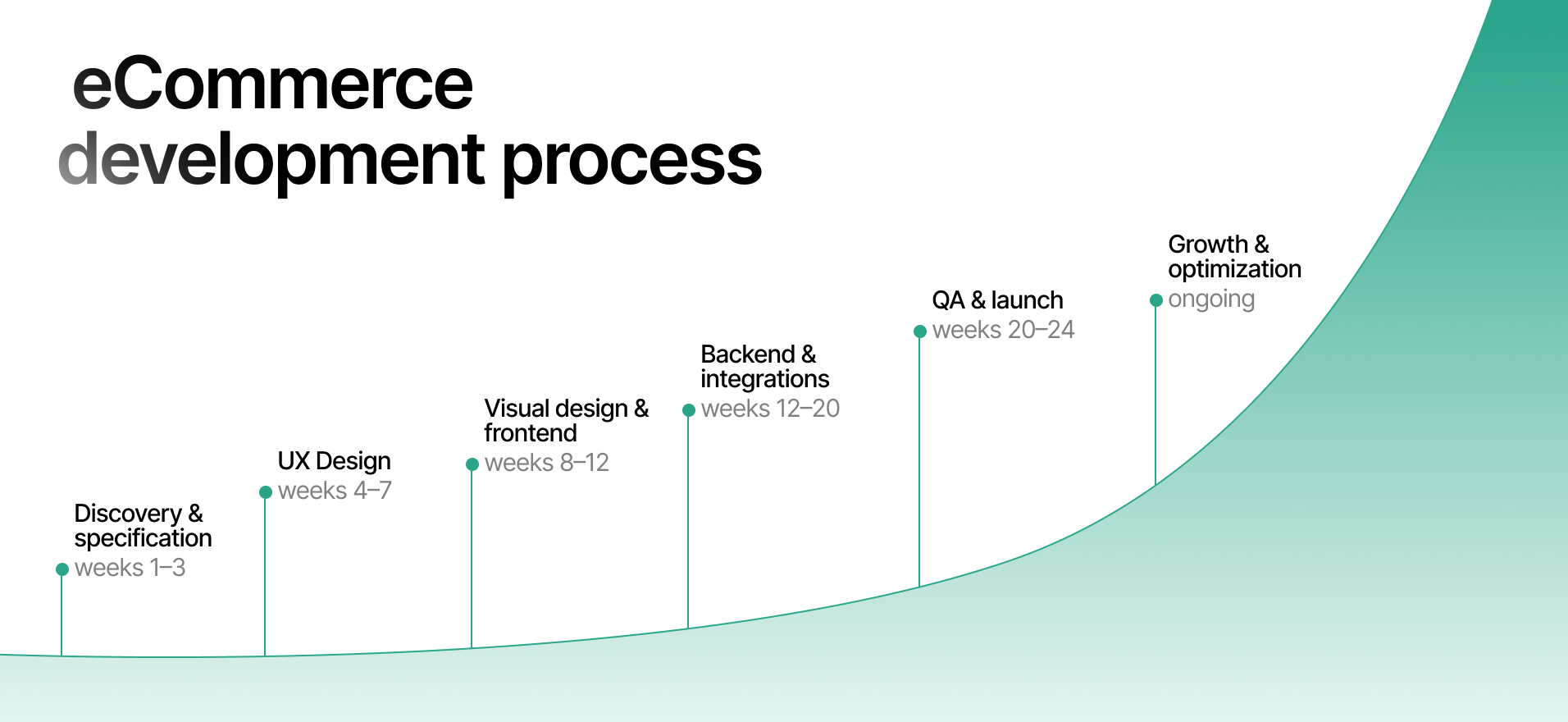
A well-run ecommerce web development project follows a predictable arc. Here is what best-in-class delivery looks like:
Weeks 1–3: Discovery and specification. Stakeholder workshops, technical audit of your existing stack, customer journey mapping, and commercial goal-setting.
Output: a detailed functional specification and project plan.
Weeks 4–7: UX design. Wireframes and interactive prototypes, reviewed and iterated with your team. Design system established.
Output: approved UX designs ready for visual design.
Weeks 8–12: Visual design and frontend build. Brand-aligned visual design applied to approved UX, followed by frontend development. Regular demos and feedback cycles keep the build aligned with expectations.
Weeks 12–20: Backend development and integration. Platform logic, systems integrations, and data migration (if applicable). Parallel testing begins.
Weeks 20–24: QA, UAT, and launch preparation. Full testing cycle, performance optimisation, content population, and team training. Staged rollout with monitoring in place.
Post-launch: Iteration and growth. Data review at 30/60/90 days, CRO programme, ongoing development retainer.
Finding reliable ecommerce development services near you
For UK-based brands, geography still matters not because great ecommerce development can't be delivered remotely, but because the best client-agency relationships involve genuine strategic partnership, and that is easier to build with regular in-person touchpoints.
London, Manchester, Bristol, Leeds, and Edinburgh all have strong concentrations of experienced ecommerce development services agencies. When evaluating options, consider:
- Does the agency work with brands at your revenue stage and in your category?
- Can they evidence post-launch commercial results, not just delivery?
- Do their client reviews speak positively to communication and long-term relationship quality?
- Is their process structured to surface and resolve problems early, before they become expensive?
The right agency is not necessarily the largest or the most prominent. It is the one that treats your commercial outcomes as their professional responsibility and has the process, the people, and the track record to back that up.
Fourmeta: custom ecommerce development services for ambitious UK brands
If you're evaluating UK agencies for custom ecommerce development services, Fourmeta is one worth putting at the top of your shortlist, particularly if your brand is on Shopify or considering a move to Shopify Plus.
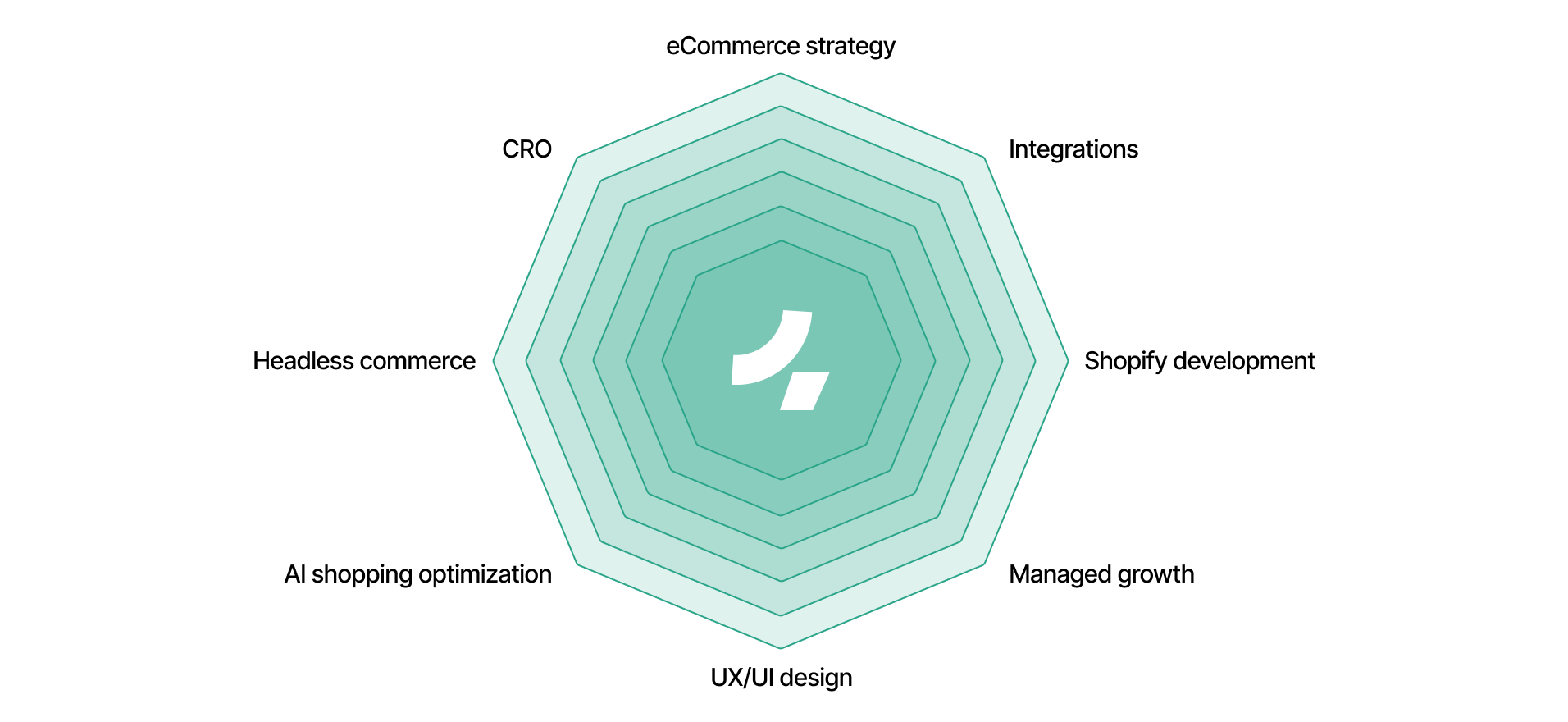
Based in London and working with brands across the UK and internationally, Fourmeta positions itself as a full-service ecommerce agency built specifically for brands that are serious about growth. Their work spans strategy, UX and design, development, CRO, and ongoing managed services, meaning they can engage at the level your business actually needs, rather than handing off at the point of launch.
What sets Fourmeta apart in the custom ecommerce space
Accredited Shopify expertise
Fourmeta holds Shopify Expert certification, a credential held by relatively few UK agencies, and specialises in both standard Shopify builds and headless commerce architectures using Shopify as the backend. For DTC brands where platform performance and scalability are non-negotiable, this level of platform depth matters.
A genuinely commercial approach to ecommerce web development services
Fourmeta's methodology is built around commercial outcomes, not just delivery. Their process includes proprietary tools and frameworks for identifying engagement gaps, diagnosing tech stack bottlenecks, and developing conversion rate optimisation strategies as a core part of the build. They identify conversion opportunities before a development engagement even begins, which reflects a confidence in their diagnostic process that generalist agencies rarely match.
Full-service capability under one roof
One of the most common failure modes in ecommerce development is the handoff problem: the agency builds a great store, and then the client pieces together CRO, marketing, and ongoing development from separate suppliers who don't share context. Fourmeta covers ecommerce development, CRO auditing, Shopify marketing, systems integration, UX/UI design, and managed growth retainers, so the team that builds your store is the same team optimising and scaling it.
Headless commerce for performance-led brands
For brands where page speed, content flexibility, or multi-channel experience are strategic priorities, Fourmeta offers headless Shopify development, combining Shopify's reliable commerce backend with a custom frontend stack. This is a technically demanding capability that distinguishes specialist ecommerce agencies from generalist web developers.
Proven results across the UK and beyond
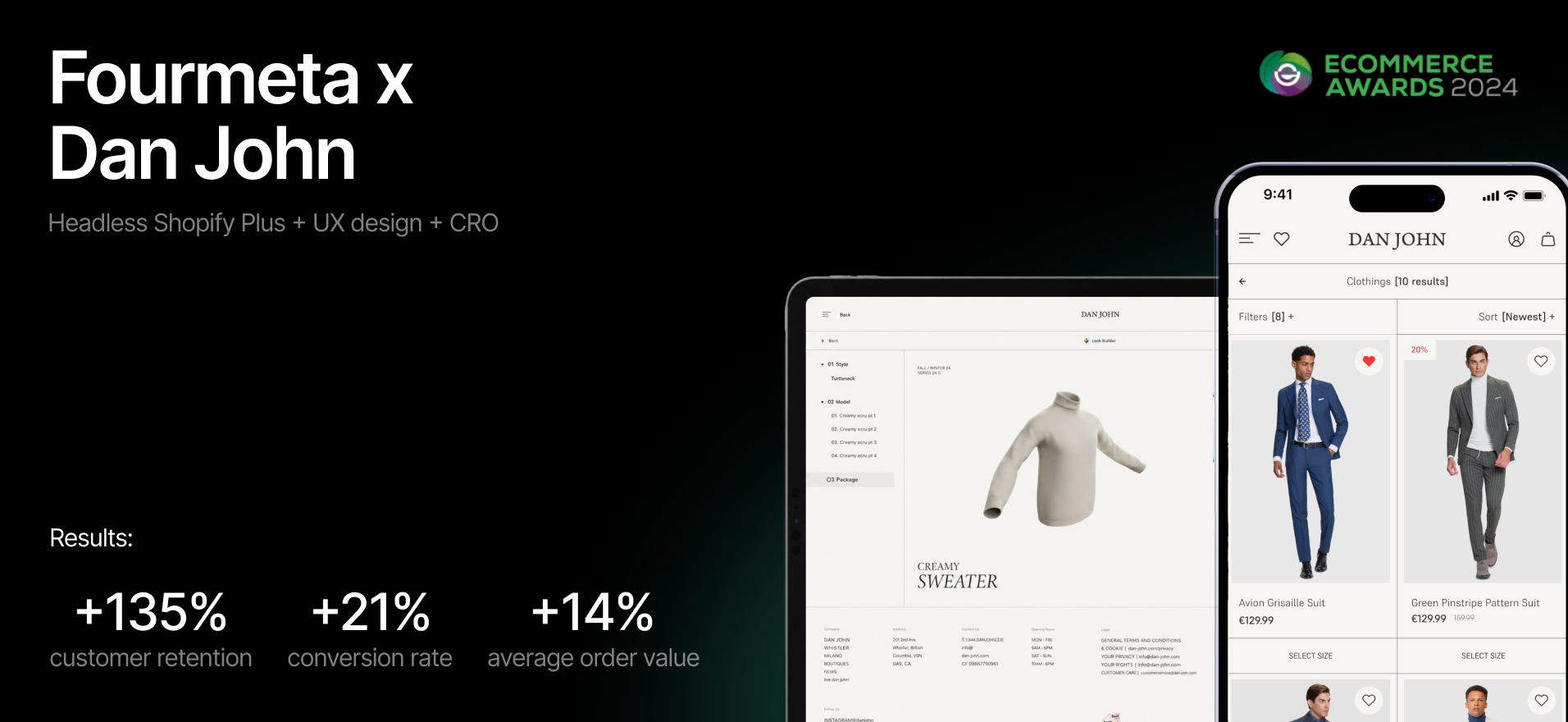
Client outcomes cited by Fourmeta include a 270% increase in website traffic and a 2% improvement in conversion rate following a full web portal redesign, numbers that reflect genuine commercial impact rather than vanity metrics.
Broad UK presence
While headquartered in London, Fourmeta serves clients across Birmingham, Manchester, Leeds, Sheffield, Liverpool, Bristol, and beyond, making them a strong choice for UK brands regardless of geography.
AI-native capabilities
Fourmeta has recently launched AI Fourmula and AI Shopping Optimisation services, integrating machine learning into ecommerce workflows, a forward-looking investment that matters for brands thinking about where ecommerce personalisation, merchandising, and search are heading.
The bottom line
Custom ecommerce development is a significant investment. The brands that see the strongest returns are those that choose their agency partner with the same rigour they apply to other major commercial decisions with clear criteria, proper due diligence, and a long-term view of the relationship.
The UK market offers genuine depth of talent in ecommerce website development services. The challenge is finding agencies that understand your business well enough to build the right thing, and are structured to support your growth long after launch day.
If you're at the stage where you're evaluating options, the right next step is a discovery conversation with two or three agencies whose track record genuinely reflects your category and scale. Come prepared with your commercial context, including current revenue, conversion rate benchmarks, the specific problems you're trying to solve, and pay close attention to the quality of the questions they ask you back.