
Magento to Shopify Plus Migration Services: Why Enterprises Are Switching This Year

I’m Alex, CEO at Fourmeta, and over the last few years I’ve had the same conversation with CTOs and eCommerce directors across the UK. They’re running serious revenue through Magento, but behind the scenes the platform feels increasingly like a leaky old warehouse that needs constant patching just to stay open. At some point, the question stops being “Can we fix this?” and becomes “Is it finally time to migrate from Magento to Shopify Plus?”.
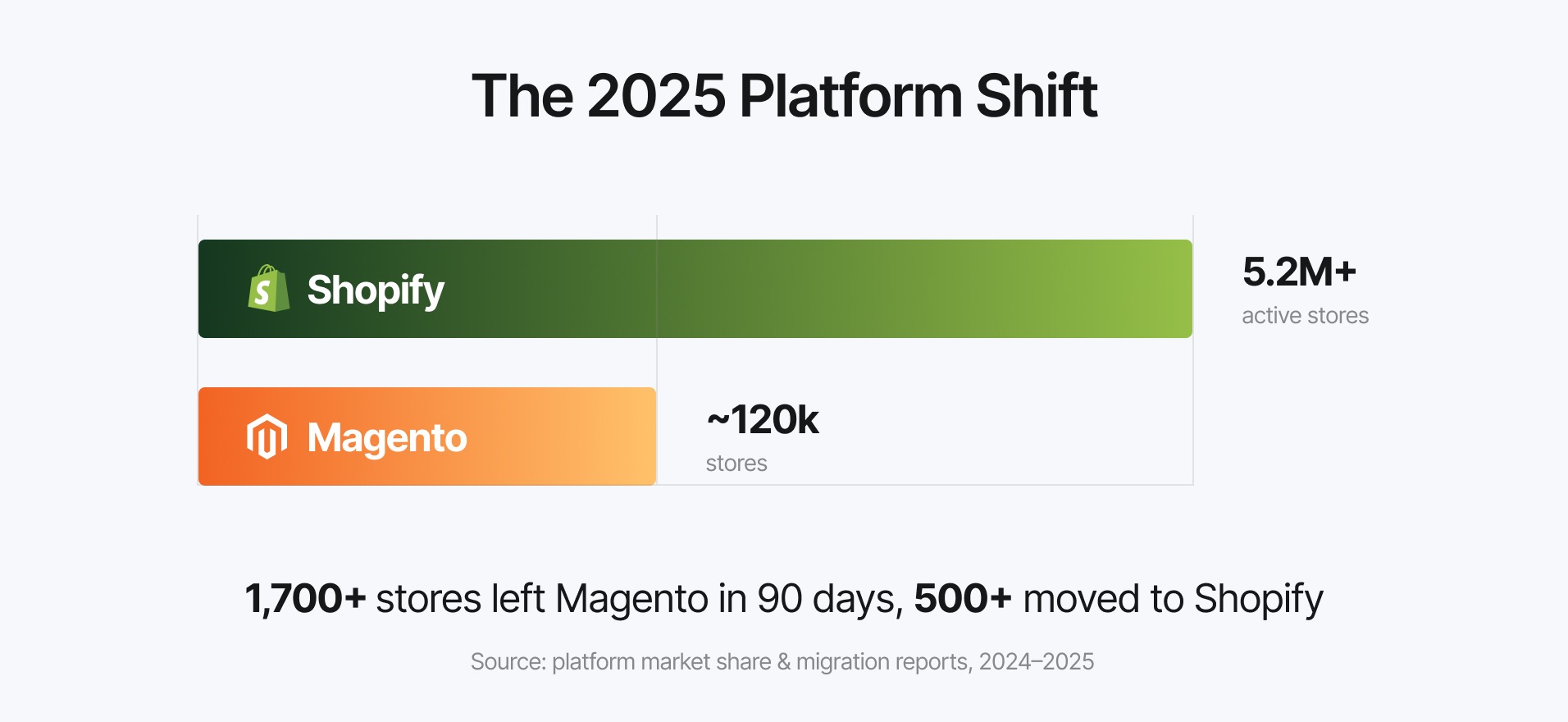
By 2024, Shopify was powering over 5.2 million active eCommerce sites compared with around 120,000 on Magento, and that gap keeps widening. Shopify’s total cost of ownership is now estimated to be around 29–36% better than Adobe Commerce, thanks to bundled hosting, security, and lower maintenance overheads. Small wonder that every quarter we see more enterprise brands asking for Magento to Shopify migration services and wanting to know what the move really looks like in practice.
In this article I’ll walk you through why so many enterprises are planning a Shopify Plus migration this year, what problems it actually solves, and how to manage the risks around data and SEO. I’ll share real numbers, real examples, and a few war stories from projects where we’ve helped teams finally step off the Magento treadmill. Most importantly, I’ll show you how an experienced partner can help you migrate from Magento to Shopify Plus without losing your traffic, your sanity, or your Q4.
The 2026 Magento Dilemma
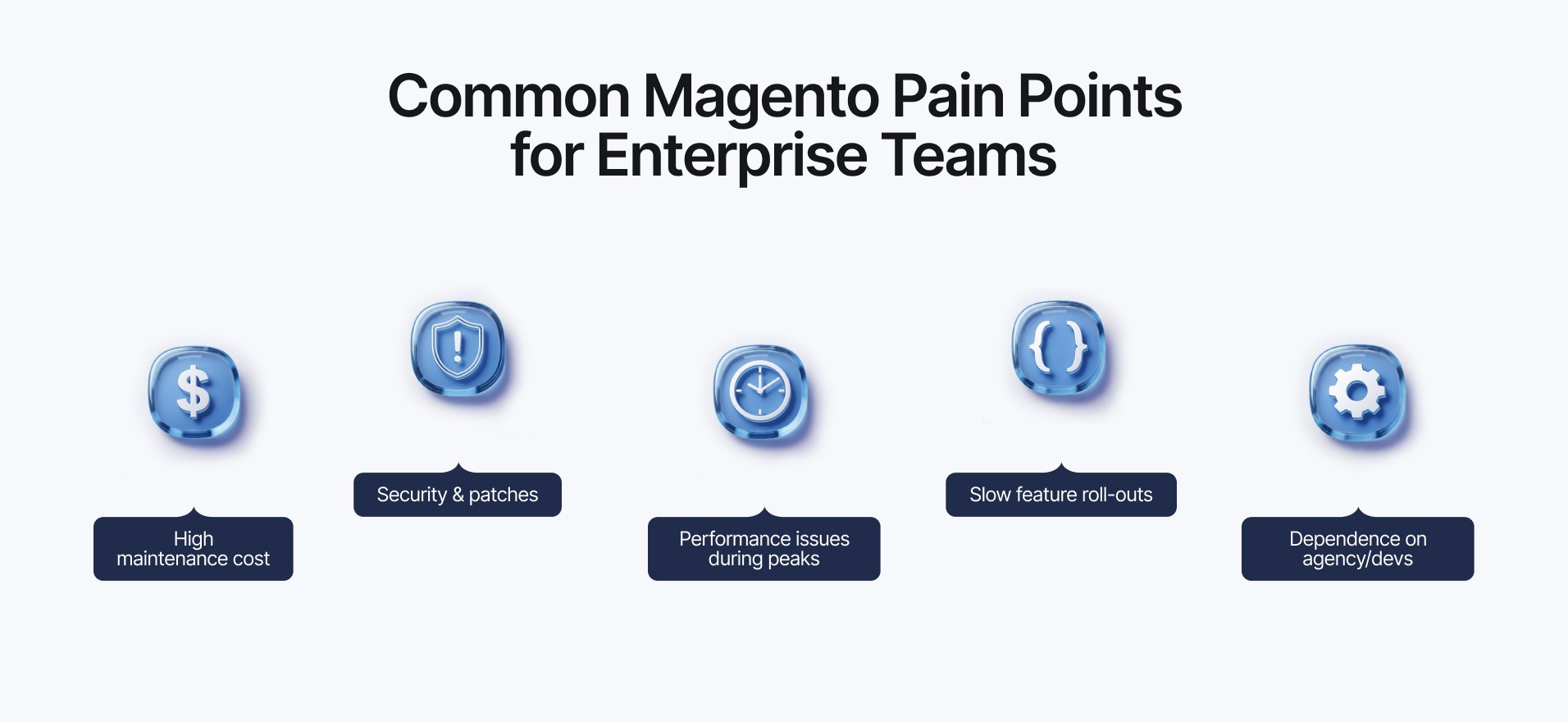
Magento is still a powerful platform, but the market signals are loud and clear. Shopify has exploded in adoption while Magento’s share has remained relatively flat, with industry analysis showing a steady flow of merchants moving away from Adobe Commerce towards simpler, hosted platforms like Shopify. When mid-market brands start talking about “replatforming” this year, they rarely mean onto Magento.
Security has become a serious headache too. In late 2025, a critical “SessionReaper” vulnerability in Adobe Commerce and Magento Open Source was actively exploited, with over 250 attacks recorded in just 24 hours and an estimated 62% of Magento stores still unpatched six weeks after Adobe released a fix. For an enterprise CISO, that’s not just a red flag; it’s a flashing red billboard.
Add in the constant cycle of patches, PHP version upgrades and extension conflicts, and it’s no surprise many teams feel they’re spending more time babysitting infrastructure than optimising conversion. I frequently speak to technical leaders who joke that they could practically give their Magento dev agency a company credit card and still not keep up. It’s funny in the meeting room, but not so funny when you’re trying to hit aggressive growth targets on top of it.
The Real Cost of Staying on Magento
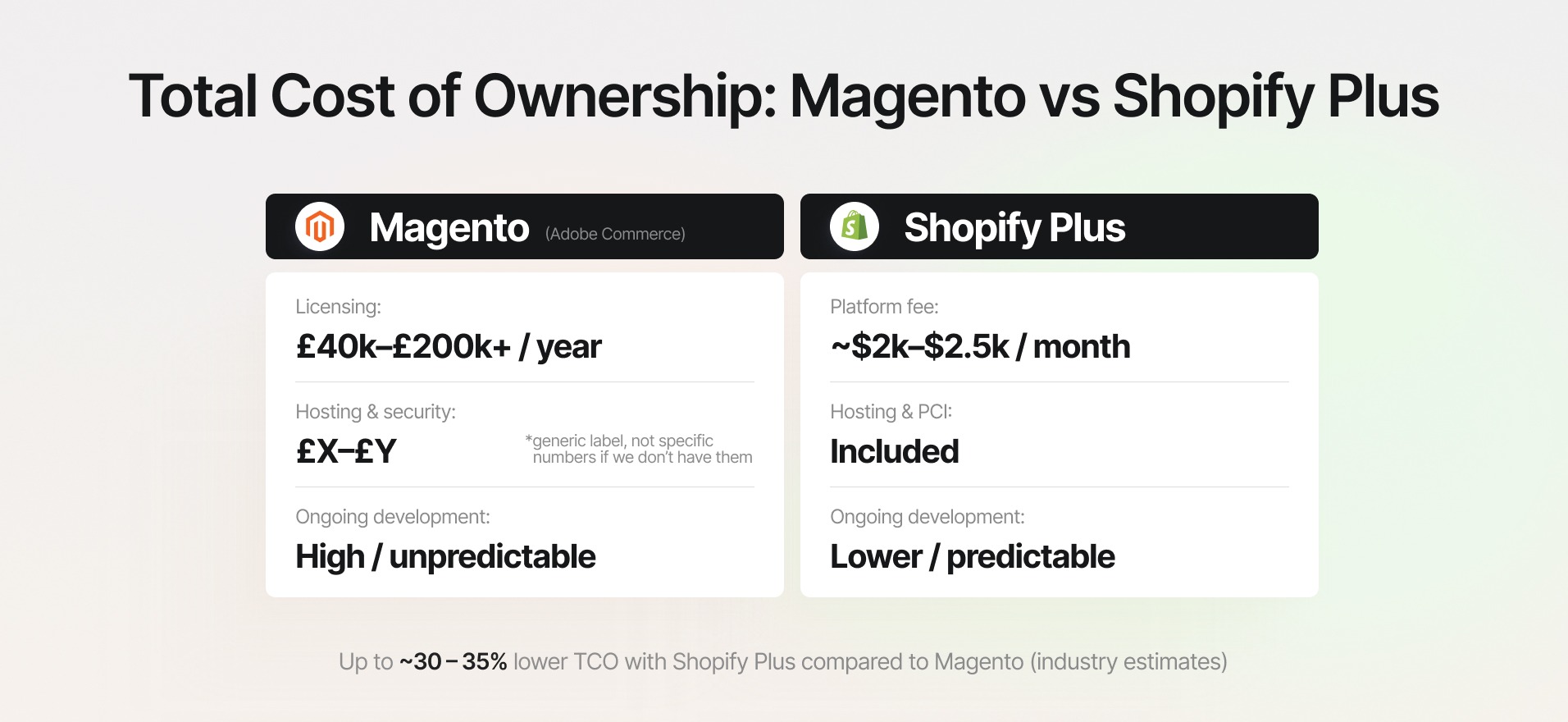
Let’s talk about money, because that’s what usually tips the decision. Independent TCO comparisons now consistently show that Shopify’s all-in-one model can deliver around a one-third lower total cost of ownership than Magento once you factor in hosting, upgrades, security work and ongoing development. In other words, even before we talk about growth, many brands are simply paying more just to stand still.
On the Shopify side, Shopify Plus typically starts from around $2,000–$2,500 per month for enterprise merchants, with variable fees only kicking in at very high volumes and capped for the largest brands. Compare that with the combined cost of Adobe Commerce licensing, premium hosting, security services and a retainer with a specialist Magento agency, and it’s easy to see why CFOs start raising an eyebrow. The money you’re currently burning on “keeping the lights on” could instead be redirected into CRO, acquisition, or international expansion.
From our conversations with enterprise retailers, high and unpredictable TCO is often the single biggest trigger for exploring magento to shopify migration services. It’s not that Magento can’t do the job; it’s that the cost of doing that job keeps creeping up while the market around you gets more competitive. At some point, the spreadsheet starts making the argument for a Shopify Plus migration all by itself.
Why Shopify Plus Appeals to Enterprises
Shopify Plus is unapologetically opinionated: it handles infrastructure, security, and PCI compliance for you so your team can focus on product, marketing, and customer experience. Shopify’s managed architecture delivers high uptime and fast page speeds out of the box, with features like global CDNs, built-in SSL, and automated updates baked into the platform. You don’t need to schedule “patch Tuesdays” or wonder whether that new module will clash with your caching layer.
From a scalability perspective, Shopify has proven it can comfortably handle enterprise traffic, processing hundreds of millions of requests per minute at peak and outgrowing global ecommerce by a wide margin. For brands planning aggressive growth, that matters more than the theoretical flexibility of self-hosted solutions. Knowing your platform can handle Black Friday without breaking a sweat is worth a lot more than being able to tweak every line of PHP.
Then there’s conversion. Recent data puts the average Shopify store conversion rate at around 1.4%, with top performers hitting 4.7% or more, helped by a highly optimised checkout and payment flow. In our own projects, we regularly see brands improve both site speed and checkout completion rates within months of replatforming, even before we start serious CRO experiments.
Is It Really Worth Migrating from Magento to Shopify Plus?
I completely understand the hesitation. You’ve likely invested six or seven figures over the years into your Magento build, and the idea of ripping it out and starting again feels risky. But the reality is that many brands have already proven that the move pays off.
Take Molekule, a high-end air purification brand that migrated from Magento to Shopify Plus to escape frequent site lags and confusing UX. After replatforming, they reported a smoother checkout, fewer crashes, and a better subscription experience, all delivered in a matter of months without pre- or post-launch issues. That’s exactly the kind of win we see when you treat migration not as a vanity project, but as a performance upgrade.
You’ll also find a growing list of well-known brands—Gymshark and Bombas among them—that have chosen to migrate from Magento to Shopify Plus to support global scale and rapid marketing experimentation. None of these companies moved because they were bored; they moved because Shopify Plus provided a better foundation for the next five years of growth. If your own roadmap includes internationalisation, omnichannel, or significant product expansion, staying on Magento may quietly be the riskier choice.
Enterprise Replatforming for Magento to Shopify Plus
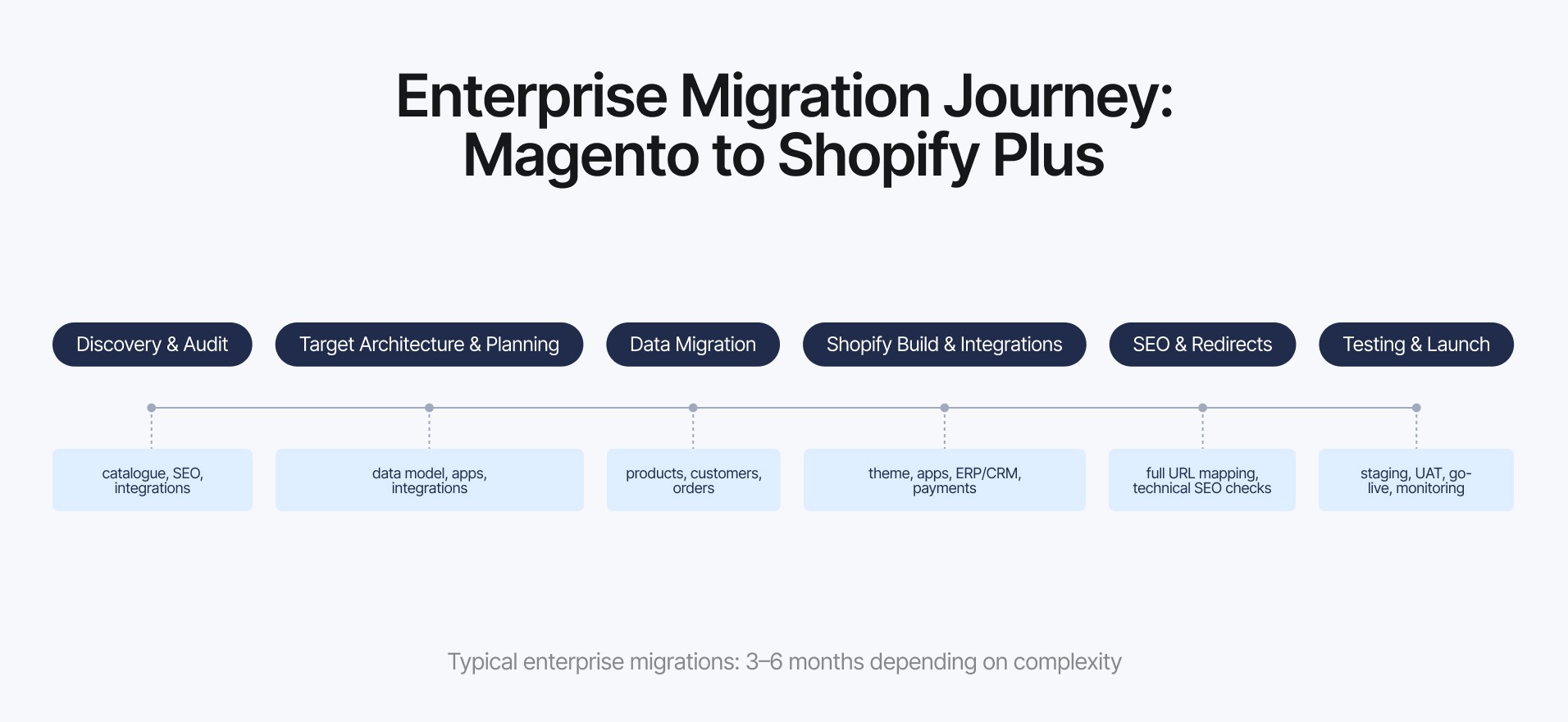
Now for the unglamorous bit: the hard work of migration. Moving from Magento 2 to Shopify is not just a case of exporting a CSV and hoping for the best; it’s a complex, technical sequence that touches every part of your business. The good news is that with the right framework, you can de-risk the process and avoid nasty surprises.
First, data. Product catalogues, customers, orders, discounts, and content all need to be mapped from Magento’s schema to Shopify’s, often with plenty of quirky edge cases along the way. Enterprise brands typically have to think about multiple price lists, B2B terms, custom attributes, and historic order data for reporting, and each of those decisions should be made consciously rather than on the fly a week before launch.
Second, integrations. Your ERP, WMS, CRM, ESP, reviews platform, and anything else currently plugged into Magento all need a clear integration plan on Shopify Plus. Thankfully, Shopify’s ecosystem of apps and APIs makes it easier to replace custom Magento extensions with robust, supported solutions, but you still need someone who understands the entire architecture—and not just the front end—to design it properly.
Protecting SEO During a Magento to Shopify Plus Migration
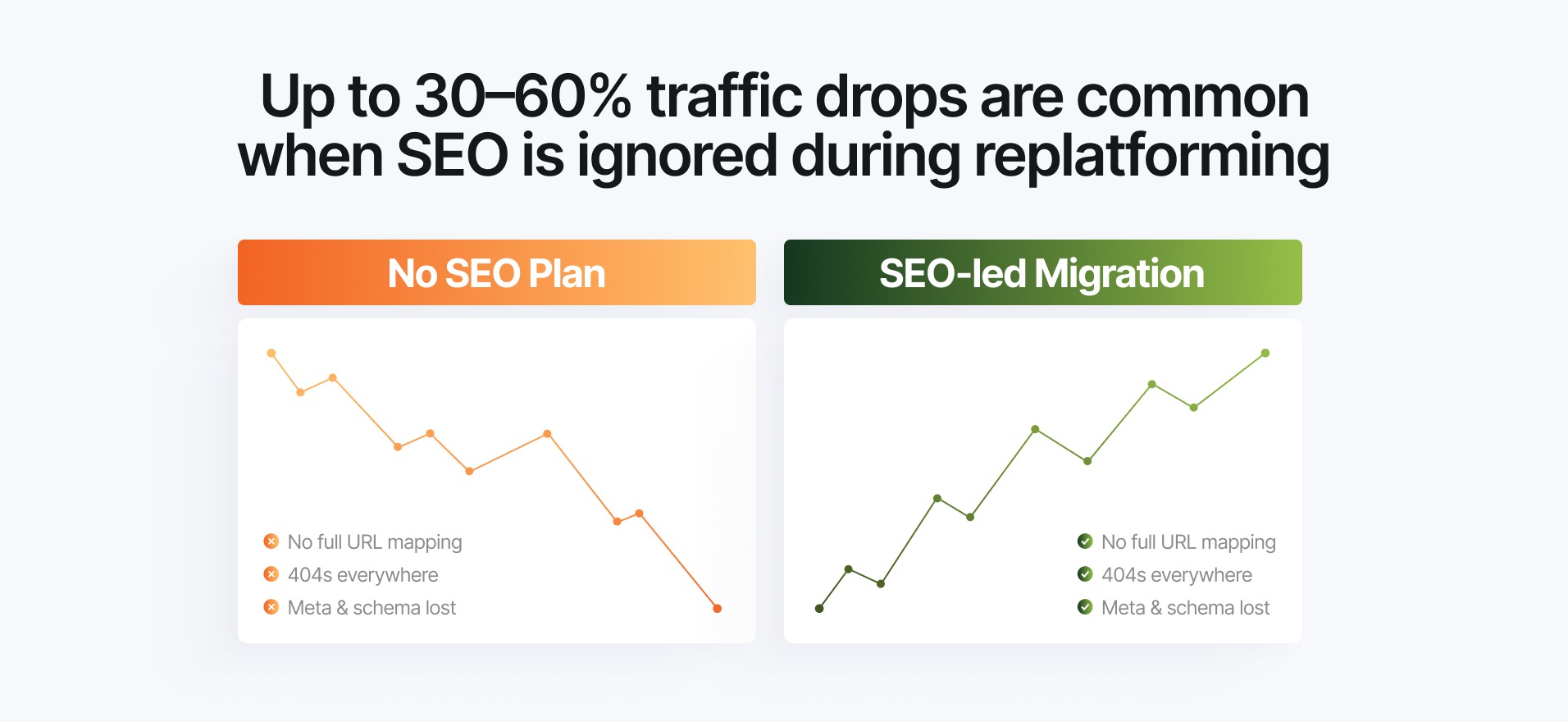
If there’s one thing that keeps marketing teams awake at night during a replatform, it’s SEO. The fear is justified: independent studies show that only around 10% of site migrations actually improve organic visibility, while 30–60% traffic drops are common when SEO isn’t handled carefully. Migration is not the time to wing it and hope Google understands what you meant.
The single most critical job is mapping and implementing 301 redirects from every important Magento URL to the corresponding Shopify URL. Shopify itself warns that without proper redirects, new pages “lose all the SEO value from the old versions” and traffic can plummet as both users and bots hit 404s instead of being seamlessly forwarded. For large catalogues, this usually means generating redirect lists programmatically, crawling both sites, and verifying that every legacy URL resolves correctly after cut-over.
On top of redirects, you’ll want to migrate meta titles, descriptions, H1s, structured data and internal links as faithfully as possible. Case studies and SEO practitioners regularly report that poorly handled migrations can “decimate years of SEO progress” in a matter of days, while carefully planned ones actually create an uplift by pairing stronger technical foundations with preserved equity. When we deliver magento to shopify migration services at Fourmeta, protecting that SEO equity is treated as non-negotiable, not an optional extra tacked on at the end.
Minimising Risk: Testing, Staging and Change Management
Even the best migration blueprint will fail without rigorous testing. Before a Shopify Plus migration ever touches your live domain, you should have a fully configured staging store mirroring your catalogue, pricing rules, customer flows and integrations. On our projects we run multiple rounds of functional testing, regression testing and user acceptance testing with real internal stakeholders, not just the dev team.
We test full journeys: from browsing and filtering to checkout, refunds, account creation, B2B ordering and subscription flows. We simulate peak traffic, weird discount scenarios and edge-case customer data, because if something can break it tends to break on the busiest day of the year, not on a quiet Tuesday afternoon. We also run SEO crawls pre- and post-launch to catch any missed redirects or broken internal links before Google does.
Change management is just as important. Your operations team will need training on the Shopify admin, your customer-service team will need new playbooks for refunds and exchanges, and your finance team will need to understand how payouts and reporting differ from Magento. A good migration plan bakes in this soft side of transformation so that on launch day, your people feel confident rather than confused.
Fourmeta Magento to Shopify Plus Migration Services — What’s Included
At Fourmeta we live and breathe Shopify, but we also understand Magento deeply, which is essential for a clean cut-over. Our team has delivered dozens of Shopify replatforms from Magento, WooCommerce and custom builds, and our Head of Sales alone has led more than 50 successful migrations from open-source platforms into Shopify ecosystems. That matters because the weird issues only show up once you’ve done this many times.
How Our Shopify Plus Migration Service Works
We treat every Shopify Plus migration as an engineering project and a growth project at the same time. On the engineering side, we design your target architecture, manage data transformation, configure integrations and handle all the unglamorous details like tax rules and shipping logic. On the growth side, we align the new store with your CRO priorities, analytics, and marketing roadmap so you’re not just moving platform, you’re levelling up.
A big part of our edge is how we use AI. We’ve built internal tooling to automate test-case generation, content mapping and even parts of QA, which has saved clients thousands of hours and dramatically reduced human error in high-volume catalogues. Instead of your team manually checking every PDP, we let AI flag anomalies so humans can focus on the decisions that actually need judgement.
Magento Enterprise to Shopify Plus Cost & Timeline
Planning a Magento Enterprise to Shopify Plus migration? Our Magento to Shopify Plus migration services make the process seamless, secure, and SEO‑safe.
Timeline
- Discovery & planning: 1–2 weeks. We audit your Magento setup, integrations, and data.
- Migration & testing: 3–6 weeks. Products, customers, and order history are migrated with zero downtime.
- Launch & optimization: 1 week. Post-migration QA, Shopify Plus feature activation, and SEO checks.
Cost
The price for a Magento to Shopify Plus replatforming service depends on store complexity, integrations, and customizations. Typical enterprise migrations start at £9,000, including:
- Full data migration
- Custom Shopify Plus setup
- Third-party integrations
- SEO-safe redirects
By choosing our Magento to Shopify Plus migration services, you get a reliable partner to migrate from Magento to Shopify Plus efficiently, minimizing risks and ensuring your store is fully optimized for growth on Shopify Plus.
Ready to start your Magento Enterprise to Shopify Plus migration? Book a free migration assessment today
A Real-World Example: From Fragile Flash Sales to Confident Growth
One fashion retailer we worked with was turning over well above £10 million a year on Magento, but every major promotion felt like playing Russian roulette. The site had a history of slowing to a crawl under traffic spikes, and just keeping it patched and running was costing them more than £150,000 a year in combined hosting and development fees. Unsurprisingly, their ecommerce director looked permanently tired.
We designed a phased plan to migrate from Magento to Shopify Plus, starting with a detailed audit of their catalogue, SEO footprint, and back-office processes. Over several months we migrated their data, rebuilt their UX using Shopify’s modern theme stack, and re-implemented their B2B and loyalty logic using a mix of Plus features and best-in-class apps. We also used AI-assisted testing to validate thousands of product pages and price combinations before launch.
Post-migration, their average page load time dropped by more than 40%, cart-to-checkout completion improved noticeably, and Black Friday finally became something the team could look forward to rather than dread. The total platform and maintenance cost fell despite adding new functionality, which made the CFO almost as happy as the marketing team. That’s the kind of outcome a well-planned magento to shopify migration service should deliver as standard.
Where AI Fits into Your Shopify Plus Migration

AI isn’t magic, but when used properly it’s an incredible force multiplier. On migrations we now routinely use AI to generate draft product descriptions, category copy, and meta tags that your brand team can refine rather than write from scratch, saving weeks on large catalogues. We also use AI models to compare pre- and post-migration datasets, spotting mismatches in pricing, stock or SEO fields long before a customer encounters them.
Looking forward, Shopify is doubling down on AI with tools like Shopify Magic for content and Sidekick as an on-platform assistant, which means the platform you are migrating to is improving faster than the one you’re leaving behind. Migrating now positions you to take advantage of those innovations rather than watching them from the sidelines. As an AI-first agency, we build these capabilities into your roadmap so you arrive on Shopify Plus already set up to benefit from them.
In practice, that might mean AI-driven merchandising rules, predictive search, smarter onsite recommendations or more efficient experimentation pipelines. It’s not about replacing your team; it’s about giving them a smarter toolkit so they can iterate three times faster in the same working week. In a market growing towards $4.8 trillion in online sales by 2025, those marginal gains compound quickly.
Ready to Talk About Your Own Shopify Plus Migration?

If you’ve read this far, you’re probably already experiencing at least some of the pain points I’ve described. Maybe it’s spiralling Magento maintenance costs, maybe it’s the fear of the next security advisory, or maybe it’s the simple frustration of how long it takes to launch anything new. Whatever the trigger, you’re not alone, and there is a proven way out.
Migrating from Magento to Shopify Plus is a serious decision, but with the right partner it doesn’t have to be a gamble. At Fourmeta we combine deep platform expertise, AI-driven tooling and a ruthless focus on SEO and data integrity to deliver magento to shopify migration services that are safe, predictable and commercially worthwhile. Our job is to help you step off the old platform without losing momentum—and ideally to come out the other side faster, leaner and ready for the next wave of growth.
If you’d like to explore what that could look like for your business, I’d be happy to review your current setup and roadmap. Book a free migration assessment with our team, and we’ll map out what it would take to migrate from Magento to Shopify Plus in a way that protects your revenue and sets you up for the next five years, not just the next five months. Your future platform shouldn’t be another constraint; it should be your competitive advantage.