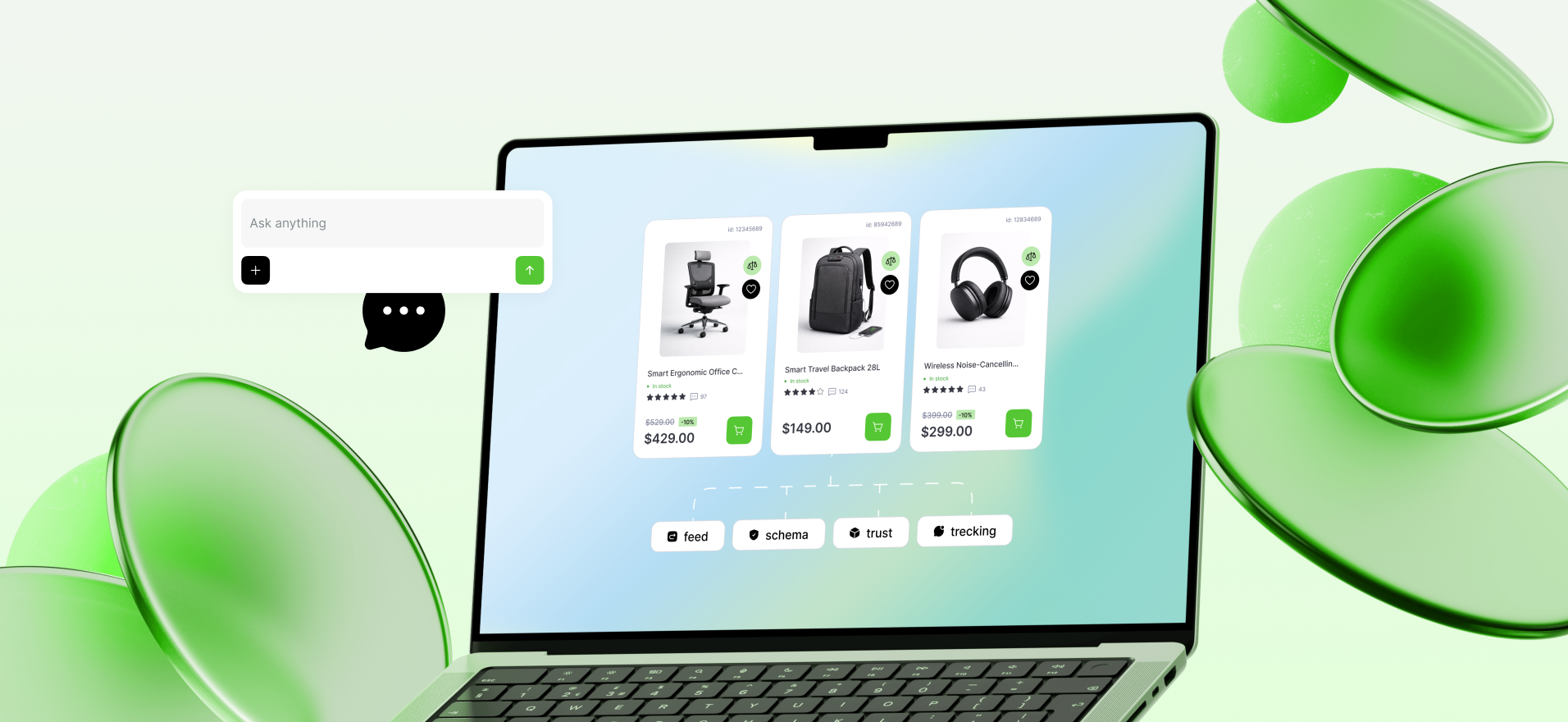
10 Questions eCommerce Directors asked us about ChatGPT Shopping (and the answers we keep giving)

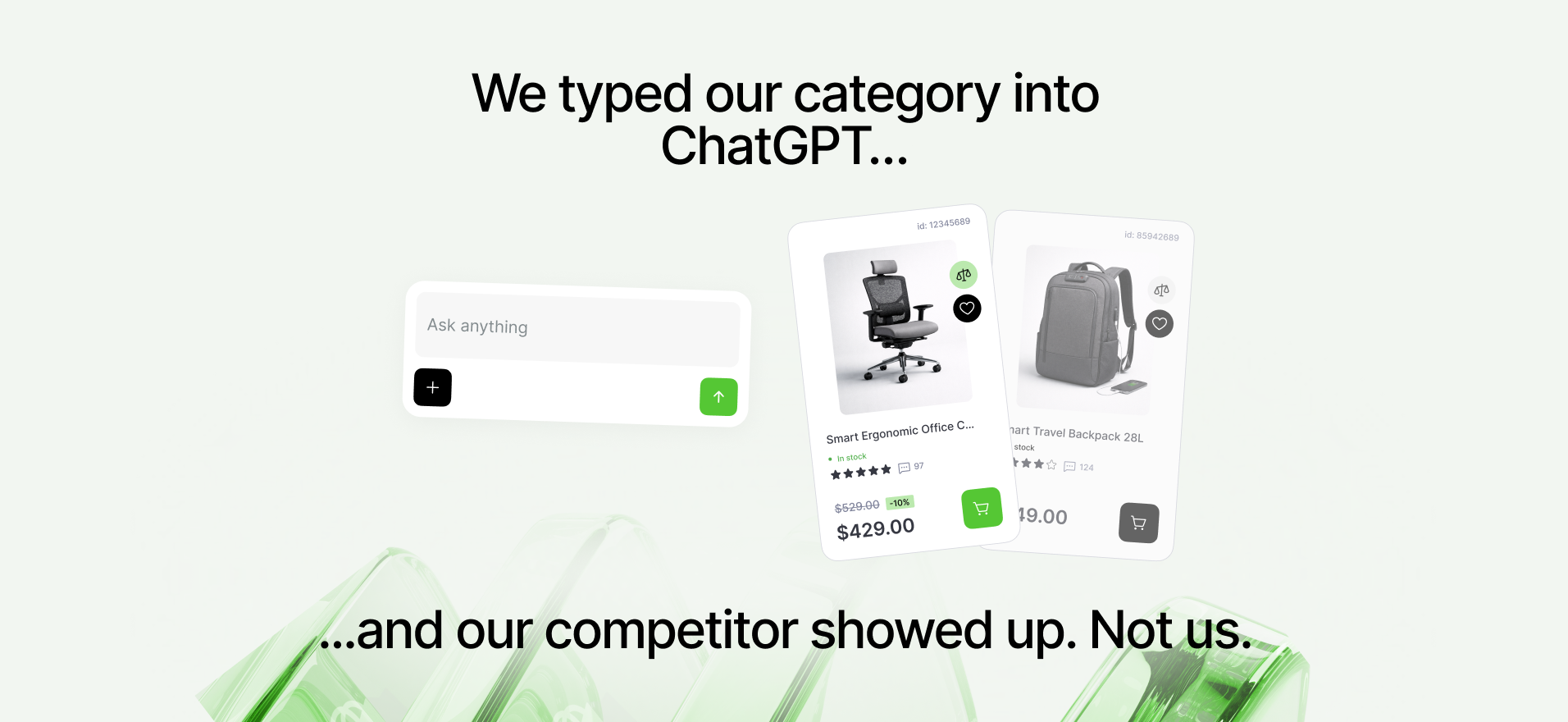
It’s only the beginning of 2026, but I’m already hearing the same sentence on calls: “We typed our category into ChatGPT… and our competitor showed up. Not us.”
I’m Maria, Head of Marketing at Fourmeta, and this exact moment is why AI shopping is suddenly getting budget — not because it’s trendy, but because it’s customer discovery happening somewhere you don’t fully control yet.
And yes, the space is moving fast. OpenAI is already pushing Instant Checkout and “agentic commerce,” including public partnerships like Walmart for in-chat buying.
Google is also rolling out buy buttons in Gemini AI Search and promoting an open standard called Universal Commerce Protocol (UCP) with major retailers and payments companies.
So here’s the post I wish existed when half the internet started asking “how do we show up in AI shopping?”
These are the 10 questions ecommerce directors asked us last year and keep asking in 2026, with practical answers and examples you can apply to a Shopify store (or any ecommerce stack).
1) “Do customers actually shop inside ChatGPT now — or is it hype?”
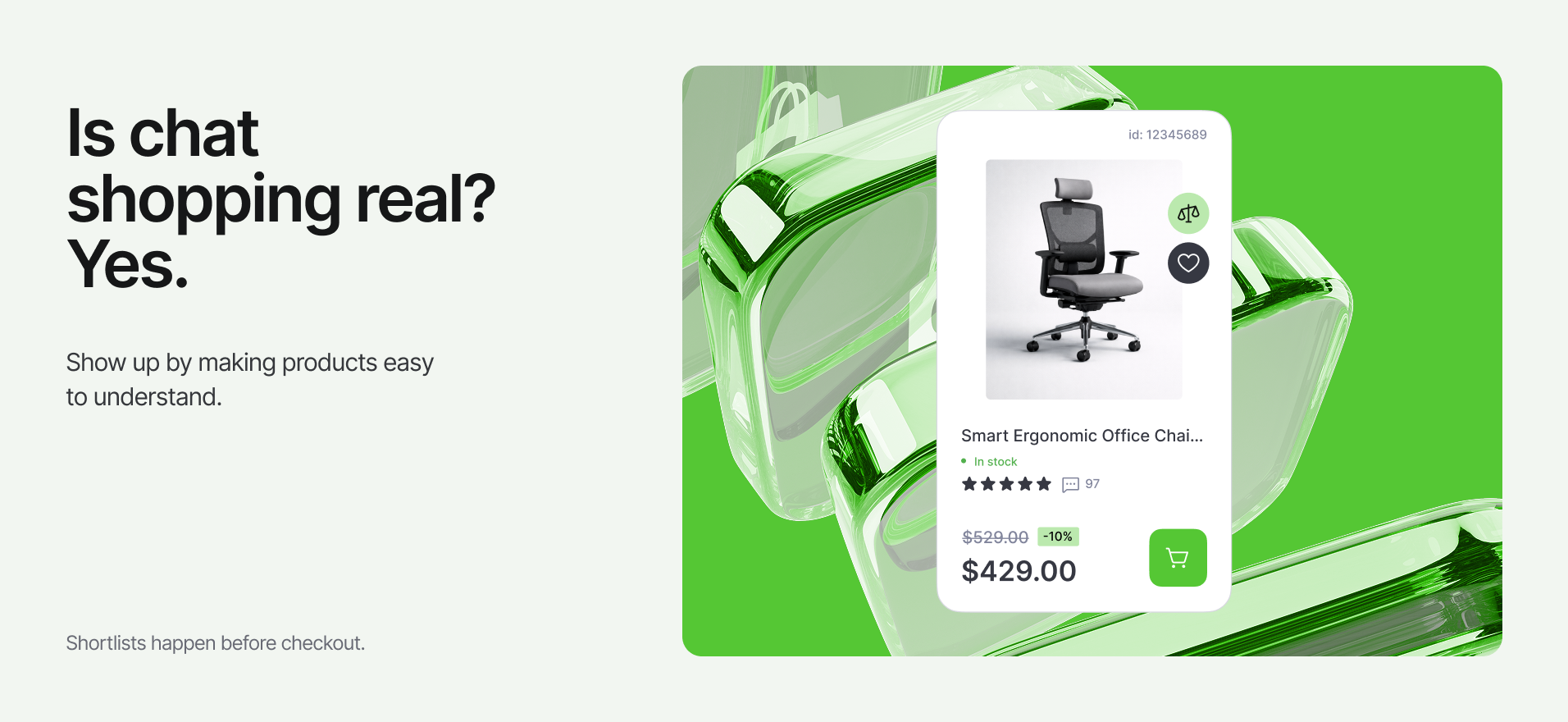
It’s not everyone, but it’s real enough that platforms are building checkout rails. OpenAI publicly announced ChatGPT Instant Checkout as part of its “agentic commerce” direction, and the Walmart partnership shows the intent to make “chat-to-purchase” normal.
The practical takeaway: even when people don’t buy inside chat, they use it to shortlist. If you’re not in the shortlist, you’re fighting uphill later.
Example: a shopper asks “best white sneakers under €150 that don’t crease.” If your PDPs and catalog don’t clearly describe materials, fit, care, and price — AI will recommend someone who does.
2) “How do we get our products to show up in ChatGPT Shopping?”
Think of this as AI shopping optimization, not “AI hacks.” ChatGPT shopping results depend heavily on structured product information and how easily a system can understand your product, price, and availability.
Start with the boring stuff (it wins): clean titles, complete attributes, accurate variants, clear availability, and consistent pricing.
Then make your PDP copy helpful enough that an assistant can summarize it without guessing.
Example: “100% cotton” beats “premium fabric.” “True to size, fits narrow” beats “perfect fit.”
3) “Is this just SEO with a new name — GEO, AEO… what’s the difference?”
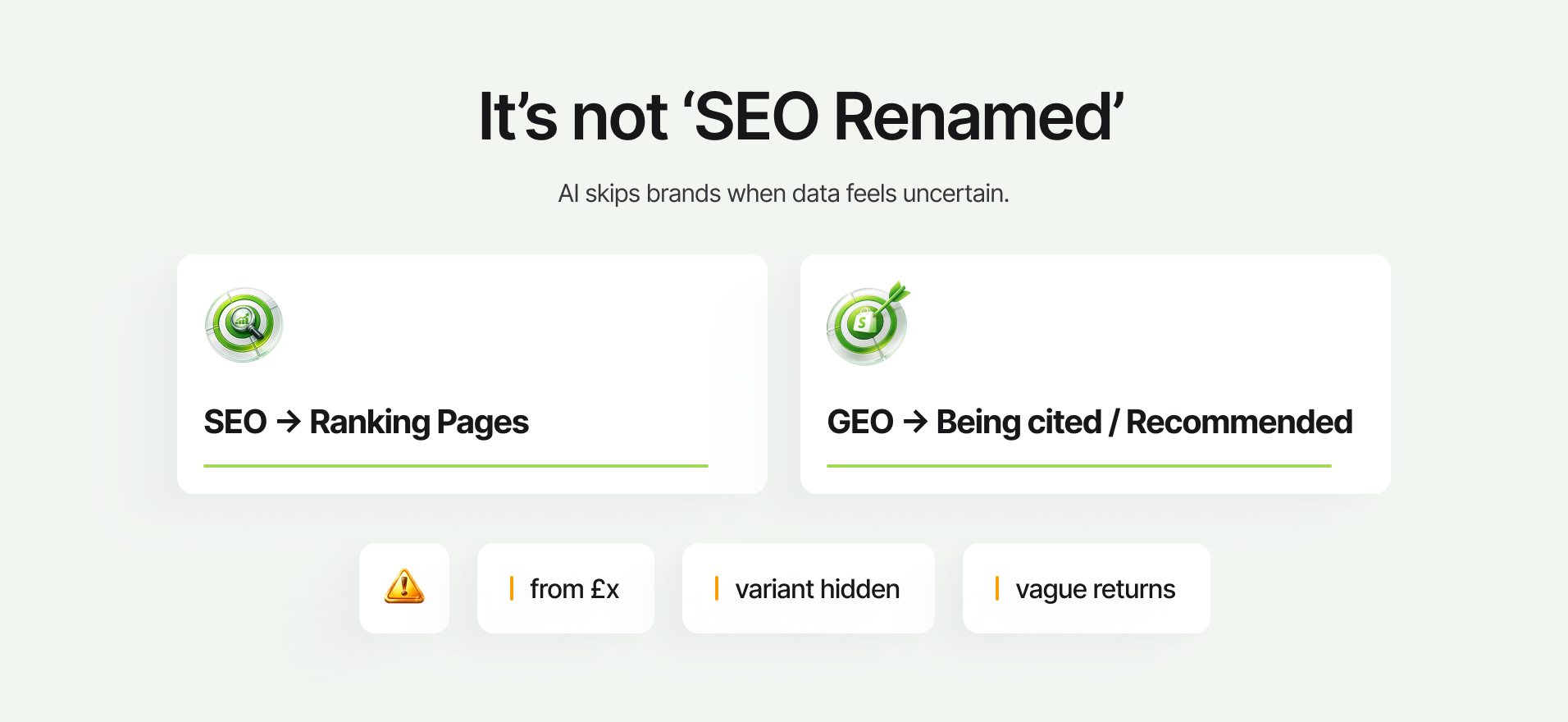
Traditional SEO tries to rank pages. Generative Engine Optimization (GEO) is about being mentioned, cited, or recommended in AI answers — sometimes without a click.
If you want AI to pick you, you need content and data that’s easy to trust and easy to reuse.
In practice, that means: structured product data + credible “why choose this” explanations + off-site signals that confirm you’re legit.
4) “What’s the #1 reason AI assistants skip a brand?”
Uncertainty. If your product truth is messy, AI plays safe and recommends someone else.
The most common culprits are inconsistent price/stock, thin PDPs, confusing variants, or unclear shipping and returns.
Example: if your feed says “in stock,” your PDP says “ships in 2–3 weeks,” and your returns page is vague, you’ve created three different realities. AI will avoid being wrong.
5) “Do we need a special product feed for ChatGPT Shopping?”
You need a product feed strategy that’s portable across AI surfaces. Search Engine Land has been covering how structured merchant feeds are becoming central to discovery inside conversational shopping.
Treat your feed like a storefront, not a CSV export.
A “good” feed isn’t just titles and prices — it’s also the attributes that help the assistant match user intent (materials, sizes, compatibility, skin type, room type, use case).
Example: beauty brands win when “fragrance-free,” “non-comedogenic,” “sensitive skin,” “pregnancy-safe” are explicit and consistent.
6) “What’s the deal with Perplexity Instant Buy — is it relevant?”
Perplexity is also pushing conversational shopping with Instant Buy and PayPal checkout integrations, meaning it’s not just one platform experimenting.
This matters because your customers don’t care which assistant they used — they care that the answer felt confident.
If your product data is clean, you can benefit from multiple surfaces without rebuilding everything per platform.
7) “Do we need schema and structured data in 2026, or just feeds?”
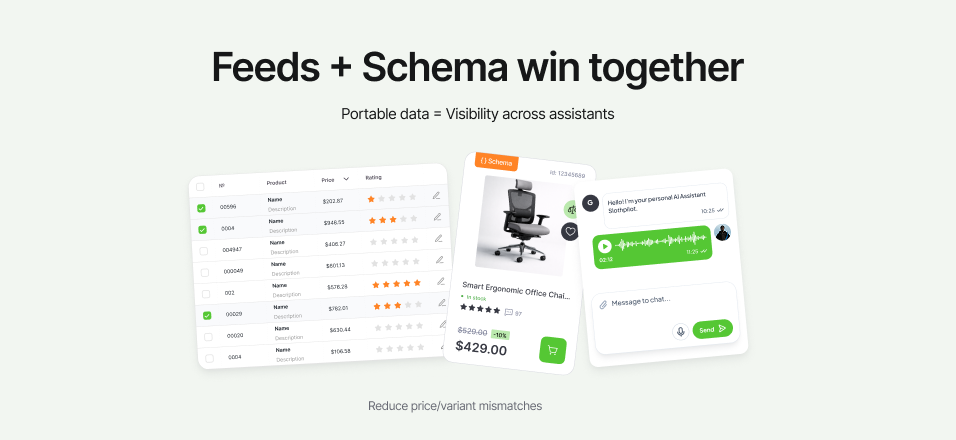
Both. Feeds help platforms ingest catalog data at scale, and structured data helps your PDPs stay machine-readable when assistants pull details from the web.
When teams skip structured data, they often end up with wrong variant summaries and weird pricing mismatches in AI answers.
Example: if your “from” price is shown but your best-selling variant is higher, assistants may repeat the lowest price and disappoint customers later.
That’s not an “AI problem,” that’s a product data problem.
8) “Google’s UCP and OpenAI’s ACP — do we really need to care?”
Yes, because it signals the same trend from two giants: AI agents will talk to commerce systems directly. Google described UCP as an open standard for agentic commerce, and reporting shows buy buttons moving into Gemini/AI search with major retail partners.
OpenAI is pushing a parallel direction with agentic commerce and Instant Checkout.
The safest strategy is not betting on one protocol — it’s making your commerce foundation clean enough to plug into any of them.
9) “How do we track AI shopping traffic in GA4 without lying to ourselves?”
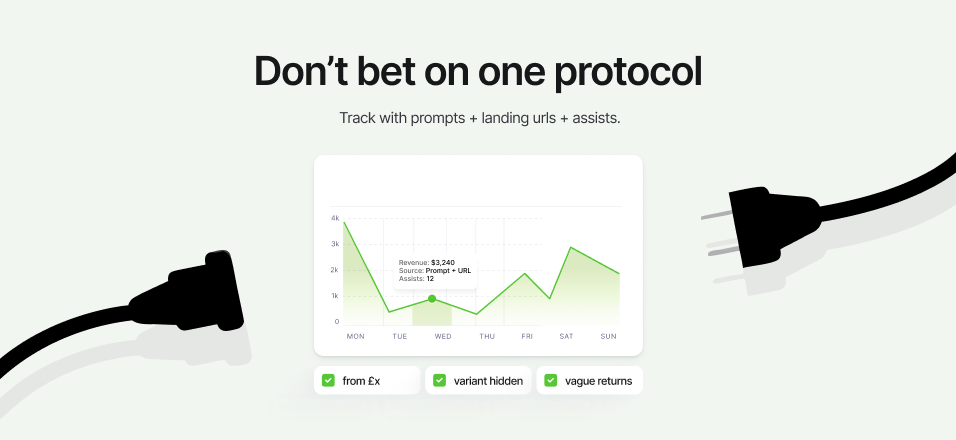
Start with what’s measurable today: referral sources, landing pages, and assisted conversions.
Then add a consistent “prompt set” (10–20 prompts customers actually ask) and track whether you appear and which URLs get pulled.
One useful reality check: AI-referred sessions have been reported as growing sharply, which means the “invisible referrer” problem will get louder, not quieter.
If you don’t build a baseline now, you won’t know if you’re improving.
Example prompt set: “best [category] for [use case],” “alternatives to [competitor],” “best [material] for [condition],” “what should I choose between A vs B.”
10) “What’s a realistic 14-day plan to improve AI visibility?”
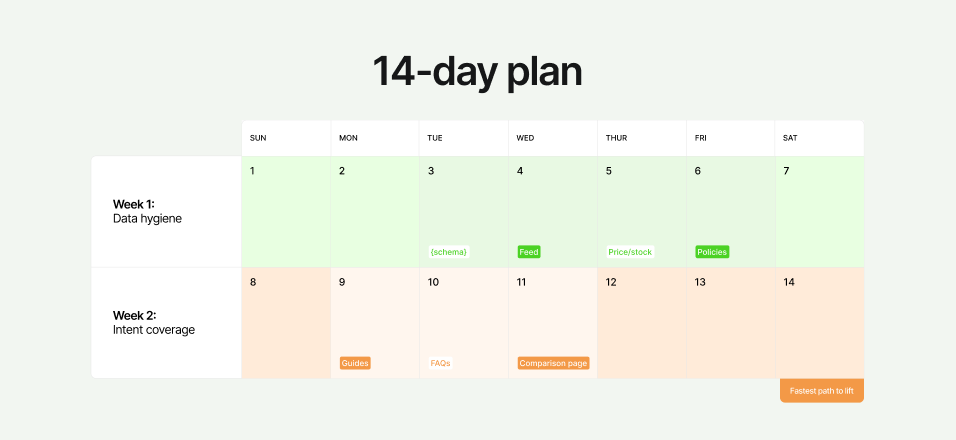
Week 1 is data hygiene. Week 2 is intent coverage.
If you do these two things well, you usually see the biggest lift early.
Week 1 (catalog + PDP foundations):
- Fix missing attributes and variant logic in your feed.
- Clean up PDP copy so it answers: who it’s for, what it solves, what it’s made of, how it fits/works, how it ships, how it returns.
- Make sure price and availability are consistent everywhere.
Week 2 (content AI can reuse):
- Publish 2–3 “use-case” pages that match real prompts.
- Add FAQ blocks on collections and best sellers (sizing, materials, compatibility, care).
- Create 1 honest comparison page (your product vs popular alternative) so the assistant has a clean source.
If you want a structured way to do this, a lot of the current guidance for AI shopping points to the same direction: optimize product data and enrich the signals that help systems match intent.
A quick note from me before you go
If you’re an eCommerce Director reading this and thinking, “Cool, but I don’t have time to chase 25 little fixes,” that’s exactly why we productized it.
At Fourmeta, we run an AI Shopping Readiness Audit: product feed + PDP structure + collection pages + trust signals + tracking setup.
You get a 1-page scorecard and a prioritized fix list your team can execute (or we can implement with you).
If you want, send your store URL + one hero collection URL, and I’ll outline what your “first 5 fixes” would likely look like (the kind you can ship in two weeks).