
BigCommerce vs Shopify Plus: is Shopify Plus the better long-term platform?

As the CEO of Fourmeta, I’ve seen growing brands face a common crossroads: BigCommerce or Shopify Plus? Both platforms offer enterprise-level features, but as businesses scale, the choice can dramatically impact growth, costs, and operational efficiency. In this article, I’ll break down the key differences, share why many brands are migrating from BigCommerce to Shopify Plus, and explain how the right platform can unlock faster growth and higher ROI.
Shopify Plus vs BigCommerce: two titans of SaaS eCommerce
BigCommerce and Shopify Plus are both established SaaS e-commerce platforms built for growing brands. Each serves mid-market and enterprise retailers looking for stability, scalability, and flexibility without the overhead of fully custom platforms.
BigCommerce has historically appealed to brands that value built-in features, especially for B2B and multi-storefront setups. Shopify Plus, meanwhile, has rapidly surged ahead in adoption, ecosystem depth, and global usage.
Today, Shopify powers over 20% of online stores globally, with more than 4.6 million active sites, while BigCommerce represents a much smaller share, roughly 3%, with around 40,000 stores. That scale matters. It shapes everything from innovation speed to partner availability.
As a result, many brands that started on BigCommerce Enterprise are now asking the same question: Would we gain more by migrating from BigCommerce to Shopify Plus?
Shopify Plus vs BigCommerce comparison
Comparing total cost of ownership
At first glance, BigCommerce and Shopify Plus can appear similarly priced. Both target enterprise merchants, both are SaaS, and both avoid the heavy infrastructure costs of legacy platforms.
The difference shows up as brands scale.
BigCommerce Enterprise pricing is often tied to revenue thresholds. As Gross Merchandise Value (GMV) increases, merchants can be pushed into higher pricing bands. Additional costs may also emerge around API usage, advanced integrations, or custom development required at scale.
Shopify Plus uses a far more predictable model. Most merchants pay a flat monthly fee (typically around $2,000–$3,000/month) up to very high GMV levels. This makes forecasting easier and removes the feeling of being “penalised” for growth.
Independent studies comparing platforms have found:
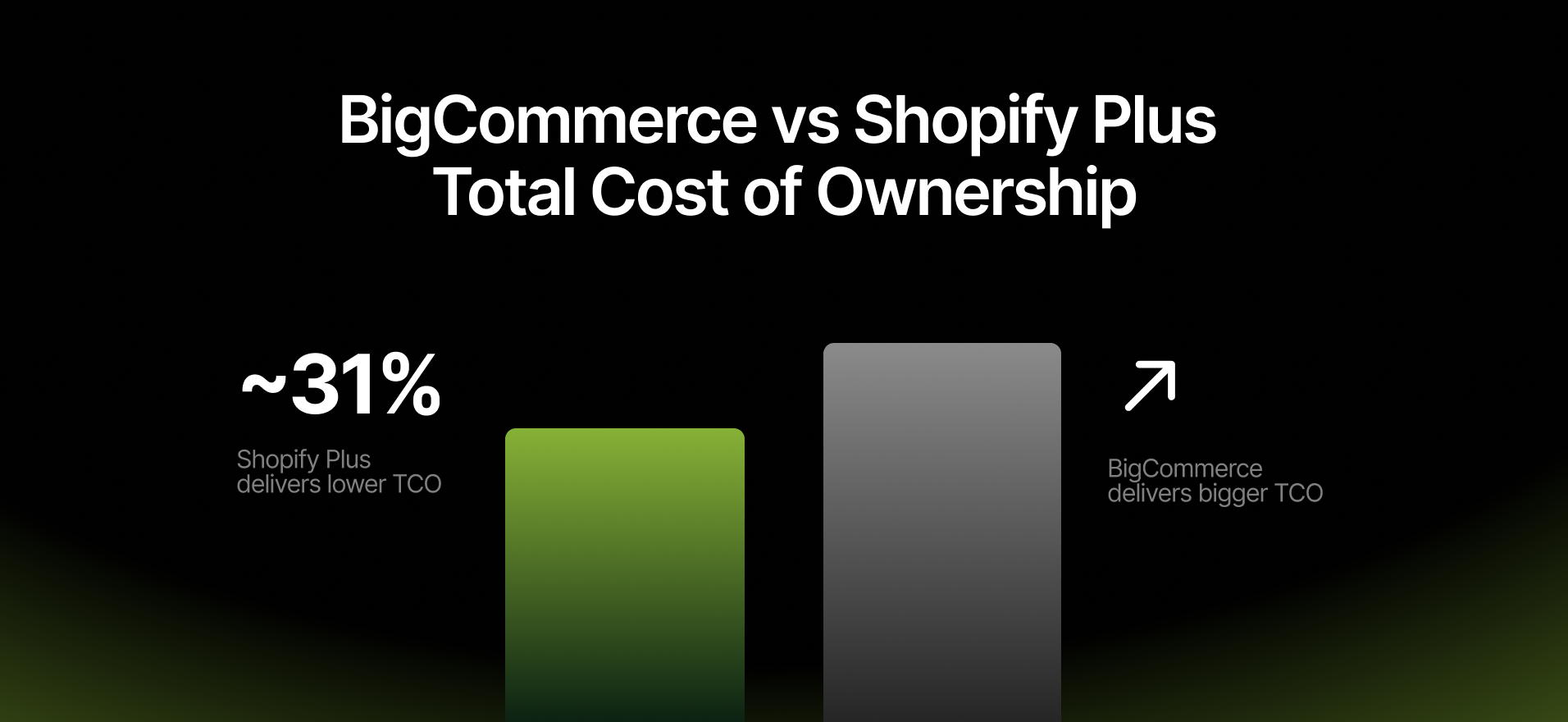
- Shopify delivers ~31% lower total cost of ownership than BigCommerce
- Implementation costs can be up to 88% lower on Shopify due to faster setup and a richer app ecosystem
Transaction fees are often mentioned in comparisons, but in reality, payment processing costs tend to be comparable across platforms. The bigger savings come from reduced development effort, faster launches, and lower ongoing maintenance.
For brands thinking long term, Shopify Plus often proves to be the more cost-efficient option as complexity grows.
Ecosystem and extensibility
BigCommerce promotes a “built-in first” philosophy. Many features are available out of the box, reducing early reliance on apps. This can feel attractive, especially for technically confident teams.
However, Shopify’s ecosystem is on a completely different scale.
Shopify offers 8,000+ apps covering everything from subscriptions and loyalty to ERP, PIM, CRM, and international logistics. BigCommerce’s marketplace, by comparison, contains a few hundred integrations.
This gap has practical consequences:
- Shopify merchants can add new functionality quickly, often without custom development
- Most enterprise tools already prioritise Shopify integrations
- Finding experienced Shopify developers or agencies is significantly easier
Shopify’s larger partner ecosystem means brands are rarely forced to “build what already exists.” Instead, they can focus resources on growth rather than maintenance.
Multi-storefront and international selling
BigCommerce often highlights its native multi-storefront capability. Multiple sites and brands can be managed from a single backend, which is appealing for complex catalog or B2B setups.
Unlike BigCommerce, Shopify Plus takes a different approach.
Many Shopify Plus merchants run multiple stores, typically one per region or brand. Each store has its own admin, which some see as a drawback. However, Shopify has steadily improved tooling around this, introducing organisational controls and shared permissions.
More importantly, Shopify Markets allows brands to manage currencies, domains, languages, and regional pricing from a single store when appropriate. For many international brands, this reduces the need for multiple storefronts altogether.
The Shopify Plus vs BigCommerce trade-off is clear:
- BigCommerce offers centralised control in one backend
- Shopify offers flexibility, regional optimisation, and ecosystem depth
Despite the operational differences, many global brands still choose Shopify Plus for its international selling tools and partner support.

Checkout and conversion performance
Checkout is where revenue is won or lost.
Shopify’s checkout is widely regarded as one of the highest-converting in e-commerce. Features like Shop Pay, one-click checkout, and saved customer credentials dramatically reduce friction.
Multiple studies have shown Shopify checkout outperforming competitors, with Shop Pay alone delivering significantly higher conversion rates compared to standard checkouts.
BigCommerce allows more out-of-the-box checkout customisation, which can be appealing to some teams. Shopify historically restricted checkout changes, but on Shopify Plus, brands gain access to deeper customisation while retaining Shopify’s optimisation.
For brands focused on performance and conversion uplift, Shopify’s approach consistently delivers results.
BigCommerce vs Shopify B2B capabilities: the gap has closed
BigCommerce has long been considered strong in B2B, offering features like:
- Customer groups
- Custom price lists
- Account-based purchasing
These tools were traditionally a key reason some brands stayed on BigCommerce.
Shopify Plus has closed that gap.
Shopify now offers a native B2B suite with company accounts, custom pricing, payment terms, and wholesale catalogs built directly into the platform. For most B2B and hybrid merchants, Shopify Plus can now meet requirements without heavy workarounds.
Many B2B brands have already migrated BigCommerce to Shopify Plus and report simpler operations and better alignment with their DTC channels.
Platform philosophy: simplicity vs flexibility
At its core, the difference between Shopify Plus vs BigCommerce is philosophical.
Shopify is intentionally opinionated. It limits certain types of access and customisation to preserve platform stability, performance, and ease of use. This makes it highly attractive for teams that want speed and reliability without constant technical oversight.
BigCommerce offers more flexibility under the hood. It appeals to brands that want granular control while staying on a SaaS platform.
In practice, as Shopify Plus has matured, many BigCommerce merchants have found they no longer need that extra flexibility. Shopify now delivers similar outcomes with far less effort.
Brands prioritising velocity, operational efficiency, and managed growth tend to lean toward Shopify Plus.
Why brands migrate BigCommerce to Shopify
While every situation is different, common reasons for BigCommerce to Shopify migration include:
- Access to a significantly larger app ecosystem and partner network
- Difficulty scaling without rising costs or technical complexity
- Better international and omnichannel support
- A more intuitive admin that improves team productivity
- Desire to leverage Shopify innovations like Shop Pay, the Shop app, Hydrogen, and rapid platform updates
- Higher ROI driven by improved conversion rates and lower total cost of ownership
For many, the decision isn’t about BigCommerce failing. It’s about Shopify Plus offering more momentum for the next growth stage.
BigCommerce to Shopify migration considerations
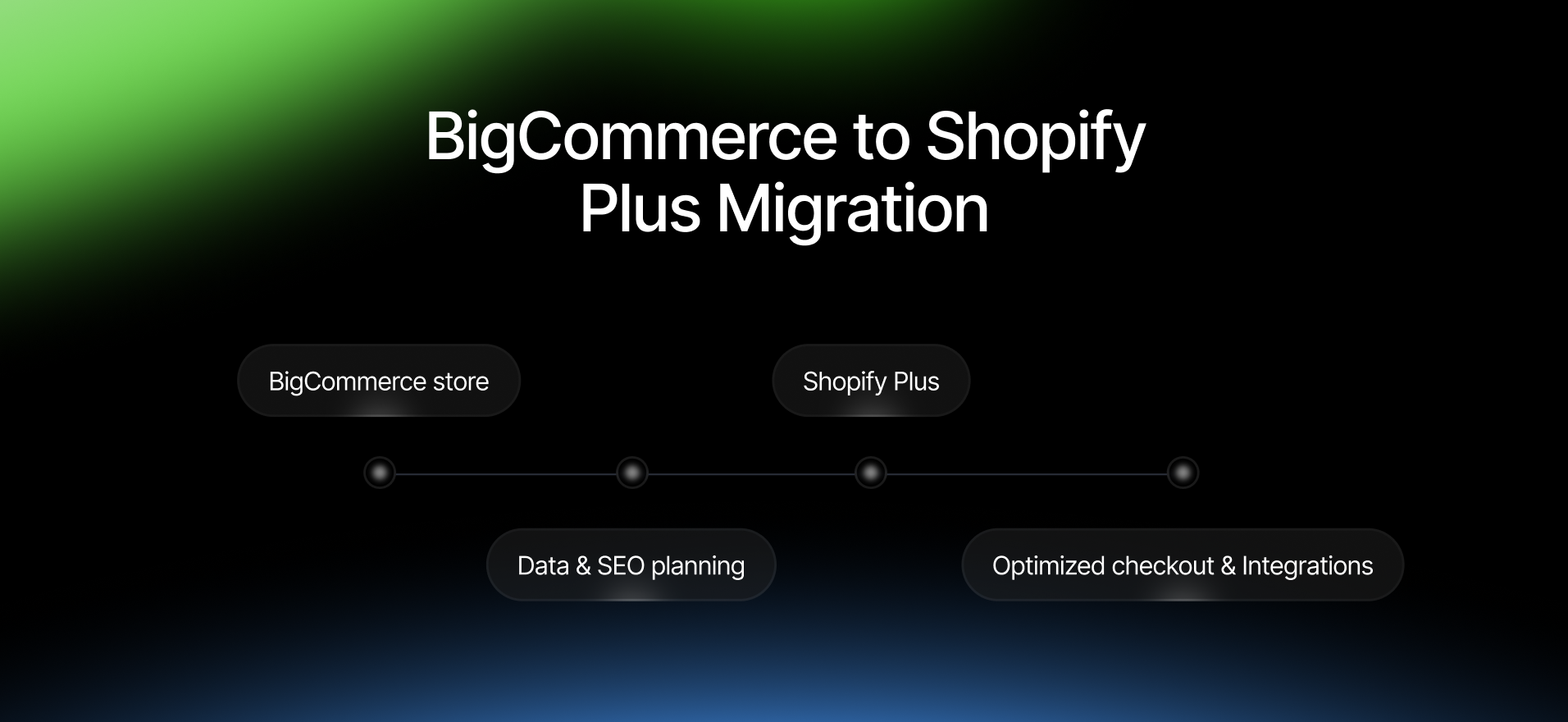
Replatforming is a serious decision. A successful BigCommerce to Shopify migration requires careful planning around:
- Product, customer, and order data
- URL structures and SEO redirects
- Integrations and custom functionality
- Minimising downtime and risk
Handled correctly, the transition can be smooth and low-risk.
At Fourmeta, we specialise in complex migrations between enterprise platforms, including BigCommerce Enterprise to Shopify Plus. We manage data, SEO, integrations, and performance optimisation to ensure nothing is lost and everything improves.
Shopify Plus vs BigCommerce: a platform for the future
Every platform choice carries opportunity cost.
If your team is compensating for limitations, working around tooling gaps, or struggling to move quickly, it may be time to reassess whether BigCommerce still fits your ambitions.
Shopify Plus offers predictability, scale, and access to the largest commerce ecosystem in the world. For many mid-market and enterprise brands, that combination unlocks faster growth and better ROI.
Migrating platforms is a big decision. Staying on the wrong one for too long can be even more expensive.
If you’re exploring a BigCommerce to Shopify migration, Fourmeta can help you evaluate the opportunity and plan a transition built for long-term success.