

Black Friday 2025 has just wrapped up, and as Head of Marketing at Fourmeta I’ve been closely watching how this year’s “peak” weekend unfolded. Spoiler: it wasn’t business as usual.
From the way shoppers hunted for deals to the tactics brands used to stand out, Black Friday 2025 felt markedly different from years past. In this review, I’ll share what I observed, what’s changed, and the key e-commerce trends that defined Black Friday 2025 – all in an easy-to-scan format (we know you’re busy!). Let’s dive in.
Black Friday Becomes a Season, Not Just a Day
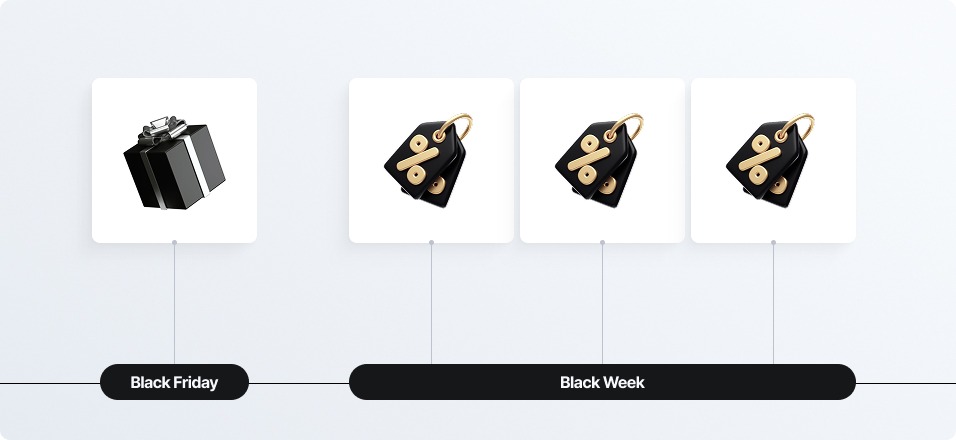
Remember when Black Friday was a one-day frenzy? Not anymore. Black Friday has evolved into a multi-week season of shopping, and 2025 cemented that shift. Retail analysts pointed out that the Black Friday we “know and love” has “changed” and is “not as much of a frenzy” as in years past .
Consumers were peppered with deals well before and after the day itself, making the event more fluid and stretched out. In fact, search data in the UK shows interest in Black Friday now begins 6–8 weeks in advance , as retailers start teasing “Black November” promotions.
Many brands kicked off holiday discounts earlier than ever – some premium fashion labels like Ganni and Tommy Hilfiger even launched major sales in late October this year, several weeks ahead of their 2024 schedule .
What does this mean? Shoppers no longer feel compelled to do all their bargain-hunting in a single 24-hour window. The urgency factor has diminished, replaced by a “slow burn” of deals throughout November.
One retail strategist noted it’s “too confusing to limit Black Friday to just one day” now, given how frequently consumers see discounts across the season . As a result, year-over-year comparisons for Black Friday day sales are tricky – you have to consider the whole Cyber Week (or even Cyber Month!).
The bottom line is that Black Friday is now more of a marathon than a sprint, and successful brands treat it as a month-long campaign, not a one-day blitz.
Shoppers Are Savvier and More Cautious (Value is King)
Another clear trend in 2025: shoppers have become both savvier and more value-conscious. Economic factors played a big role. Inflation is still lingering, and consumer confidence has been shaky, so people are watching their wallets.
Consumers are in “value hunting” mode – they research early, compare prices, and pounce only when a deal truly offers genuine savings. UK data from October showed many shoppers held off on buying non-essentials, likely waiting for Black Friday deals . As I saw with several e-commerce clients, customers were loading wishlists and price-tracking items weeks in advance.
Despite tighter budgets, shoppers did open up their purse strings for the right bargains. Interestingly, fewer people participated in Black Friday this year, but those who did were prepared to spend more per person.
In the UK, only 46% of consumers said they were interested in Black Friday (down from 53% last year), yet average spend per shopper jumped 13% to about £262 – the highest since pre-pandemic.
In other words, Black Friday’s fan base got a bit smaller but more spend-happy. Overall UK Black Friday spending was forecast around £6.4 billion (a modest 1.5% up from 2024) , showing growth but not a huge boom.
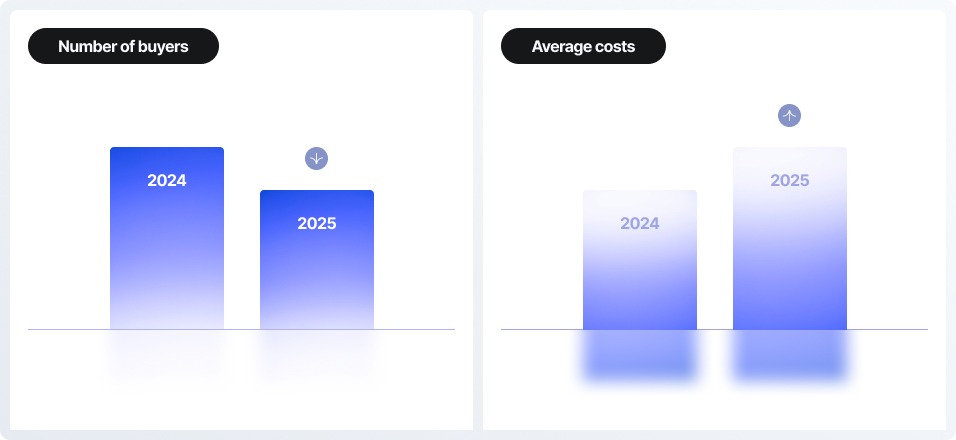
Why the dichotomy? Higher prices are one factor – with product costs up, people end up spending more pounds or dollars even if they buy fewer items. Adobe Analytics reported U.S. online sales hit a record $11.8 billion (up 9% YoY), yet Salesforce noted order volumes actually fell ~1% while average selling price rose ~7%.
Translation: inflation and rising costs meant the same TV or coat simply cost more this year. Shoppers felt that “bite of inflation,” as one analyst put it , and many responded by being selective and seeking value above all.
Discounts themselves were about the same as last year, broadly speaking. The average online discount rate peaked around 27–28%, flat compared to 2024. Retailers weren’t necessarily offering deeper markdowns – often it was the standard 20–30% off many had already been running throughout the year.
This kept some deal-hunters cautious. When everything from TVs to trainers cost more than before, even a 25% off deal might not feel as exciting. As a result, shoppers bought slightly fewer items per transaction on average . The savvy consumers stuck to their game plans: grab the truly good deals, leave the rest.
One coping strategy gaining traction is “Buy Now, Pay Later”. Many shoppers turned to BNPL services to stretch their budgets. Adobe’s data showed BNPL usage on Black Friday was up ~9%, accounting for $747 million in online spend.
These short-term financing options let people snag deals and worry about payments later – a trend that benefits retailers now, but could have repercussions if those bills become hard to pay . Notably, BNPL was especially popular on mobile apps, with over 80% of BNPL checkouts happening on phones (more on mobile in a moment).
Finally, it’s worth noting the “K-shaped” consumer pattern this season – a term I heard in industry chatter. Those with higher disposable incomes spent robustly (we saw luxury items and pricey electronics selling very well), while more budget-strained consumers pulled back.
For example, luxury apparel and accessories were among the most popular categories in U.S. online sales, indicating affluent shoppers are still splurging . Meanwhile, some brands worried about appearing tone-deaf to those struggling.
The beauty industry illustrates this split: certain beauty brands rolled out glitzy, maximalist holiday campaigns (think Mariah Carey in sparkly ads urging you to splurge), while others took a Patagonia-style anti-Black Friday stance, encouraging “buy less” ethos.
A great example is Deciem (The Ordinary skincare): for the seventh year, they ran “Slowvember”, shutting all stores and their website on Black Friday and instead offering a modest 23% off all month . Talk about a bold anti-consumerism statement! It shows how not every brand chases the Black Friday frenzy – some now deliberately zag while others zig, to build trust with conscious consumers.
AI-Powered Shopping Hits the Mainstream

If I had to name one thing that truly changed this Black Friday compared to last year, it’s AI. In 2024, AI was a buzzword; in 2025, it became a shopping tool for the masses. Shoppers enlisted AI assistants and chatbots to find deals in record numbers.
Adobe reported that traffic to retail sites from AI tools jumped 805% on Black Friday (U.S.) compared to 2024 . Yes, you read that right – an 8x increase! It seems many consumers asked ChatGPT, Bing (with GPT-4), or other AI “agents” to help them hunt down the best prices or gift ideas. (Having personally experimented with this, I’m not surprised – why scroll through dozens of sites when you can ask an AI to do the legwork?)
This wasn’t just a U.S. phenomenon. Globally, Salesforce estimated AI chatbots and agents influenced about $14.2 billion in online sales on Black Friday – roughly one-fifth of total online spend for the day.
Clearly, AI-assisted shopping has arrived, and it’s effective: Adobe found shoppers coming via an AI recommendation were 38% more likely to convert (make a purchase) than those coming from a normal channel. When an AI helps you zero in on exactly what you want (and perhaps applies a voucher code too), it’s a smoother path to checkout.
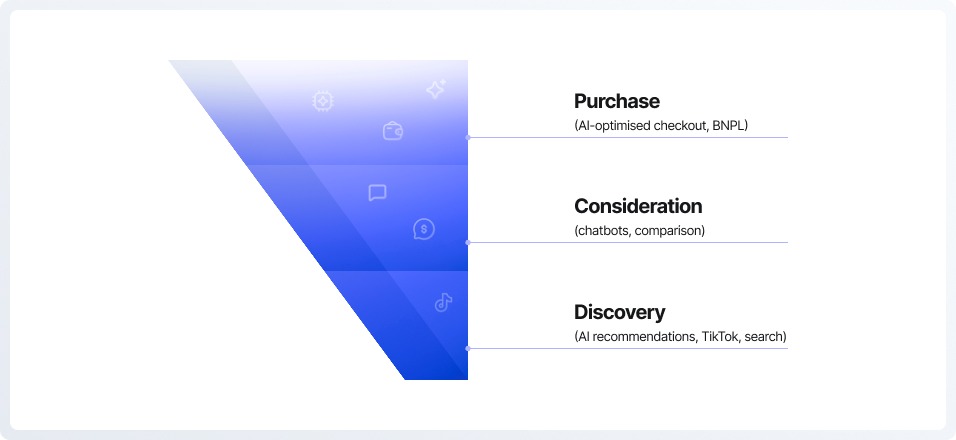
What kind of AI are we talking about? Beyond general chatbots, retailers rolled out their own AI helpers. Big names like Walmart (“Sparky”) and Amazon (“Rufus”) launched AI shopping assistants this year.
These tools can digest your vague request (“I need a gift for a 10-year-old who loves science”) and spit out tailored suggestions in seconds. It’s like having a personal shopper who’s lightning-fast and has infinite catalog knowledge. According to an eMarketer analyst, consumers appreciate this because LLMs make discovery feel quicker and more guided – less stress, more confidence in finding the right item . I noticed many e-commerce sites also promoting their AI chat features prominently during Cyber Week.
And AI isn’t just front-end. Brands used AI on the back-end to cope with the Black Friday surge: think AI-driven inventory management, dynamic pricing, and customer service bots.
For example, companies deployed AI to adjust offers in real time and to field common customer questions so human staff could focus on urgent issues . It’s a far cry from a few years ago when a hot sale could overwhelm support teams. This year, an AI agent might calmly handle “Where’s my order?” queries on Black Friday, 3 AM.
For e-commerce marketing, AI also played a role in content creation (some brands used generative AI to whip up holiday ad visuals or product descriptions). But the biggest impact was on how shoppers found what to buy.
In the UK, surveys ahead of Black Friday suggested 15% of consumers (and about 33% of Gen Z) planned to use AI chatbots to search for deals – and given the global data, many followed through on that. This is a game-changer for how customers navigate the e-commerce jungle.
If your brand’s offers weren’t “AI-visible,” you might have missed out on that traffic. (This is something we emphasise at Fourmeta: optimising clients’ product data so AI assistants can easily recommend their products.)
The takeaway: AI in e-commerce is no longer experimental – it’s essential . Black Friday 2025 was likely the first major shopping event where AI truly augmented the front-end shopping experience at scale.
From here on, brands will be racing to ensure they show up in AI-driven recommendations. As a marketer, it’s exciting – and a tad scary – to see this rapid shift. But one thing’s clear: those who embraced AI early (both for customers and internal ops) gained an early-adopter advantage this year.
Mobile and Social Commerce Lead the Way

It almost goes without saying, but I’ll say it: mobile commerce dominated Black Friday 2025. Every year the share of sales on smartphones creeps upward, and this year mobile firmly took the driver’s seat.
Adobe projected that in the UK, 56.7% of online holiday revenue would come via mobile devices , and Black Friday bore that out – more than half of online shoppers checked out on their phones. Our own client data echoed this: traffic and sales from mobile were at all-time highs. (One fashion DTC brand we work with saw ~70% of BF purchases on mobile.) The convenience of apps and mobile sites – plus the fact that people were shopping deals on-the-go, even while commuting or eating leftover turkey – made mobile the default channel.
Beyond just volume, mobile experiences were critical. Shoppers expect fast, easy checkouts on their phones, and many retailers have finally optimised their mobile UX. Features like one-tap payments, mobile wallet integration, and click-and-collect options at checkout were big winners.
In fact, click-and-collect (buy online, pick up in-store) continues to grow, blurring online and offline – but even that often starts with a mobile purchase. Brands that offered smooth mobile shopping likely captured outsized share of the Black Friday pie.
Hand-in-hand with mobile dominance is the rise of social commerce. 2025 was the year social media truly became a shopping platform in its own right. We have to talk about TikTok here. TikTok Shop exploded onto the scene in the past year, and it was a major player in Black Friday.
In the US, TikTok only launched its shop feature in 2023, but by Black Friday 2024 it drove about $100 million in sales (3× the prior year) – and this year its growth went even further. For Black Friday 2025, household-name brands jumped on TikTok Shop en masse. Business Insider reported a “wave of big-name brands” like Samsung, Disney, and Ralph Lauren joined TikTok’s holiday push, running flash deals and livestream shopping events on the app . This is a notable shift – these big brands used to stick to their own sites and maybe Amazon; now they’re embracing TikTok as a legitimate sales channel.
Why TikTok? Because that’s where the eyeballs (especially Gen Z and Millennials) are, and TikTok’s algorithm can turn products into viral hits overnight. During Black Friday week, my TikTok feed was an addictive stream of “Live now: flash sale 50% off!” videos, unboxings, and promo codes flying left and right. It appears to be working: an industry survey found intent to shop on TikTok Shop during the holidays jumped from 76% last year to over 83% in 2025 among U.S. social media users .
The UK has been ahead on TikTok Shop (it piloted there earlier), so British beauty and fashion brands have been leveraging it heavily too. One cosmetics brand told me their TikTok live streams during Black Week brought in thousands of new customers who never visited their website before – truly new-age digital window shoppers.
It’s not just TikTok. Instagram shopping and Facebook Marketplace also saw plenty of action, and YouTube hopped on the bandwagon with more shoppable livestreams. Social commerce is finally more than “just browsing inspiration”; it’s driving conversions directly .
The platforms have smoothed out the buying process (with saved payment info, in-app carts, etc.), making it easy to go from seeing a cool product in a video to buying it within seconds. And influencers played their part: tons of influencer-led “Black Friday deal” posts popped up, effectively acting as personalised ads for products with affiliate links.
For direct-to-consumer brands, social media became a primary Black Friday battleground. We saw DTC fashion and beauty labels launching exclusive drops on Instagram or TikTok, collaborating with creators for limited-time discount codes, and generally whipping up FOMO on social channels.
It’s a potent mix of content and commerce. One caution: competition on these platforms is fierce, and ad costs surged during the holiday weekend (CPCs on social ads always spike for BFCM). But the reach is unparalleled. If you can crack TikTok, you can reach millions. As a marketer, seeing social commerce mature in 2025 has been gratifying – it opens new creative avenues beyond the traditional “email + website sale” playbook.
Key stat: Globally, TikTok announced it had its “biggest holiday season ever” via TikTok Shop this year, with some live shopping events drawing tens of thousands of shoppers simultaneously.
And notably, TikTok isn’t just for small impulse buys; even major electronics retailers and apparel brands are now there, meaning social commerce spans low-end to high-end products.
Brands Got Creative: Beyond Just Big Discounts
With shoppers more choosy and competition cutthroat, many retailers realised that simply slapping a “% OFF” sign wasn’t enough. 2025’s Black Friday saw brands getting creative to stand out. Here are a few interesting strategies I noticed:
- Exclusive Perks and Freebies: Some retailers won by offering special perks rather than bigger discounts. For instance, Target attracted actual early-morning queues by giving the first 100 in-store customers a free limited-edition tote bag filled with goodies . Lowe’s did something similar, handing out buckets of products and even raffle tickets for a chance to win a $2,000 appliance . These tangible freebies created buzz and a reason to choose one store over another. As one analyst quipped, “Build it and they will come, give me a gift, and I’m going to show up” – price alone isn’t enough when everyone has similar prices . The lesson: incentivise customers with something unique (gift-with-purchase, VIP experiences, etc.) to break through the noise.
- Longer, Smarter Promotions: Many brands spread their promotions across the whole “Golden Quarter.” I already mentioned early sales in October. Additionally, some did tiered deals (e.g. Week 1: 20% off select lines, Week 2: sitewide 25%, Black Friday weekend: 30% on bundles + free gift). Strategic sequencing of discounts kept shoppers engaged all month . A lot of DTC brands also reserved their best deals for loyal customers or newsletter subscribers – like a secret sale for VIPs before the public sale. Personalisation came into play too: some e-commerce sites served different offers based on customer segments (e.g. a higher discount to cart abandoners to lure them back). The focus was on “smart discounts, not just big discounts”, preserving margins while still offering perceived value.
- Omnichannel Plays: Retailers with both online and physical presence tried to blend the experience. For example, several fashion retailers let customers buy online and pick up in store with an extra discount or freebie for doing so – leveraging stores as pickup points to drive foot traffic. Some even turned stores into experiential spaces during Black Friday weekend (think DJs, refreshments, limited in-store-only deals). The idea was to give people a reason to venture out and shop online – meeting customers wherever they wanted to shop. In the UK, where four out of five Black Friday pounds were expected to be spent online , the high street still had a role if combined cleverly with digital. Early data on store footfall was mixed – one analysis said U.S. in-store traffic was down ~3.6%, another said it ticked up ~1% – but the consensus is that impulse walk-ins are fewer. Shoppers head to stores with purpose, not just for the chaos vibe. So retailers made stores worthwhile destinations through exclusives and experiences.
- Playing the Long Game (Sustainability and Brand Values): I touched on this with the Deciem example, but it bears repeating. A subset of brands used Black Friday to underscore their values instead of pure selling. Outdoor apparel brands, for instance, promoted sustainability – some ran “Green Friday” campaigns planting trees for every purchase, others donated a portion of sales to charity. This resonates with consumers who are cynical about hyper-commercialism. Even some fashion and beauty DTC brands opted for modest discounts framed around durability (“Buy this quality item that lasts, now at 15% off – a smart investment”). Brand trust and identity can be a differentiator on Black Friday, not just price. It’s a trend of tone: not every brand shouted “SALE!!!”; some told a story or started a conversation (and still got sales from like-minded shoppers).
- Top Products and Surprises: On the product front, it was interesting to see what sold and what didn’t. Electronics and tech gadgets remained the stars of Black Friday – no surprise, as tech was the top category for UK shoppers (48% planned to buy tech) followed by fashion (38%) and beauty . In the U.S., Adobe said hot sellers included LEGO sets, Pokémon cards, gaming consoles (Nintendo Switch, PlayStation 5), Apple AirPods, and KitchenAid mixers . Basically, a mix of classic holiday gifts and trendy items. Meanwhile, one analyst noted a “lack of exciting newness” in products this year – many of the hottest items were similar to last year’s hits, which might have dampened some excitement. (No brand-new must-have toy or console came out in 2025, for example.) This put even more pressure on retailers to differentiate via marketing since the products alone didn’t create a frenzy.
Conclusion: An Evolving Black Friday – Is Your Brand Adapting?
Black Friday 2025 showed that e-commerce is constantly reinventing the rules of engagement. We saw a more stretched-out, strategic approach to the holiday season, a consumer base that’s careful yet willing to spend for value, and the unmistakable rise of new digital forces like AI shopping and TikTok commerce.
From my perspective, the brands that thrived were those that anticipated these shifts – they started promotions early, embraced new channels and technologies, and kept the customer’s mindset in focus (be it offering genuine value for the price, or aligning with their values).
One thing’s for sure: the line between “Black Friday” and the broader holiday campaign is blurring. As e-commerce professionals, we need to think of Black Friday not as a one-day spike, but as a culmination of months of strategy. It’s about priming your audience early, being omnipresent on the channels that matter (mobile, social, search – and now AI), and executing flawlessly when the peak weekend hits.

At Fourmeta, we’ve helped clients navigate exactly these challenges – from optimising online stores for mobile and AI discovery to crafting marketing campaigns that build hype through November and convert in late November. The goal isn’t just to have a big Black Friday, but to turn seasonal shoppers into loyal customers and carry that momentum into the new year.
Black Friday 2025 is in the books, and it was fascinating, innovative, sometimes challenging – but ultimately a success for many in e-commerce. The playbook is evolving, and if you’re reading this to get ideas for your own brand, my advice is: stay agile and customer-centric.
The only constant is change (and perhaps consumers’ love of a good deal!). We’ll be here watching the trends and helping our partners stay ahead of the curve. Now, onward to the rest of the festive season – and start marking your calendar, because Black Friday 2026 will be here before we know it (and who knows what new twists it will bring).