

For mid-market retailers turning over £1M–£100M, the platform your business runs on is technical and commercial choices. Yet too many growing brands find themselves trapped on legacy systems that limit their ambitions, slow their sites, and frustrate their teams. This guide covers everything you need to know about ecommerce replatforming: what it involves, how to protect your SEO, how to migrate a large online store, and how to find the right ecommerce migration specialists in the UK.
What is eCommerce replatforming?
Ecommerce replatforming is the process of moving your online store from one technology platform to another, replacing the underlying system that powers your catalogue, checkout, customer accounts, and integrations. It's a significant undertaking, but for brands that have outgrown their current setup, it's often the most commercially sound decision they can make.
Ecommerce replatform vs ecommerce migration: what's the difference?
These terms are often used interchangeably, but there's a useful distinction. An ecommerce replatform refers to the broader strategic decision: evaluating your current platform, choosing a new one, and rebuilding or restructuring your store on top of it. An ecommerce migration refers more specifically to the technical process of transferring your data, like products, customers, orders, content, from the old system to the new one.
In practice, every replatform involves a migration, but a migration doesn't always mean a full replatform. You might, for instance, migrate your data to a new instance of the same platform following a restructure.
When should you consider an ecommerce platform migration?
The clearest signal is when your platform is actively limiting revenue. That might look like:
- slow page load times that your development team can't resolve at the infrastructure level
- a checkout experience you can't customise for your market
- an inability to support multiple currencies and storefronts as you expand internationally
- end-of-life announcements (Magento 1 being the most significant example for UK mid-market retailers)
- ERP integration failures that create operational bottlenecks
- a growing gap between the features your competitors are shipping and what your current platform allows.
Risks of staying on the wrong platform
Staying put isn't cost-free. Platforms like Magento 1.x are no longer receiving security patches, creating genuine legal and reputational exposure, particularly relevant given GDPR obligations. Beyond security, the compounding cost of developer workarounds, hosting complexity, and slow site performance creates an invisible tax on your operation. Every month you delay the migration is a month your conversion rate, page speed scores, and team productivity are being dragged down by technical debt.
Why ecommerce site migration is a major SEO risk (and opportunity)
If there's one reason brands hesitate to migrate, it's the fear of losing organic search traffic. That fear is well-founded, a poorly executed ecommerce site migration can wipe out years of hard-won rankings. But a well-planned migration can actually improve your SEO position by eliminating technical debt, improving site structure, and unlocking performance gains.
How ecommerce platform migration impacts rankings
Search engines rank URLs, not websites. When you change your platform, you typically change your URL structure, alter your page templates, shift your server infrastructure, and modify the HTML output of every page. Each of these changes is a signal to Google that needs to be interpreted correctly. If redirects are missing, metadata is lost, or structured data is dropped, your rankings will suffer. The impact typically appears in Google Search Console 2–6 weeks after launch.
Common SEO mistakes during replatforming
The most damaging mistake is treating SEO as a post-launch task. Brands that migrate first and audit later often discover that thousands of URLs have no redirect, that product schema has been stripped from templates, or that canonical tags are pointing incorrectly. Other frequent errors include failing to migrate meta titles and descriptions from the old CMS, losing hreflang tags for international variants, and launching without submitting an updated XML sitemap.
Ecommerce platform migration SEO checklist
Before go-live, your team should be able to confirm every item on this list:
- Full crawl of the old site with a tool like Screaming Frog, exported with all metadata
- URL mapping document matching every old URL to its new equivalent or a 301 redirect destination
- Redirect implementation tested and validated (no redirect chains, no 302s where 301s are needed)
- Meta titles, descriptions, and H1s migrated and validated across a sample of 500+ pages
- Structured data (product schema, breadcrumb schema, review schema) present on all relevant templates
- XML sitemap updated and submitted to Google Search Console
- Analytics tracking validated (GA4 and any third-party pixels)
- Core Web Vitals benchmark captured on staging, with performance targets set for post-launch
Preserving backlinks, metadata & structured data
Backlinks point to specific URLs. If those URLs change without a 301 redirect in place, the link equity built up over years is lost. For a mid-market retailer with thousands of product and category pages, the redirect mapping exercise alone can take weeks. Structured data requires particular attention: product schema that includes price, availability, and aggregate review data directly influences how your products appear in Google Shopping and rich results. Many platform migrations strip this data from templates by default, it must be explicitly rebuilt.
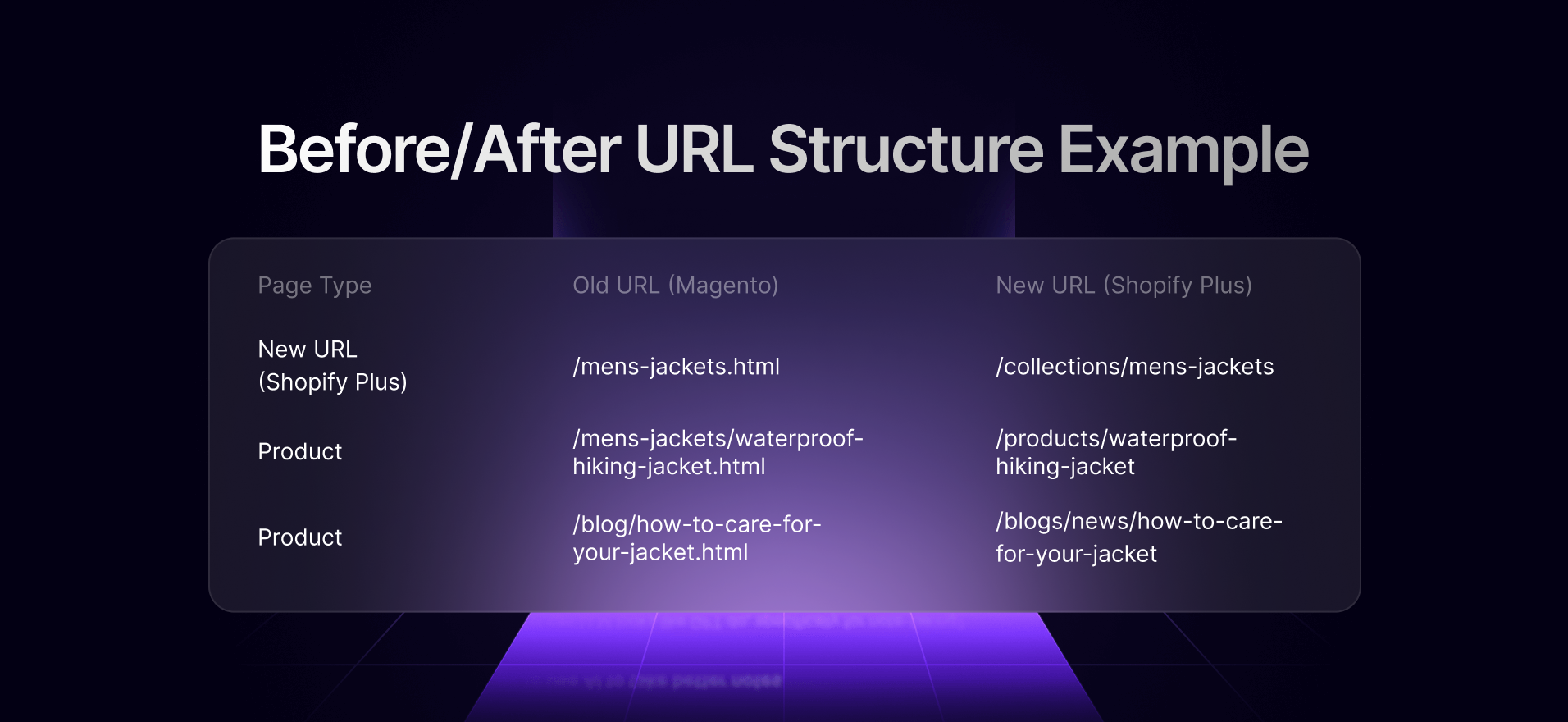
Each of these requires a 301 redirect, and each redirect should be tested before go-live.
How to migrate a large online store to a scalable e-commerce system
The question of how to migrate a large online store is where most guides become vague. Below is the methodology Fourmeta uses with mid-market clients moving tens of thousands of SKUs onto scalable modern platforms.
Step 1 – Technical audit & platform evaluation
The audit has two components: understanding what you have and what you need. On the current platform side, this means a full crawl of your existing site, an inventory of all integrations (ERP, PIM, OMS, loyalty, email, CRM), and a performance benchmark. On the future state side, it means evaluating candidate platforms against your actual requirements, not vendor feature lists.
For UK mid-market retailers with 500–25,000 SKUs, multi-channel ambitions, and B2B requirements, the platform shortlist typically includes Shopify Plus, commercetools, or SFCC, depending on complexity and budget.
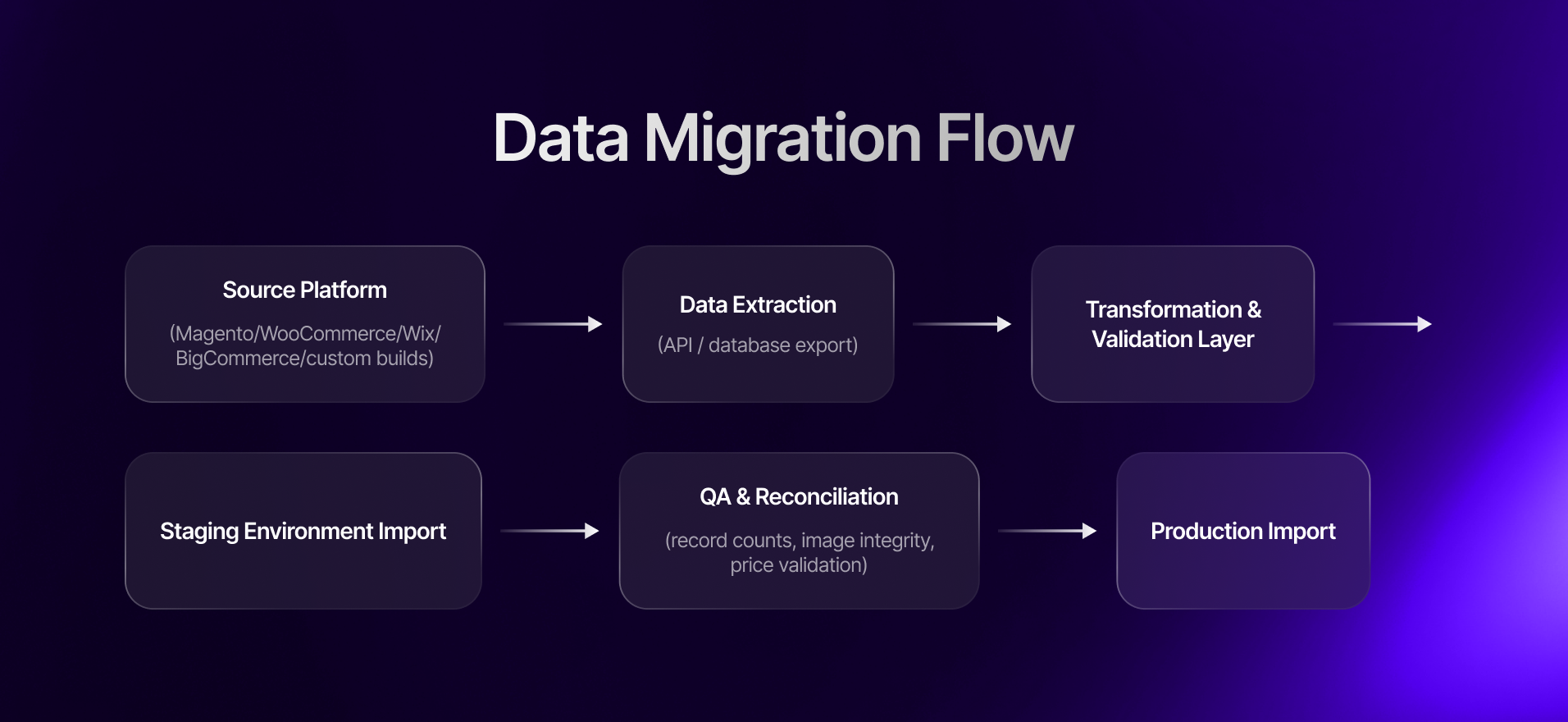
Step 2 – Data migration (products, customers, orders)
Data migration is the most technically demanding phase. For catalogues with 10,000+ SKUs, the migration must be scripted and validated at every stage, manual exports and imports introduce errors at scale. The key data sets to migrate include product data (titles, descriptions, variants, metafields, images), customer records (with GDPR-compliant handling of historical data), order history (essential for customer service and loyalty programme continuity), and CMS content (blog posts, landing pages, editorial content).
For stores with ERP or PIM integrations, the migration is the right moment to review the integration architecture. Migrating to Shopify Plus or a headless setup while keeping a legacy ERP integration intact often recreates the exact bottleneck you were trying to escape.
Step 3 – SEO mapping & redirect planning
At catalogue scale, redirect mapping can't be done manually. Fourmeta uses a combination of crawl data, URL pattern matching, and custom scripting to generate redirect maps for large catalogues. For stores with 50,000+ SKUs, this phase typically takes 3–4 weeks and requires close collaboration with your SEO team to prioritise high-value pages.
Step 4 – UX optimisation & conversion enhancements
Ecommerce migration is the right moment to rebuild your checkout and product page templates for conversion, not just functional parity. Too many migrations aim to replicate the old site, which is a missed opportunity. The new platform should deliver measurable improvements in checkout completion rate, mobile experience, and page speed. For multi-currency and international setups, this phase includes implementing geolocation-based redirects, local payment methods, and market-specific pricing.
Step 5 – Testing & post-launch monitoring
Pre-launch testing should cover every critical user journey: product search and filtering, add to basket, checkout (across all payment methods), account login and registration, and order confirmation emails. Post-launch, the first 90 days are critical. Google is re-indexing your site, redirects are being followed at scale, and any configuration errors will surface in your Search Console data, Core Web Vitals, and revenue reporting.
Ecommerce migration services: what to expect
What do ecommerce migration specialists actually do?
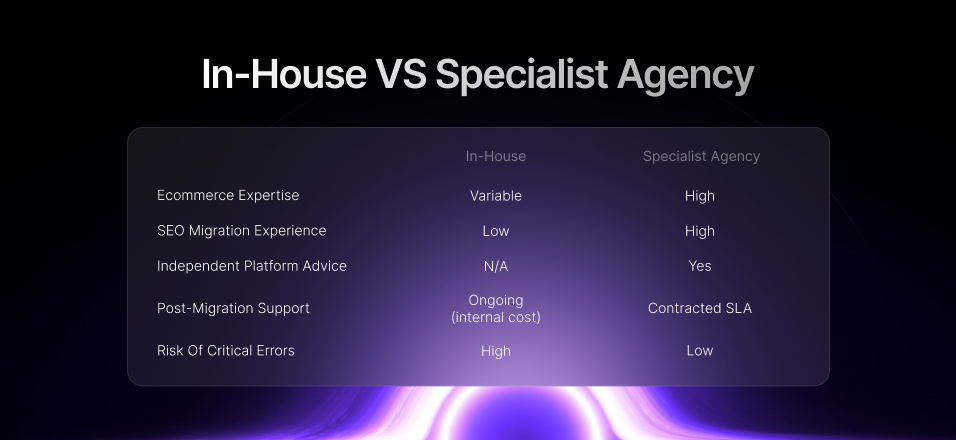
A specialist migration agency manages the entire project, from technical audit and platform selection through to data migration, SEO preservation, UX build, and post-launch optimisation. They bring experience across dozens of similar migrations, which dramatically reduces the risk of costly errors. More importantly, they've seen the edge cases: the ERP integration that doesn't survive a URL structure change, the product variant data that doesn't map cleanly to the new platform's schema, the redirect configuration that works in staging but fails at scale.
Technical vs SEO-focused migration services
Some agencies lead with development; others lead with SEO. The best ecommerce migration services do both with equal rigour. A technically flawless migration that drops 40% of organic traffic within 60 days is not a successful migration. Similarly, an SEO-perfect redirect map that sits on a slow, poorly built storefront won't convert. Look for agencies that can show you examples of both clean technical migrations and preserved or improved post-migration search rankings.
Platform-specific migration (Magento, WooCommerce, Wix, custom)
Platform origin matters. Magento 2 migrations involve navigating complex attribute sets and extension dependencies. WooCommerce migrations often involve moving away from a hosting setup that was never designed for scale. Custom legacy platforms may have no API layer at all, requiring direct database access for data extraction. Each starting point requires a different technical approach.
Timeline & cost expectations
Are there ecommerce migration specialists near me in the UK?
Why UK-Based ecommerce migration experts matter
Working with a UK-based ecommerce migration agency means you're working with a team that understands the commercial context: UK consumer behaviour, the VAT rules that affect your checkout configuration, GDPR obligations around customer data, and the payment methods, like Klarna, Clearpay, PayPal, that UK shoppers expect. Time zone alignment also matters more than most clients anticipate during a live migration, when fast decision-making can be the difference between a two-hour issue and a two-day one.
Fourmeta is a UK-based ecommerce agency with deep expertise in replatforming projects for mid-market retailers. We work with brands across London, Manchester, Birmingham, and beyond, including those with international storefronts and complex multi-channel operations.
GDPR, VAT & UK-specific considerations
A migration is a data processing event. If you're moving customer records, like names, emails, purchase histories, between platforms, you need to ensure that the process is GDPR-compliant, with appropriate data processing agreements in place with any third-party tools involved in the transfer. On the VAT side, your new platform's tax configuration needs to handle UK VAT correctly post-Brexit, including the rules around digital goods and cross-border B2C sales to EU customers.
Questions to ask before hiring a UK ecommerce migration partner
Before signing a statement of work, ask your prospective agency the following:
- Can you share three examples of migrations at a similar scale to ours, and what were the SEO outcomes?
- How do you handle redirect mapping for catalogues of our size?
- What does your post-launch monitoring process look like for the first 90 days?
- How do you handle GDPR compliance during data transfer?
- What's your process when a critical issue surfaces on go-live day?
Which ecommerce migration services offer the best support for UK businesses?
Headless commerce approaches
Headless commerce, separating the front-end presentation layer from the back-end commerce engine, is increasingly popular with mid-market retailers who need performance and flexibility without enterprise-level budgets. Platforms like Shopify Plus (with a headless front-end) or commercetools paired with a React/Next.js storefront can deliver sub-2-second page loads and near-total UX flexibility. The migration complexity is higher, but the long-term commercial upside is significant for brands with high traffic and strong organic channels.
Shopify & Shopify Plus migrations
Shopify Plus is the most common destination for UK mid-market retailers migrating from Magento or WooCommerce. The platform's SaaS model eliminates hosting complexity, and its ecosystem of apps and integrations covers most mid-market requirements out of the box.
Shopify Plus migrations are well-understood by experienced agencies, which makes timelines and costs more predictable. Fourmeta has delivered multiple Shopify Plus migrations for UK retailers, with post-migration revenue uplifts typically ranging from 20% to 45%.
Ongoing support & CRO after migration
The ecommerce migration is the beginning, not the end. Post-migration optimisation, like A/B testing checkout flows, improving category page conversion, refining site search, should be part of your migration contract. At Fourmeta, we include a 90-day post-launch optimisation period in all migration projects, with defined SLAs for bug fixes and a dedicated project manager throughout.
Ecommerce replatforming checklist
Use this checklist before and after your migration to ensure nothing is missed:
- SEO audit. Full crawl of existing site, metadata export, backlink profile review, Core Web Vitals benchmark
- URL mapping. Every old URL mapped to new URL or 301 redirect destination, reviewed and tested
- Data validation. Product record counts reconciled, image integrity checked, pricing validated, customer records verified
- Speed testing. Lighthouse scores and Core Web Vitals measured on staging; target improvement documented
- Analytics tracking. GA4 tags firing correctly on all page types; ecommerce events (add to basket, purchase) validated
- Conversion audit. Checkout flow tested across all devices and payment methods; form validation checked; abandoned cart triggers confirmed
Ecommerce platform migration case study (before & after results)
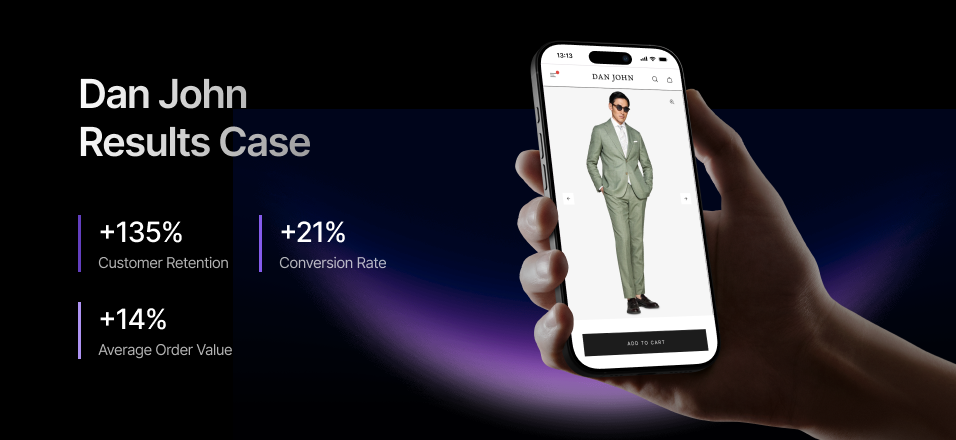
Dan John — Shopify Plus migration
Dan John is a UK menswear retailer with a strong DTC proposition and a growing wholesale operation. They were facing slow load times, a difficult checkout experience on mobile, and a development backlog that was eating into their agility as a business.
Fourmeta managed the full migration to Shopify Plus, including a ground-up rebuild of their storefront, full data migration of 3,200 SKUs and 8 years of order history, and a comprehensive SEO migration covering redirect mapping, metadata transfer, and structured data rebuild.
Results at 90 days post-launch:
- +135% Сustomer retention
- +21% Сonversion rate
- +14% Average order value
The SEO outcome was particularly significant: organic traffic grew rather than declined, due to the thorough redirect strategy and the improved Core Web Vitals scores following launch.
FAQ – Ecommerce migration & replatforming
What is ecommerce replatforming?
Ecommerce replatforming is the process of moving your online store from one platform to another, for example, from Magento to Shopify Plus. It involves migrating your product data, customer records, and content, rebuilding your storefront, and preserving your SEO rankings throughout the transition.
How long does ecommerce migration take?
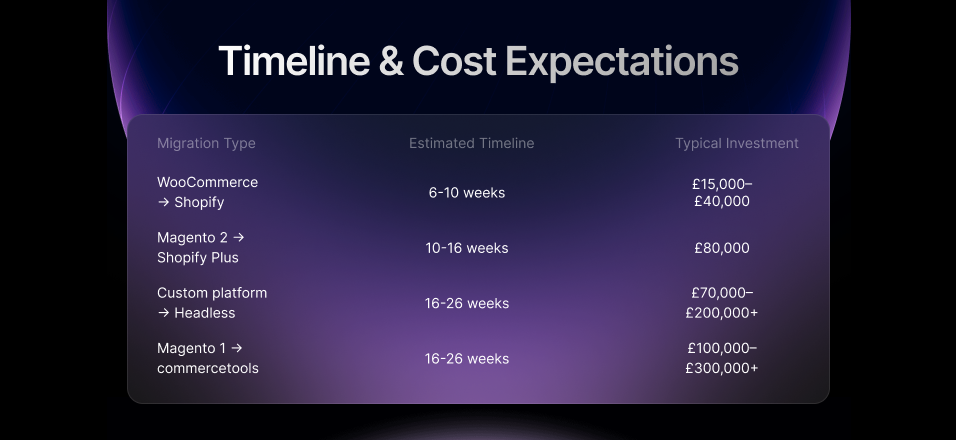
Timelines vary significantly by complexity. A WooCommerce to Shopify migration for a store with 1,000 SKUs typically takes 6–10 weeks. A Magento 2 migration with ERP integrations and 20,000+ SKUs can take 16–24 weeks. Post-launch stabilisation and optimisation adds a further 8–12 weeks.
How much does ecommerce platform migration cost?
For UK mid-market retailers, ecommerce migration costs typically range from £15,000 for a straightforward WooCommerce migration to £200,000+ for a complex headless or enterprise replatform. The variables are catalogue size, integration complexity, and the level of UX build involved.
Will I lose SEO traffic during site migration?
Not necessarily, but the risk is real without careful planning. A well-executed ecommerce site migration with comprehensive redirect mapping, metadata transfer, and structured data preservation can maintain or even improve organic traffic. Poorly planned migrations can cause significant drops that take months to recover from.
Is it better to replatform or optimise the existing platform?
If your platform is limiting your growth through poor performance, missing features, or security vulnerabilities, optimising it is a temporary fix at best. Replatforming is a larger upfront investment but typically delivers a far better long-term return. The question to ask is: can the existing platform support where we want to be in three years?
How to choose ecommerce migration services in the UK?
Look for an agency with verified case studies at your scale, a demonstrable SEO migration methodology, and UK-specific expertise (GDPR, VAT, local payment methods). Ask for references from brands in your sector and ensure post-launch support is included in the contract. Fourmeta offers a free initial migration assessment for UK retailers, a useful starting point before committing to a project.