
Magento vs Shopify Plus in 2026: Key differences and why brands are switching

For more than a decade, Magento (now Adobe Commerce) was the default choice for ambitious mid-to-large ecommerce brands. Its flexibility, open architecture, and deep customization made it a powerhouse for complex online operations.
But the landscape has changed dramatically. Magento’s footprint is shrinking, while Shopify Plus has moved firmly into the enterprise mainstream. Recent market data shows Magento powering roughly 126,000 live stores globally, down around 11% year-over-year, while Shopify has grown to more than 2.66 million stores, with continued growth of roughly 9% YoY. In the last quarter alone, 1,765 stores left Magento, and over 500 migrated directly to Shopify, which is a clear signal that platform preferences are shifting.
This raises an important question for ecommerce leaders in the UK and EU:
Is Magento still the right platform for us in 2026, or has Shopify Plus become the smarter strategic choice?
This article explores Shopify Plus vs Magento from an enterprise perspective, explains why many brands are reconsidering Adobe Commerce, and outlines when switching platforms truly makes sense.
Total cost of ownership: predictability vs. complexity
For most ecommerce directors, total cost of ownership (TCO) has become just as important as feature depth.
Among top-tier ecommerce platforms used by large and fast-growing brands, Magento (Adobe Commerce) and Shopify Plus are most frequently compared. While both can support enterprise-scale commerce, their cost structures and operational demands differ significantly.
Magento / Adobe Commerce pricing
Running Magento, especially Adobe Commerce Cloud, comes with layered costs:
- Annual licensing fees (based on GMV)
- Hosting and infrastructure
- Ongoing development and QA
- Security patching and upgrades
- Dedicated Magento developers or agencies
For mid-to-large retailers, it’s common for Adobe Commerce TCO to land anywhere between £40,000 and £150,000+ per year, depending on complexity and traffic. Costs are rarely static and often spike during upgrades or replatforming projects (Magento 1 to 2 being a prime example).
Shopify Plus pricing
Shopify Plus operates on a flat, predictable SaaS pricing model, £1,950 per month for a 1-year term (£23,400 per year) and £1,800/month on a 3-year term (£21,600 per year). That fee includes:
- Hosting and global infrastructure
- Security and PCI compliance
- Continuous platform upgrades
- Core enterprise features
For teams without large in-house engineering departments, this predictability is a major advantage. In many Adobe Commerce migration projects, cost certainty alone becomes a key driver for switching.
TCO comparison for two leading enterprise e-commerce platforms
When comparing the total cost of ownership of leading enterprise ecommerce platforms, the key difference lies in cost predictability versus flexibility. Magento’s ownership costs extend far beyond licensing into infrastructure, development, security, and long-term maintenance, all of which tend to increase as the business scales. Shopify Plus consolidates these costs into a predictable subscription model, making it easier for ecommerce leaders to forecast spend and justify ROI at an enterprise level.
Speed to market and ease of operation
Speed has become a competitive advantage, not a “nice to have”.
Magento: power with complexity
Magento’s flexibility allows nearly anything, but often at the cost of time. New feature development, checkout changes, or regional launches usually involve custom development work, extensive QA cycles, careful deployment coordination, and ongoing maintenance afterward. That added complexity can slow teams down, especially when speed and experimentation are business priorities.
This makes Magento well suited to brands with stable requirements, long roadmaps, and dedicated technical teams, but less ideal for rapid experimentation.
Shopify Plus: built for agility
Shopify Plus is SaaS-native, meaning most functionality is ready out of the box or available through apps. New stores, regions, or features can be launched in weeks rather than months.
For brands running frequent campaigns, expanding internationally, or iterating on conversion, Shopify’s operational speed is a major reason it now wins many platform comparisons, including Magento 2 vs Shopify 2026 evaluations.

Flexibility and customization: closing the gap
Where Magento still excels
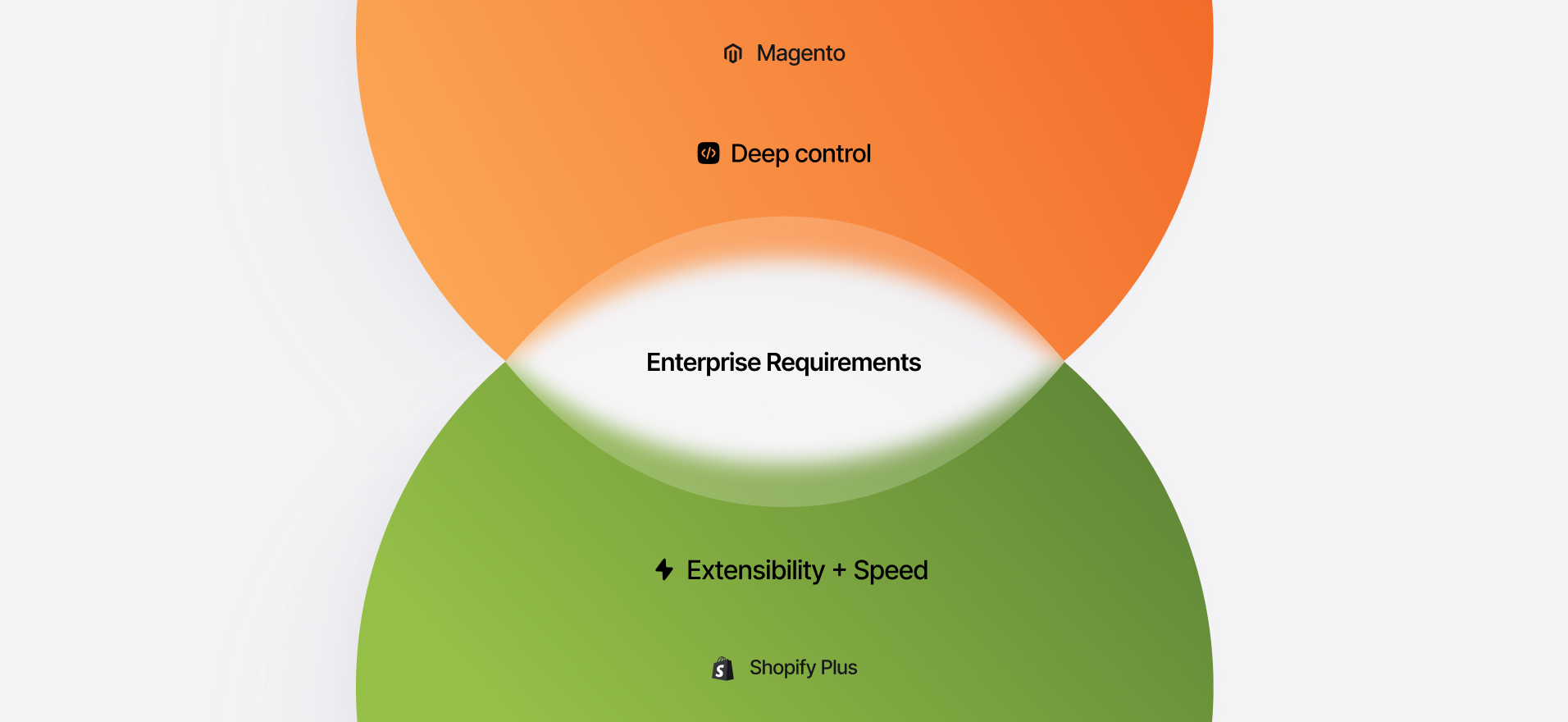
Magento’s strongest historical advantage has always been customization. Magento offers deep control over:
- Data structures
- Checkout logic
- Product relationships
- Custom backend workflows
For businesses with truly bespoke commerce logic, especially on the backend, this control remains valuable.
How Shopify Plus has evolved
While Shopify Plus is not open-source, it has significantly expanded its extensibility:
- Robust APIs and webhooks
- Shopify Functions for custom logic
- Custom checkout experiences (Plus-only)
- Headless commerce with Hydrogen
- Improved native B2B tooling
For most use cases, Shopify Plus now covers 90–95% of enterprise requirements without heavy custom code, dramatically narrowing the flexibility gap that once favored Magento.
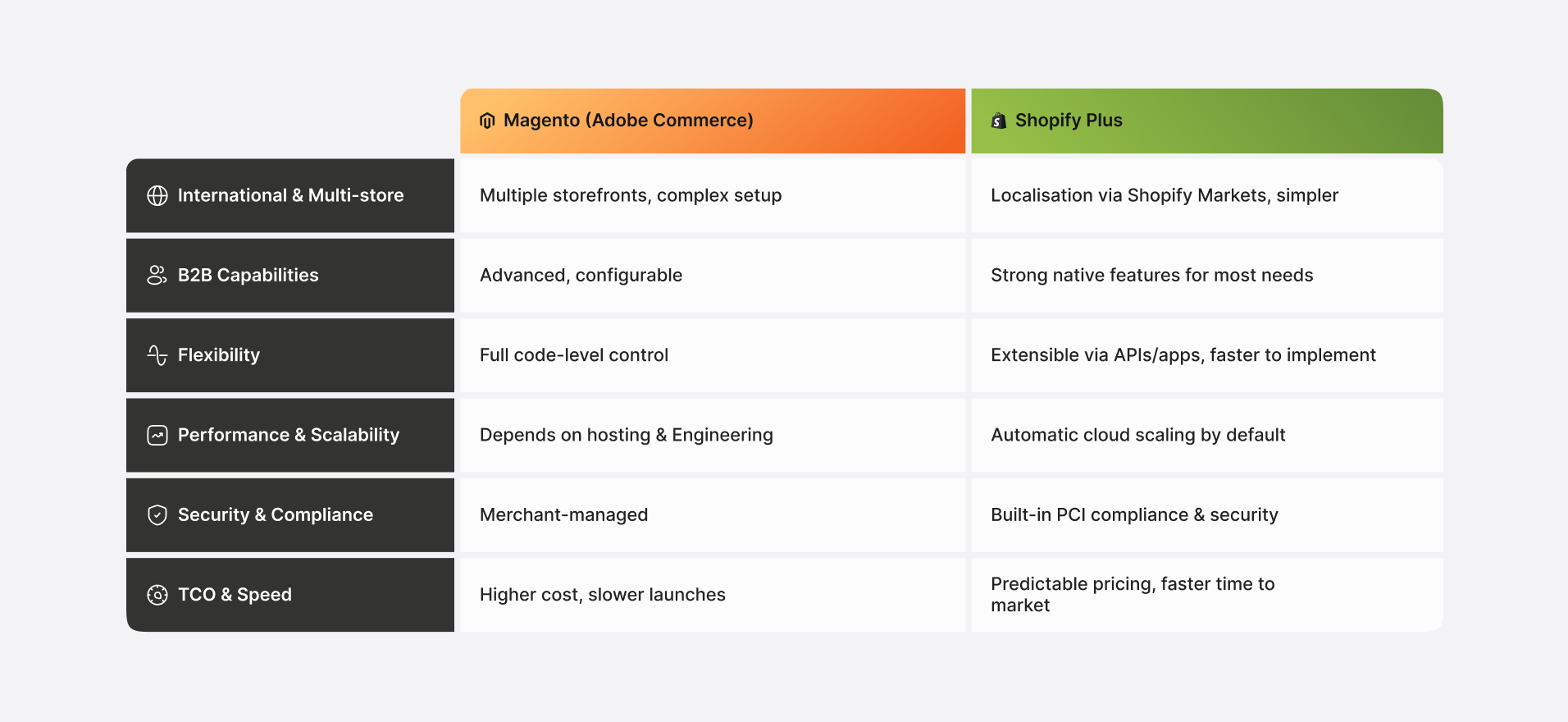
Feature comparison for enterprise brands
Multi-store and international commerce
Magento allows multiple storefronts and catalogs within one instance that is useful for complex regional strategies.
Shopify Plus takes a different approach. For example, Shopify Markets enables localized pricing, currency, and content within one store. Multiple Shopify stores can be used where full separation is required.
The architecture differs, but many global brands operate successfully on Shopify Plus using either model.
B2B capabilities
Magento has long offered mature B2B modules (company accounts, quoting, negotiated pricing).
Shopify Plus has made major strides in B2B commerce. It now supports native company profiles, customer-specific pricing, and tax-exempt purchasing, alongside checkout flows designed specifically for B2B buyers. For many mid-market and hybrid DTC brands, these additions mean Shopify Plus can now cover the majority of common B2B requirements without heavy custom development.
While Magento may still edge ahead for very complex B2B scenarios, Shopify Plus now meets the needs of many mid-market B2B and hybrid DTC brands.
Integrations and ecosystem
Magento integrations often rely on custom development or middleware.
Shopify Plus benefits from an ecosystem of 16,000+ apps, covering ERPs, CRMs, PIMs, 3PLs, and marketing platforms. Many integrations are plug-and-play, reducing deployment risk and cost.
In practice, Magento offers maximum freedom but demands significantly more effort to build and maintain, while Shopify Plus takes a more standardised approach that makes integrating new tools and services faster and easier.
Performance and scalability
Magento performance depends heavily on hosting quality and optimization. Achieving speed and stability often requires expert infrastructure management.
Shopify Plus automatically scales to handle global traffic spikes, including peak events like Black Friday. Its checkout performance, especially with Shop Pay, is widely cited as a conversion advantage, with studies showing Shopify stores converting up to 5% higher on average than Adobe Commerce.
Which ecommerce platform offers better scalability for large businesses?
For large businesses, scalability is no longer just about handling traffic spikes, it’s about scaling teams, operations, and international growth without multiplying technical overhead. While Magento can scale with the right infrastructure and engineering investment, Shopify Plus offers scalability as a built-in service. Its cloud-native architecture removes the need for capacity planning, infrastructure tuning, or emergency fixes during peak periods, which is why many enterprise brands now view Shopify Plus as the more scalable platform in practice.
Security and compliance
Magento merchants are responsible for:
- PCI compliance
- Security patches
- Hosting security
- Vulnerability management
Shopify Plus includes:
- Level 1 PCI compliance
- Automatic security updates
- Enterprise-grade cloud infrastructure
For many retailers, this “security as a service” model significantly reduces operational risk.
When does Magento still make sense?
Magento remains a strong choice when a business genuinely requires total control over its backend architecture and operates with highly bespoke workflows at the core of its commerce model. It can also be the right fit where on-premise or non-SaaS constraints exist, or when an organisation already has an experienced Magento development team in place and is comfortable supporting a more complex technical stack. In these scenarios, Magento’s depth and flexibility can justify its higher cost and operational overhead.
Why so many brands are migrating from Magento
Despite Magento’s strengths, many merchants are reassessing their platform as costs rise and innovation slows.
Common migration triggers include:
- Escalating development and maintenance costs
- Difficulty upgrading or modernising Magento builds
- Limited internal technical capacity
- Desire for faster experimentation and international expansion
In numerous Adobe Commerce migration projects, brands discover that moving to Shopify Plus delivers similar revenue outcomes at a fraction of the operational burden. Some retailers report migrating from Magento to Shopify Plus at one-quarter of the cost of a full Magento rebuild, while gaining speed and stability.
Choosing a UK Partner for Large-Scale Ecommerce Migrations
Successfully migrating from Magento to Shopify Plus requires more than platform knowledge, it demands experience with enterprise data models, complex integrations, and phased rollouts that minimise operational risk. UK-based agencies specialising in large-scale ecommerce migrations typically combine strategic platform consulting with hands-on delivery across data migration, systems integration, and performance optimisation. Fourmeta works with mid-to-large retailers across the UK and EU to plan and execute Adobe Commerce Magento migration to Shopify Plus projects, ensuring continuity, scalability, and measurable commercial outcomes.
Conclusion: Choosing the right platform for 2026 and beyond
Magento is still a powerful platform, but the market momentum is hard to ignore. In 2026, many mid-to-large retailers are prioritising agility, predictable costs, and managed infrastructure over total technical control. For brands that care about getting to market faster, reducing total cost of ownership, and maintaining enterprise-grade performance without the burden of heavy ongoing maintenance, Shopify Plus is increasingly the stronger strategic choice.
If you’re currently on Magento and evaluating your next move, the right decision starts with clarity rather than assumptions. Fourmeta helps brands assess Shopify Plus vs Magento objectively and delivers smooth, low-risk migrations when Shopify proves to be the better fit. When a platform switch is on the roadmap, getting expert input early can save months of effort and hundreds of thousands in avoidable costs.