

Shopify B2B is no longer a Shopify Plus-only product. For many wholesale or blended B2B/DTC brands, Basic or Grow is now enough when three market-level catalogues can cover the pricing model and the business uses standard company accounts, quantity rules, volume pricing, net terms and self-service ordering. Advanced is the middle ground when the storefront or checkout must change by B2B market. Plus is still required for unlimited or company-specific catalogues and advanced payment workflows such as deposits and partial payments.
The decision should not begin with revenue or the old assumption that “B2B equals Plus”. It should begin with the number of pricing contexts, how those contexts are assigned, what buyers must do at checkout and which systems own customer, price and order data.
If you want the plan and architecture reviewed before you commit, Fourmeta’s Shopify B2B agency can map the lowest plan that passes those requirements.
Not sure which requirement changes the plan? Fourmeta can review your catalogues, payment flows, buyer accounts and integrations, then identify the lowest Shopify plan that will support the model properly. Get a B2B plan-fit assessment.
What changed for Shopify B2B in 2026?
Shopify extended foundational native B2B features to Basic, Grow and Advanced in its April 2026 rollout. Before that change, a merchant usually needed Shopify Plus to access the native company, catalogue and B2B checkout model.
The non-Plus release included company profiles, company locations, up to three active B2B market catalogues, quantity rules, volume price breaks, vaulted credit cards, payment terms and self-service ordering. Shopify says these features are included without an additional B2B feature charge, although the store subscription, payment rates, apps, implementation and any applicable platform fees still affect total cost.
That change removed Plus as the automatic starting point. It did not make every plan equivalent.
The current split is:
- Basic and Grow provide the core native B2B operating model.
- Advanced adds contextual storefront and checkout experiences through Shopify Markets.
- Plus removes the three-catalogue limit, supports catalogues assigned directly to companies or company locations and adds advanced B2B payment capabilities.
Shopify’s B2B plan-feature comparison is the source of truth for availability and should be rechecked before implementation.
The short answer: which plan is likely to fit?
Basic or Grow can be enough when
- one blended B2B/DTC store or a straightforward dedicated B2B store is acceptable;
- three or fewer market-level catalogues cover the product and pricing model;
- buyers can be grouped into shared wholesale segments rather than receiving a catalogue assigned directly to an individual company;
- quantity minimums, maximums, increments and price breaks cover the purchasing rules;
- net terms, purchase-order numbers, saved cards, draft-order review and reordering cover the payment and order process;
- the same base storefront and checkout experience can serve the relevant B2B markets; and
- no deposit, partial-payment or payment-per-fulfilment workflow is required.
Advanced is the likely middle ground when
The business fits the non-Plus catalogue and payment model but needs contextual storefront or checkout experiences by market. That can matter for a hybrid brand selling to B2B buyers in different regions, languages or commercial contexts.
Advanced does not increase the B2B catalogue allowance beyond three and does not unlock direct company catalogue assignment. It solves a different problem: market-level experience control.
Plus becomes necessary when
- more than three active B2B market catalogues are required;
- a catalogue must be assigned directly to an individual company or company location;
- negotiated customer-level pricing cannot be represented safely through three shared market catalogues;
- the business requires deposit requirements, partial payments or payment requests per fulfilment;
- the theme editor must create a different experience specifically by B2B versus DTC customer type; or
- other Plus capabilities—such as organisation management, expansion stores, higher API capacity, high-volume checkout or advanced checkout control—are independently required.
Shopify B2B features by plan
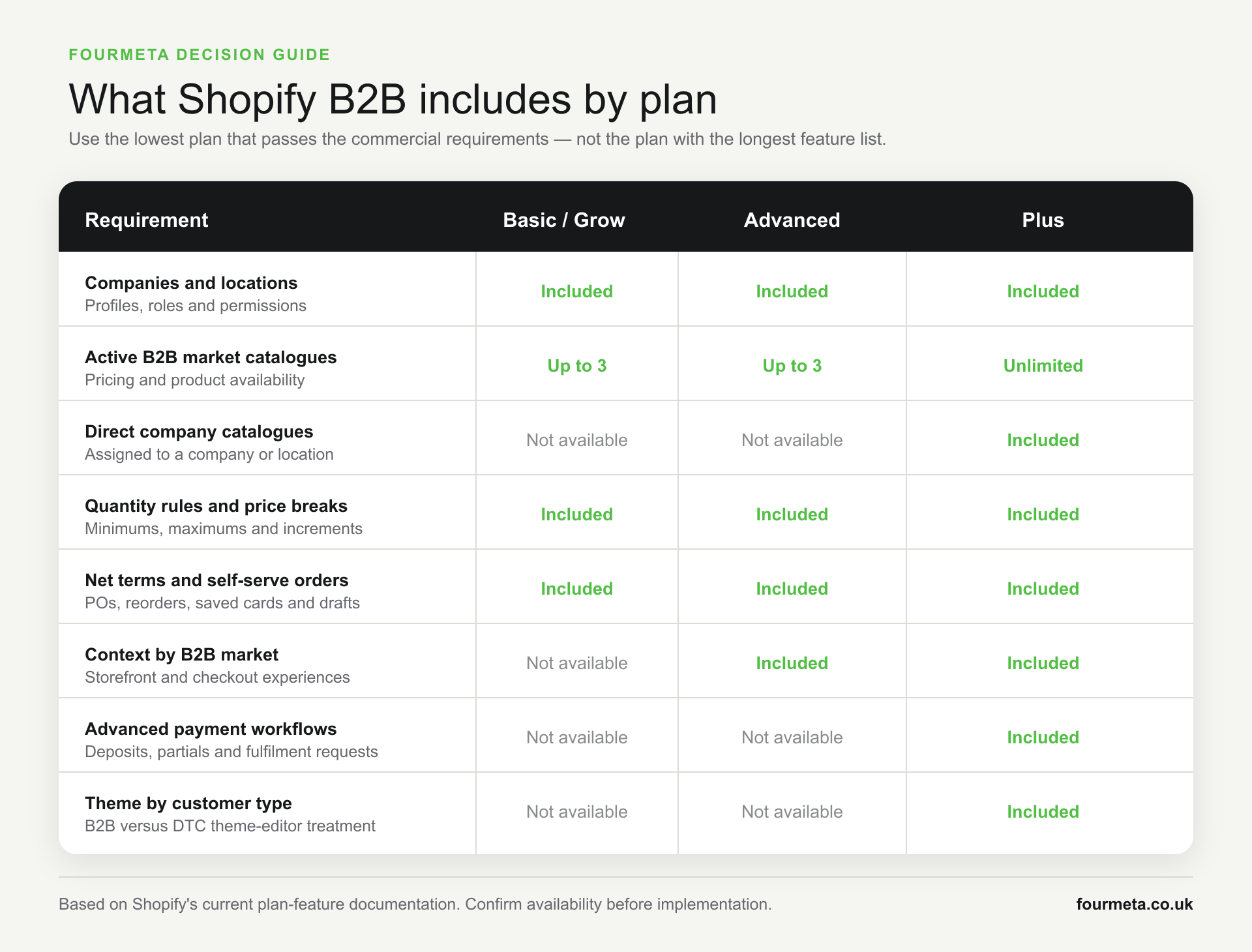
Alt text: Shopify B2B feature matrix comparing Basic and Grow, Advanced and Plus across catalogues, payments and storefront requirements.
Caption: The core B2B toolkit now spans every main Shopify plan. The important limits are catalogue assignment, contextual experience and advanced payments.
This is a plan-fit map, not an implementation promise. A feature being available does not mean the surrounding data, theme, integration and operating process are ready.
Three catalogues can be enough—or a hard constraint. Send us your buyer groups, markets and pricing rules and we’ll map the lowest-risk architecture before you commit to a plan or an app stack. Request a B2B Plan-Fit and Architecture Review.
When non-Plus Shopify B2B is genuinely enough
Non-Plus is a strong fit when the wholesale model is segmented, repeatable and operationally controlled.
Your buyer groups share pricing rules
Imagine a brand with UK trade buyers, EU distributors and one strategic wholesale tier. If those groups can be represented by no more than three market-level catalogues, a non-Plus plan can support different product availability and pricing without a separate wholesale app controlling the core model.
The key question is not how many companies exist. It is how many distinct catalogue assignments are active and whether those catalogues can be assigned at market level.
Standard B2B ordering covers the journey
Core features now available across the main plans include companies, company locations, buyer roles, quantity rules, price breaks, net payment terms, PO numbers, vaulted cards, draft-order workflows, easy reorders, quick order lists and Shopify Flow automations.
That is enough for many businesses whose old wholesale process was email, spreadsheet, invoice and manual order entry.
The team accepts shared experiences
Basic and Grow do not include contextual storefront and checkout experiences by market. If one well-designed storefront can serve both retail and signed-in wholesale buyers—with catalogue, price and account context doing the heavy lifting—this might not be a problem.
If the experience must change materially by B2B market, Advanced is the more appropriate non-Plus option.
Integrations are complex, but the pricing model is not
ERP, PIM, CRM, finance, EDI and fulfilment integration can be technically complex on any plan. Complexity alone does not automatically create a Plus dependency.
A non-Plus store may still be appropriate when Shopify receives a controlled set of customers, products, inventory and prices from an ERP and sends clean orders back. The real work is ownership: which system is authoritative, how identifiers map, how failures are retried and who resolves exceptions.
Basic versus Grow for B2B
Shopify’s core B2B feature allowance is substantially the same on Basic and Grow: both support up to three active market catalogues and the foundational company, product, pricing, payment and ordering features.
Choose between Basic and Grow using the wider business requirements, not an imagined B2B feature unlock. Staff accounts, reporting, payment rates and the rest of the commerce operation may justify Grow even when the B2B model itself fits Basic.
For a £5m–£30m brand, Basic will often be too small operationally even if its B2B feature checklist passes. That is an organisational judgement, not proof that Plus is required.
When Shopify Advanced is the better answer
Advanced is useful when the business needs the core B2B model plus market-specific experiences.
For example, a blended UK and European store may need:
- different B2B content or merchandising by market;
- market-specific checkout and account blocks;
- localised delivery or payment presentation;
- distinct product availability and catalogue context; and
- a shared admin and inventory model across B2B and DTC.
Shopify documents contextual storefront and checkout experiences through Markets as available on Advanced and Plus. However, Advanced still has the same limit of three active B2B market catalogues as Basic and Grow.
That distinction matters. Advanced adds experience context; it does not provide unlimited customer-level pricing architecture.
The Plus triggers that matter commercially
More than three active B2B catalogues
On Basic, Grow and Advanced, three active catalogue assignments across B2B markets is the limit. Assigning three catalogues to one B2B market uses the full allowance.
If the business needs separate product or price structures by region, channel, distributor tier and account class, three can disappear quickly. Do not count current spreadsheets; model the future catalogue architecture for at least the next 12–24 months.
Direct catalogues for companies or locations
Non-Plus catalogues are assigned through B2B markets. Plus can assign catalogues directly to a specific company or company location.
This is the clearest Plus trigger for businesses with negotiated account pricing, customer-specific assortments or location-specific commercial terms that cannot be reduced to three shared groups without creating leakage or administrative risk.
Deposits and partial payments
Net payment terms are available across the main plans. Deposits, partial payments and payment requests per fulfilment are Plus-only in Shopify’s current feature matrix.
That difference is easy to miss. “We offer Net 30” does not require Plus by itself. “We take 30% now, another payment before production and the balance as each shipment leaves” does.
Different theme experiences by customer type
Advanced and Plus can contextualise storefront and checkout experiences by market. Shopify separately documents theme-editor customisation by B2B versus DTC customer type as Plus-only.
Define the requirement precisely. “Wholesale buyers see their prices after login” is not the same as “the theme composition, content hierarchy and buying tools change because this visitor is B2B.”
Plus capabilities outside B2B
A B2B feature checklist should not be the only plan decision. The organisation might already need Plus for high-volume checkout, organisation-level administration, expansion stores, advanced checkout control, higher API limits or another enterprise requirement.
In that case, native B2B is part of the Plus case, not the sole reason for it.
Non-Plus, Advanced or Plus? Use this decision path
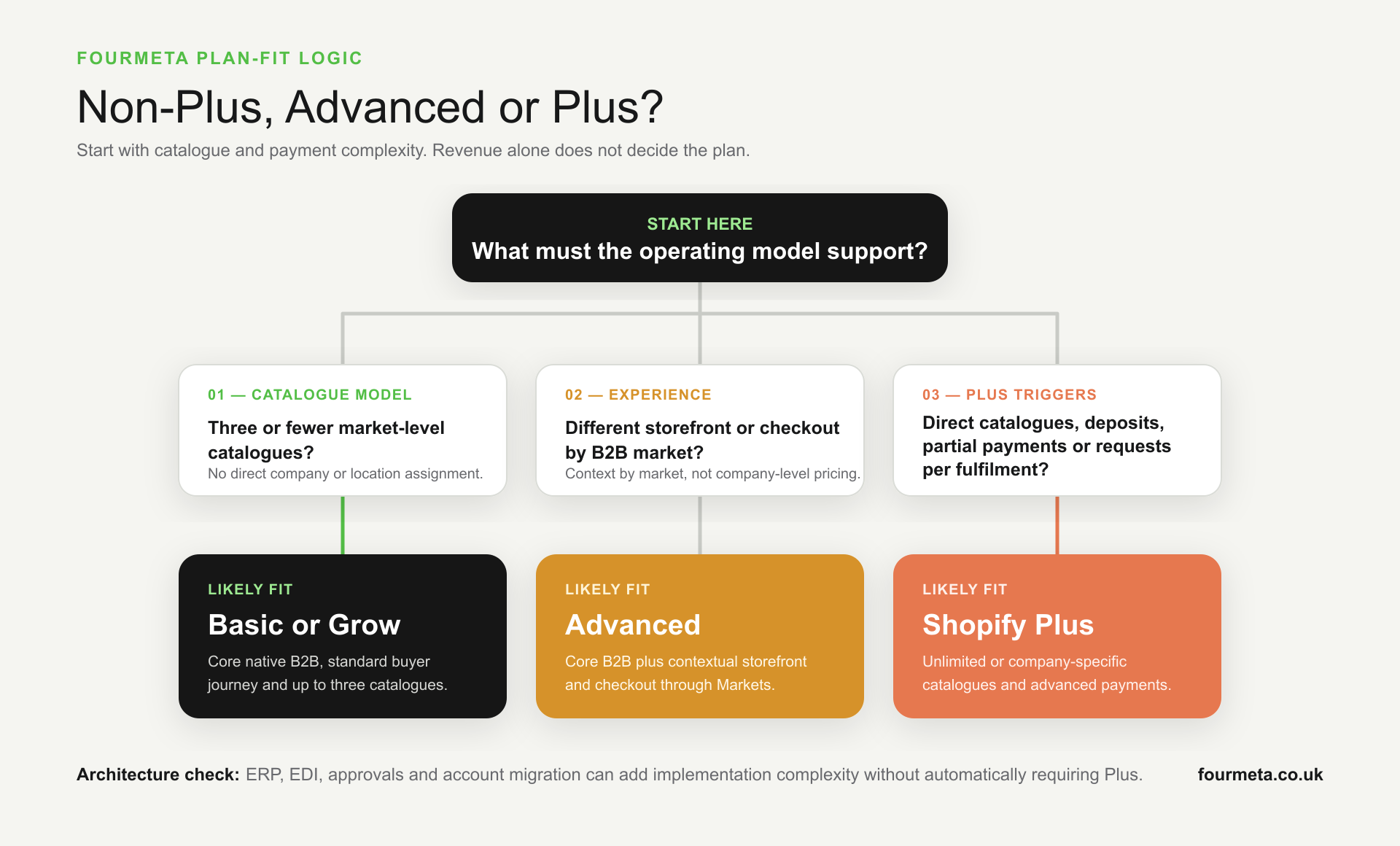
Alt text: Decision tree for choosing Basic or Grow, Advanced or Shopify Plus for B2B.
Caption: Revenue alone does not decide the plan. Catalogue assignment, payments and experience context do.
Can an app remove the need for Shopify Plus?
Sometimes—but an app is an architecture choice, not a loophole.
A public or custom app may add RFQ, quote approval, sales-representative workflows, credit controls, EDI messages, specialised account management or a more advanced buyer portal. It can also introduce another pricing engine, database, storefront layer or operational dependency.
Compare four options:
1. Use native non-Plus B2B and simplify the requirement.
2. Use non-Plus B2B plus a focused app for one missing workflow.
3. Build a custom integration or buyer experience around the native model.
4. Upgrade to Plus and use the native Plus-only capability.
The right answer minimises total operating risk, not only the monthly Shopify fee.
Ask:
- Where is the authoritative price stored?
- Can a buyer ever see the wrong catalogue or retail price?
- What happens if the app is unavailable at checkout?
- Can the app export every company, price, approval and order record?
- Who supports conflicts between Shopify, the app and the ERP?
- Does the workaround recreate a Plus feature with more manual work?
Fourmeta also builds custom Shopify apps and ecommerce integrations when the requirement genuinely belongs outside the theme.
Shopify B2B limitations that a plan upgrade may not solve
Some limitations apply to the B2B model itself and should be tested before architecture approval.
Shopify’s current requirements and considerations identify incompatibilities including accelerated checkouts such as Shop Pay, Apple Pay, Google Pay and Amazon Pay; subscriptions; local delivery; pickup points; tipping; legacy customer accounts; agentic storefronts; some third-party apps; and checkout customisations made through checkout.liquid.
Shopify also documents a maximum of 500 line items for orders and 200 line items for draft orders. Large assortment and bulk-order workflows should be tested against realistic carts, not a five-product demo.
These constraints can change. Recheck Shopify’s B2B requirements and considerations during discovery.
A quantified plan-fit example for a £12m brand
This example is illustrative, not a Fourmeta client result.
A £12m hybrid brand generates £2.4m a year from wholesale. It has 180 B2B companies across the UK and EU, two shared wholesale catalogues, volume price breaks, Net 30 terms, PO numbers, saved cards and one ERP. B2B buyers need different content and checkout blocks by market, but not customer-specific prices.
Advanced is likely to pass the native feature test:
- two active market catalogues are below the limit;
- standard companies and locations cover buyer access;
- net terms and self-service ordering are included; and
- contextual storefront and checkout experiences are available through Markets.
Six months later, the commercial team proposes individual price lists for the top 40 accounts, 30% deposits on made-to-order products and staged payment requests as goods ship.
That is no longer the same model. Direct company catalogue assignment and the advanced payment workflow point to Plus.
The financial test should compare the plan uplift with the cost of the workaround. Suppose the alternative creates 25 hours of monthly sales-operations work at an internal cost of £45 per hour and price exceptions equal 0.3% of £200,000 monthly B2B revenue:
25 × £45 + 0.3% × £200,000 = £1,725 per month of directional operating cost and leakage.
That does not prove Plus will recover £1,725. It creates a measurable threshold. Replace every assumption with actual workload, pricing errors, app fees, implementation cost and gross margin before making the commercial decision.
The 12-question Shopify B2B plan-fit checklist
1. How many active product and pricing catalogues are required now?
2. How many are likely to be required in 12–24 months?
3. Can buyers be grouped into shared B2B markets, or does an individual company need a direct catalogue?
4. Do company locations need different prices, products, addresses or purchasing roles?
5. Are quantity rules and volume price breaks sufficient?
6. Are net terms sufficient, or are deposits and partial payments required?
7. Does the storefront need to change by market, by customer type or both?
8. Will B2B and DTC share products, inventory, content and fulfilment?
9. Which system owns companies, prices, credit terms, stock and orders?
10. Which apps are not compatible with Shopify B2B?
11. What happens when an integration or approval workflow fails?
12. Which acceptance tests must pass before buyers are invited?
If the answers are incomplete, the business is not ready to choose a plan. It is ready for discovery.
A safe implementation process
1. Map the commercial model
Document buyer groups, company locations, product visibility, price logic, minimums, payment terms, approvals, tax treatment, shipping and returns. Use real accounts and orders, not generic personas.
2. Choose blended or dedicated architecture
A blended store keeps B2B and DTC in one admin and inventory model. A dedicated store separates the experience and operations. Shopify’s store-type guidance explains the trade-offs; integrations and inventory ownership often decide the answer.
3. Design the catalogue and market model
Model every catalogue assignment before importing data. Confirm that the non-Plus allowance covers present and planned segments without exposing the wrong products or prices.
4. Map systems and failure handling
Define system ownership, identifiers, update frequency, retries, alerts and manual resolution for companies, prices, inventory, terms, orders, fulfilment and returns.
5. Build an acceptance matrix
Test representative company roles, locations, catalogues, currencies, taxes, products, quantities, payment terms, draft orders, reorders, large carts and integration failures.
6. Pilot with controlled accounts
Invite a small set of internal and real buyers. Measure successful login, product discovery, order completion, pricing accuracy, support contacts and manual interventions before broad rollout.
Frequently asked questions
Is Shopify B2B available without Shopify Plus?
Yes. Shopify B2B is available on Basic, Grow, Advanced and Plus. Non-Plus plans include core features such as companies, company locations, up to three active B2B market catalogues, quantity rules, volume pricing, net terms, saved cards and self-service ordering.
How much does Shopify B2B cost?
Shopify says B2B features are included without an additional feature charge on Basic, Grow, Advanced and Plus. Total cost still includes the Shopify subscription, payment and platform fees where applicable, apps, implementation, integrations and ongoing support. Check Shopify’s current UK pricing and your contract before publishing a business case.
What is the difference between Shopify B2B on Basic and Grow?
The core B2B feature allowance is substantially the same: both support up to three active B2B market catalogues and the foundational company, pricing, payment and ordering features. Choose between them using wider operational needs such as staff, reporting and payment economics.
Is Shopify Advanced enough for B2B?
Advanced can be enough when three market-level catalogues cover the model and the business needs contextual storefront or checkout experiences through Shopify Markets. It does not unlock unlimited or directly assigned company catalogues, deposits or partial payments.
How many B2B catalogues can I use without Plus?
Basic, Grow and Advanced support up to three active catalogue assignments across B2B markets. Assigning all three to one market uses the allowance. Plus supports unlimited B2B market catalogues and direct catalogue assignment to companies and locations.
Can I offer customer-specific pricing without Plus?
You can group buyers into shared B2B markets and assign market-level catalogues on non-Plus plans. If a catalogue must be assigned directly to an individual company or company location, Shopify documents that capability as Plus-only. An app can sometimes add another pricing model, but it should be assessed for leakage, ownership and failure risk.
Can one Shopify store serve B2B and DTC buyers?
Yes. A blended store can serve retail and wholesale buyers from one admin and shared inventory. Catalogue assignment, customer access, discount eligibility, content, payment methods and integration logic must prevent B2B terms from leaking into DTC journeys.
Do net payment terms require Shopify Plus?
No. Net payment terms are available across Basic, Grow, Advanced and Plus. Deposits, partial payments and payment requests per fulfilment are the Plus-only payment triggers in Shopify’s current plan matrix.
Can Shopify B2B integrate with an ERP, PIM, CRM or EDI platform?
Yes. Shopify can exchange companies, products, prices, inventory, orders and fulfilment data through apps, APIs and custom integrations. The plan decision and the integration decision are related but not identical; data ownership and failure handling are the critical architecture questions.
When should a wholesale brand upgrade to Shopify Plus?
Upgrade when a confirmed operating requirement cannot be supported safely on the current plan and the value of the native Plus capability exceeds the full cost and risk of apps, workarounds and manual operations. More than three catalogues, direct company catalogue assignment and advanced payment workflows are the clearest B2B triggers.
Choose the architecture before the subscription
The 2026 Shopify B2B release gives wholesale brands a credible non-Plus starting point. That is good news—but it makes discovery more important, not less.
Basic or Grow can run a serious B2B model. Advanced can add market-level experience control. Plus becomes commercially necessary when catalogue assignment, payment workflows or wider enterprise requirements exceed those boundaries.
Fourmeta designs and builds Shopify B2B experiences for wholesale and hybrid B2B/DTC brands, including buyer journeys, company and catalogue data, apps, ERP integration and controlled launch.
Choose the architecture before the subscription. Get your B2B plan-fit assessment.