
Shopify Migration Specialists: Do You Need One for a Seamless Replatforming?

I’m Alex, CEO at Fourmeta, and I spend a frankly unhealthy amount of time talking about replatforming. When senior eCommerce managers or CTOs tell me they’re moving to Shopify Plus, the next sentence is almost always, “Do we really need Shopify migration specialists, or can our in-house team handle it?”. It’s a fair question, because on the surface a migration looks like “export, import, change DNS” – but under the hood, it’s much closer to open-heart surgery on a live business.
The stakes are high. You’re not just moving a website, you’re moving years of SEO equity, millions in annual revenue, and sometimes millions of rows of customer and order data. If something breaks in the process, you don’t just get a 404 – you get lost rankings, lost trust, and very real lost sales.
And sadly, failure is more common than most people realise. Gartner reports that 83% of data migration projects either fail outright or go over time and budget, usually due to poor planning and data complexity. Recent SEO studies show that more than 50% of site migrations suffer traffic losses, with only about 10% actually improving rankings after launch. When I say a replatform is “mission-critical”, I’m not being dramatic; I’m just reading the numbers.
Why eCommerce Migrations Are So High Stakes
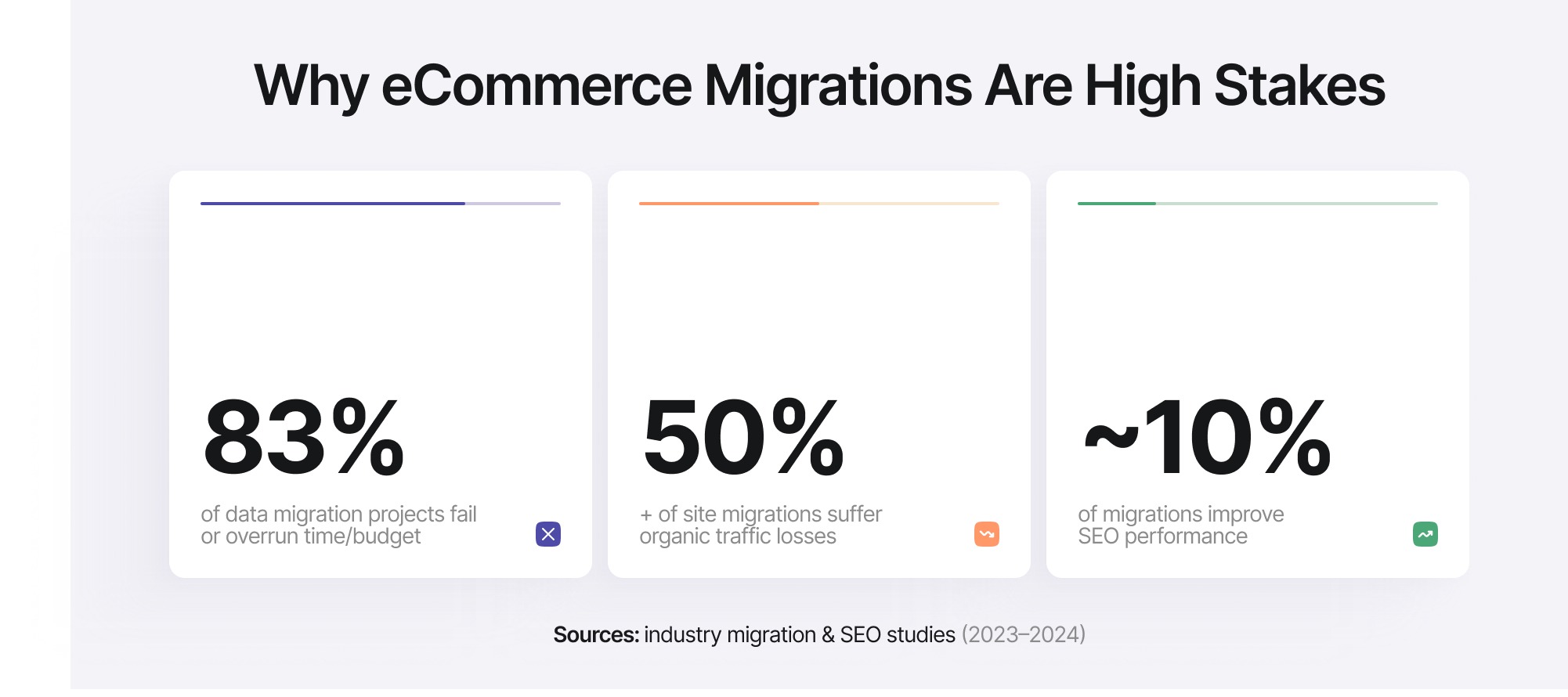
Think about everything tied to your current platform. Your Magento, WooCommerce, BigCommerce or custom stack has your catalogue logic, your customer data, historic orders, content, promotions, and all your third-party integrations wired into it. When you migrate to Shopify Plus, you’re effectively rewiring the entire nervous system of your digital business.
If that nervous system misfires, the symptoms appear very quickly. Broken checkout flows, wrong prices, missing stock, SEO drops and reporting gaps are all common side effects of rushed replatforming projects. I’ve seen brands lose 30% of organic traffic overnight because redirects weren’t handled, and others scramble for weeks because their ERP stopped syncing orders correctly.
The challenge is that you often don’t see the full impact until after launch. Everything might look fine on a staging store with a few test orders, only for edge cases to explode in production when real customers and real data hit the system. That’s why experienced shopify migration specialists treat go-live as the start of the most intense monitoring period, not the end of the project.
Why a Migration Isn’t Just Copy–Paste
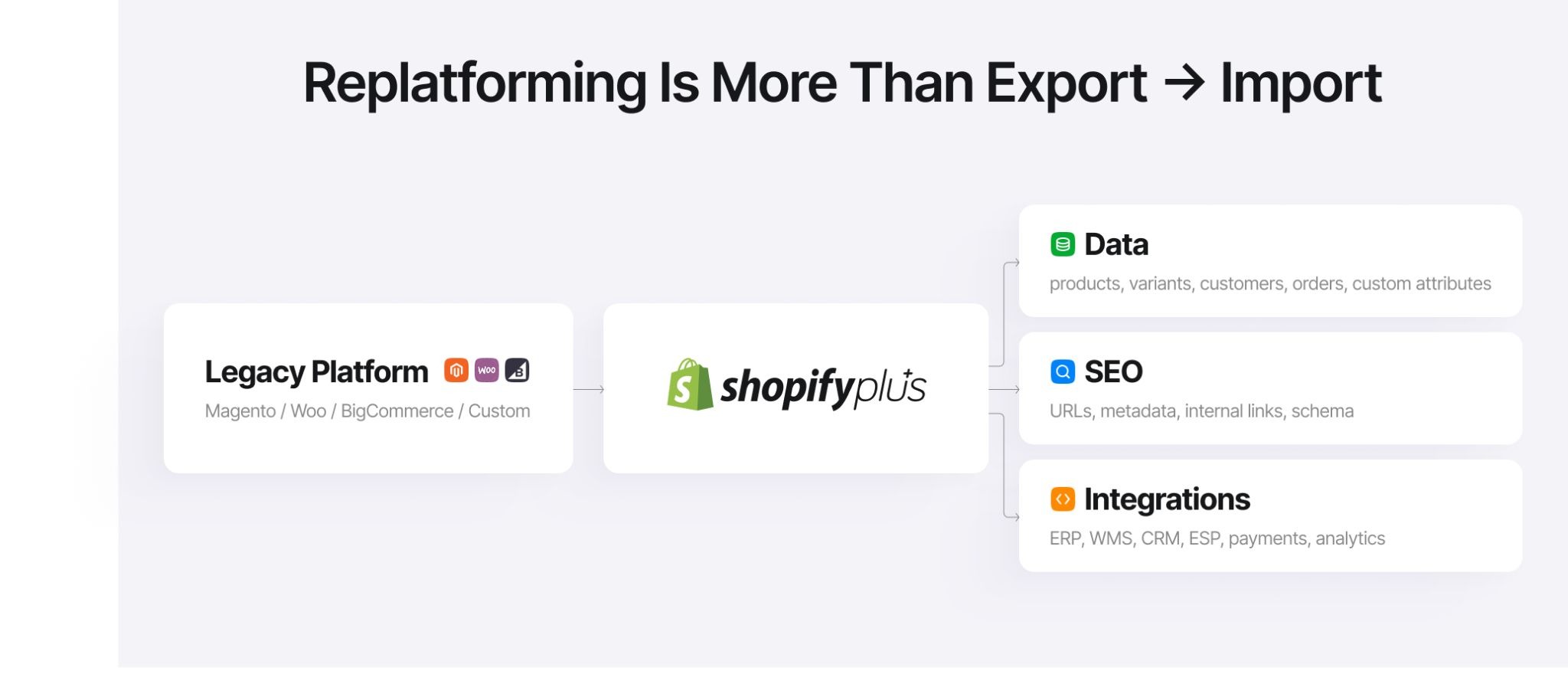
On paper, moving to Shopify sounds simple. Export products, customers and orders from the old platform, import them into Shopify, pick a theme, and off you go. In reality, every platform has its own data model, URL structure, integration patterns and quirks, and they never line up one-to-one.
Data fidelity is the first major hurdle. Product variants in Magento don’t behave exactly like variants in Shopify, customer records might have custom attributes that need mapping, and order history can span different tax rules, currencies and legacy discount logic. If you mis-map even one key field at scale, you can end up with thousands of products showing the wrong prices or orders that can’t be reconciled in finance.
Then there’s SEO. Your current URLs, internal linking, metadata and schema markup are the result of years of iteration, and Shopify’s URL structure is different from most legacy platforms. Without carefully planned 301 redirects and technical SEO checks, studies show that average sites can lose over 50% of organic traffic and take more than 500 days to recover, with 17% never fully recovering at all.
Integration: The Silent Migration Killer
For enterprise brands, integrations are where things get really interesting. Your ecommerce platform rarely lives alone; it talks to ERP, WMS, CRM, ESP, reviews tools, search vendors, payment gateways, finance systems and more. Each of those connections has to be rebuilt or re-configured when you move to Shopify Plus.
Poorly handled integrations are one of the biggest causes of replatforming pain. A 2024 survey found that 84% of companies say integration challenges slow down their digital transformation, and migrations are exactly where those weaknesses surface. If inventory isn’t syncing correctly or order statuses don’t flow back to your warehouse, it doesn’t matter how pretty your new Shopify store looks.
The complexity is less about “can we connect system A to system B” and more about “can we replicate and improve the business logic that’s evolved over the last five years”. That’s a design problem, not just a technical one. It’s also exactly where a seasoned Shopify Plus agency earns its keep.
The Growing Case for Shopify Plus
Before we get into why you might want shopify migration services UK, it’s worth acknowledging why Shopify Plus is on your radar at all. Shopify now powers millions of active stores, and Shopify Plus alone is estimated to be used by over 47,000 enterprise-level merchants globally. That share has grown sharply as brands look for fully hosted, low-maintenance platforms.
Shopify Plus is expected to grow at a triple-digit year-on-year rate in the enterprise segment, contributing more than 30% of Shopify’s recurring revenue. In plain English, that means more big brands are betting their future on Shopify Plus rather than on self-hosted stacks or ageing legacy solutions. When you see that kind of adoption from serious retailers, it tells you the platform is more than just a “SMB tool”.
For UK retailers specifically, we’ve seen Shopify handle Black Friday and peak trading with impressive resilience, including 50%+ year-on-year sales growth across some European markets during BFCM 2024. Once you know the underlying infrastructure is proven at scale, the real question becomes: how do you get onto it safely.
What Shopify Migration Specialists Actually Do
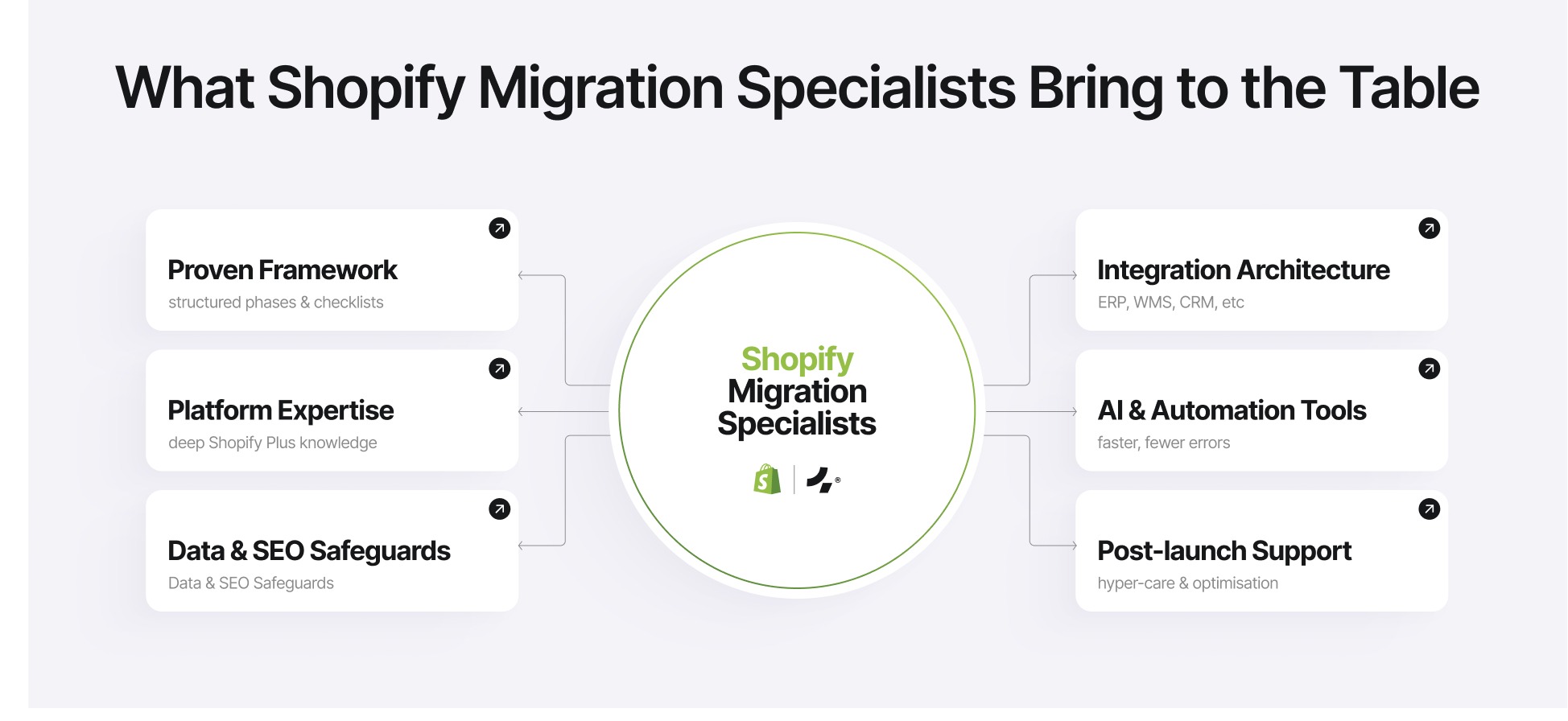
So, what do shopify migration specialists bring to the table beyond extra invoices and a lot of Gantt charts. First and foremost, they bring a proven migration framework, because this is not their first rodeo. They’ve already learned the hard lessons on other people’s projects so you don’t have to repeat them.
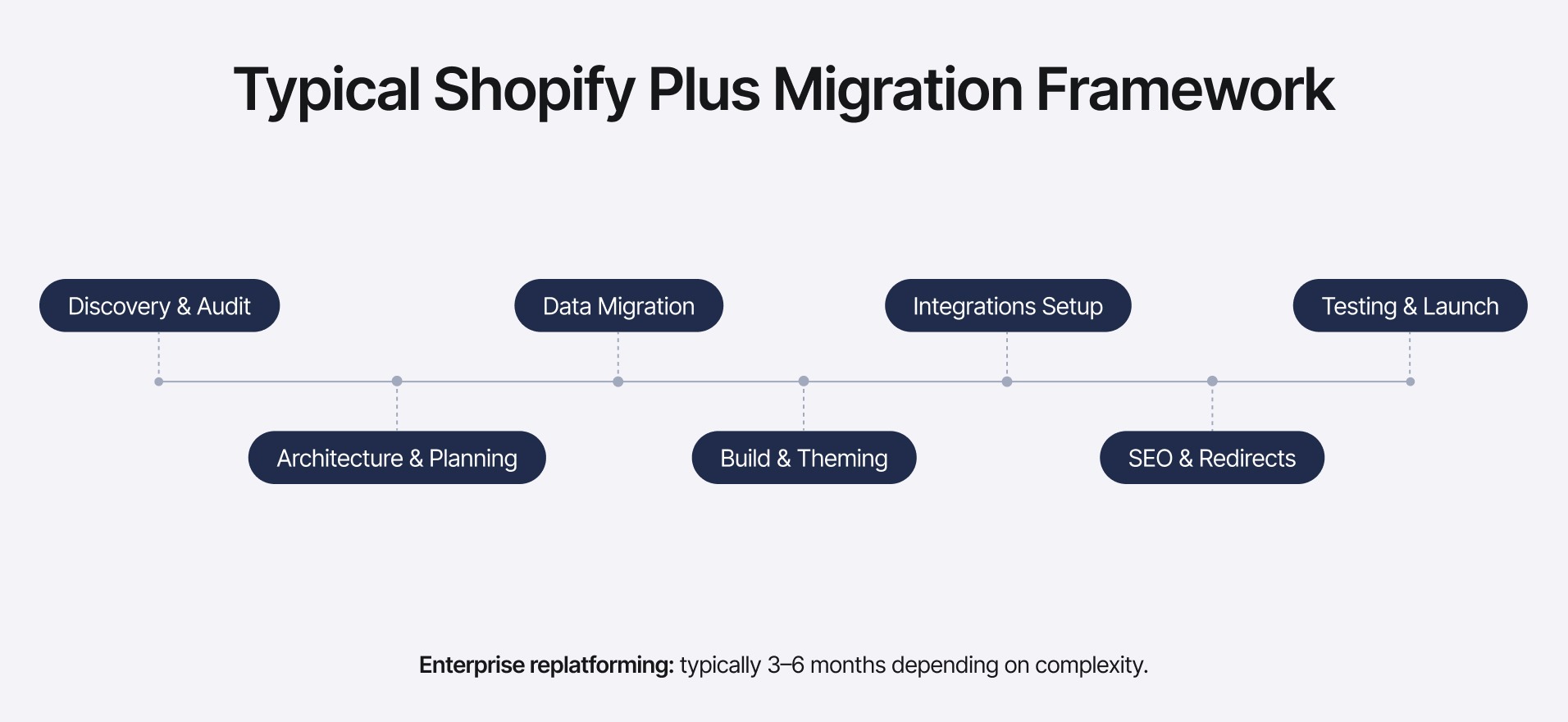
A good Shopify Plus agency will break your migration into clear phases: discovery and audit, target architecture design, data migration, build and integration, SEO and redirects, testing and launch, and post-launch optimisation. Each phase has its own checklists, sign-offs, and quality gates, so you’re not guessing whether something “should be fine” – you know it’s been verified. That structure alone eliminates a huge amount of risk and ambiguity.
Specialists also know where the landmines typically are. They’ll insist on a full URL inventory before touching redirects, they’ll test payment and tax combinations exhaustively, and they’ll push for a proper staging environment that mirrors production. It might feel pedantic at times, but it’s exactly that level of pedantry that prevents “surprise” revenue drops after launch.
Deep Shopify Platform Expertise
There’s a difference between a generalist dev shop that “can build on anything” and a team that lives inside Shopify Plus every day. Shopify has its own patterns, constraints and power features – things like Flow, Functions, Scripts, B2B features, hydrogen storefronts and app ecosystem nuances that you only really understand after many implementations.
Platform expertise means you don’t just recreate your old Magento or WooCommerce store on Shopify; you actually design something better. Specialists know when to use native Shopify features, when to leverage apps, and when to build custom solutions via APIs to keep performance and maintainability in a sweet spot.
This is where the “why can’t my internal developers do it?” question usually comes up. Your team might be excellent engineers, but if they’re not Shopify-native, they’ll spend a lot of time learning the platform on your dime and probably reinventing patterns that already exist in the Shopify ecosystem.
Efficiency, Tooling and AI
Experienced shopify migration specialists don’t start from scratch on each project. They have internal tooling, scripts, app preferences, and automation playbooks that compress timelines and reduce human error. That’s a major difference from a one-off, hand-rolled migration.
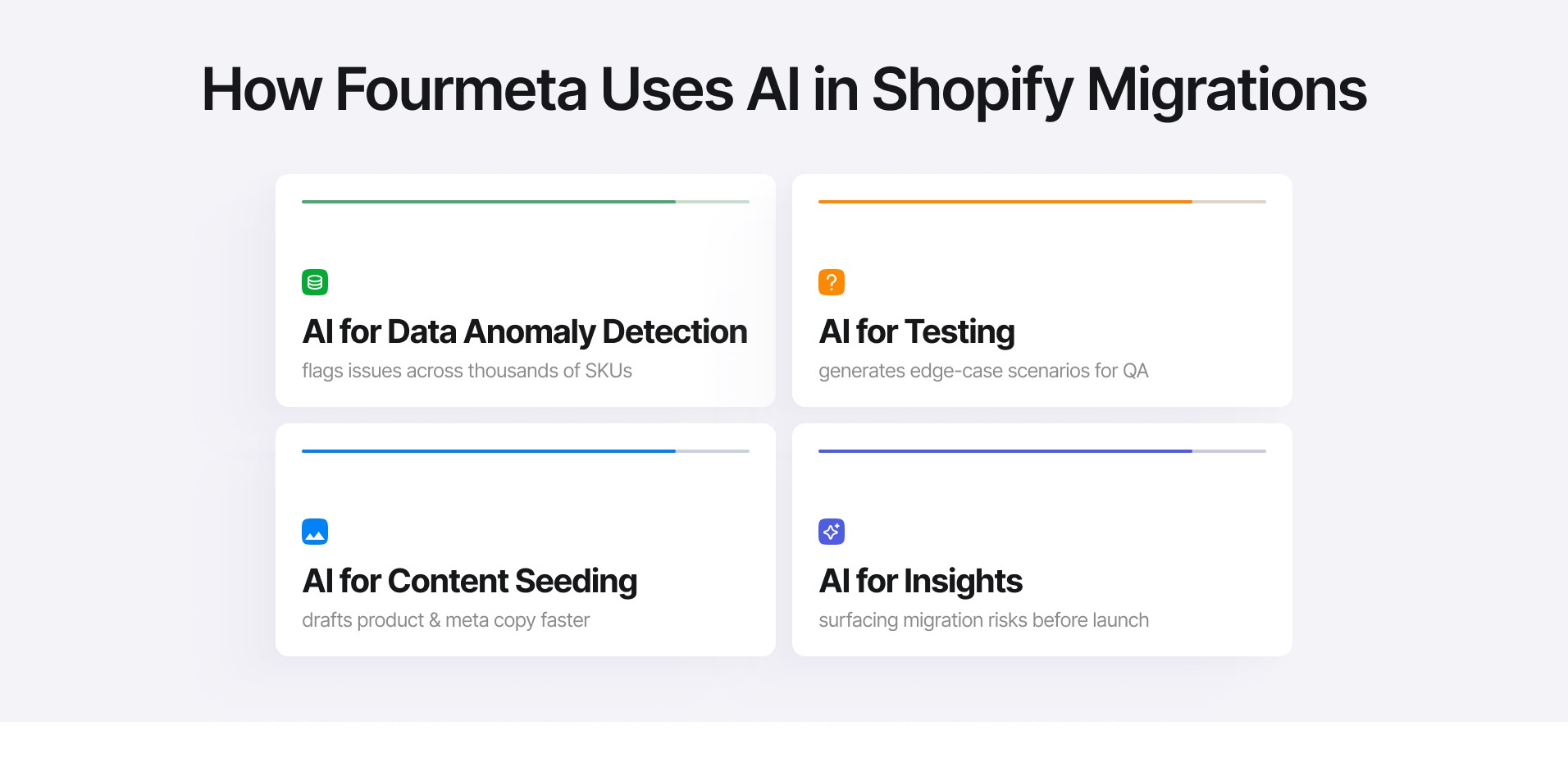
At Fourmeta, for example, we use a combination of battle-tested migration apps and our own scripts to handle bulk data transformations. On top of that, we’ve layered AI into our process to help with content mapping, anomaly detection in product data, and even generating test scenarios for QA, which has cut manual checking time by double-digit percentages.
Those efficiencies aren’t just “nice to have”. They mean your Shopify Plus migration can complete in months instead of feeling like an 18-month capital project, and they significantly reduce the chance of a subtle but costly data bug slipping into production. In 2025, if your Shopify Plus agency isn’t using AI to augment their work, they’re already behind.
SEO and Performance Retention
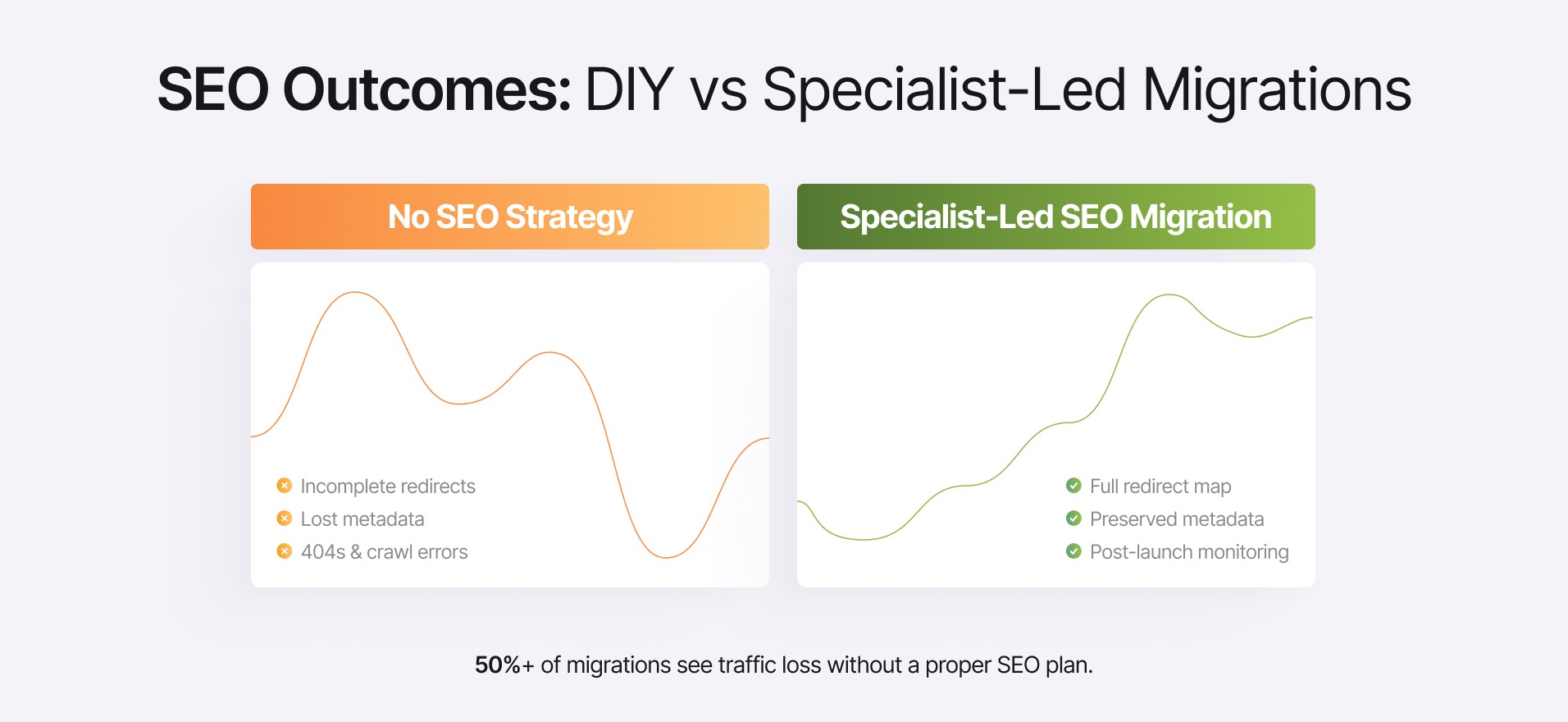
A specialist’s job isn’t just to move your store; it’s to protect and ideally improve your performance. On the SEO side, that starts with a meticulous redirect strategy and technical migration plan aligned with best-practice checklists.
Given that studies now show 50%+ traffic loss is common without a proper SEO strategy – and that only 10% of site migrations actually improve rankings – you really don’t want to treat SEO as an afterthought. A proper shopify migration services UK provider will crawl your existing site, map every valuable URL, preserve metadata and structured data, and monitor Search Console like a hawk in the weeks after launch.
Performance matters too. Shopify gives you a strong baseline with its CDN and optimised infrastructure, but theme implementation, app choices and custom scripts can still make or break load times. Migration specialists know how to keep your new Shopify Plus build lean and fast instead of accidentally recreating the bloat of your old platform.
Post-Launch Support and Stabilisation
One of the biggest misconceptions about migrations is that the project ends when the new site goes live. In reality, the first 30–60 days after launch are the most critical, because this is when real users, edge cases and bots hit the new setup at scale.
A strong Shopify Plus agency will plan for an intensive hyper-care period post-launch. That usually includes daily monitoring of key KPIs, error tracking, integration logs, and SEO metrics, along with a structured process for triaging and resolving issues quickly.
Without that safety net, small problems can snowball into major ones. An integration bug that mislabels a handful of orders on day one can become a full-blown stock or finance reconciliation nightmare by week four if no one is watching.
How to Choose the Right Shopify Migration Partner
Assuming you’ve decided that specialist help is a good idea, the next question is how to choose the right one. Not all shopify migration services UK are created equal, and a glossy sales deck isn’t enough reason to trust someone with your core revenue engine. You want evidence, not just adjectives.
Look for a track record of enterprise-level migrations, ideally from platforms similar to yours, like Magento 2 or complex WooCommerce builds. Ask for case studies where they’ve delivered measurable outcomes – faster page speeds, higher conversion rates, successful international roll-outs – not just “project completed”. For example, Shopify has public case studies where Magento to Shopify migrations have delivered 40%+ conversion lifts or doubled organic traffic when executed well.
Check their Shopify credentials too. Are they a recognised Shopify Plus agency, do they contribute to the ecosystem, do they understand newer features like B2B, Markets, and AI tools such as Shopify Magic and Sidekick. Finally, look for an AI-forward approach, because the agencies that are systematically using AI for quality, speed and experimentation will out-deliver those that still treat everything as manual craft.
In-House vs Specialist: A Tale of Two Migrations
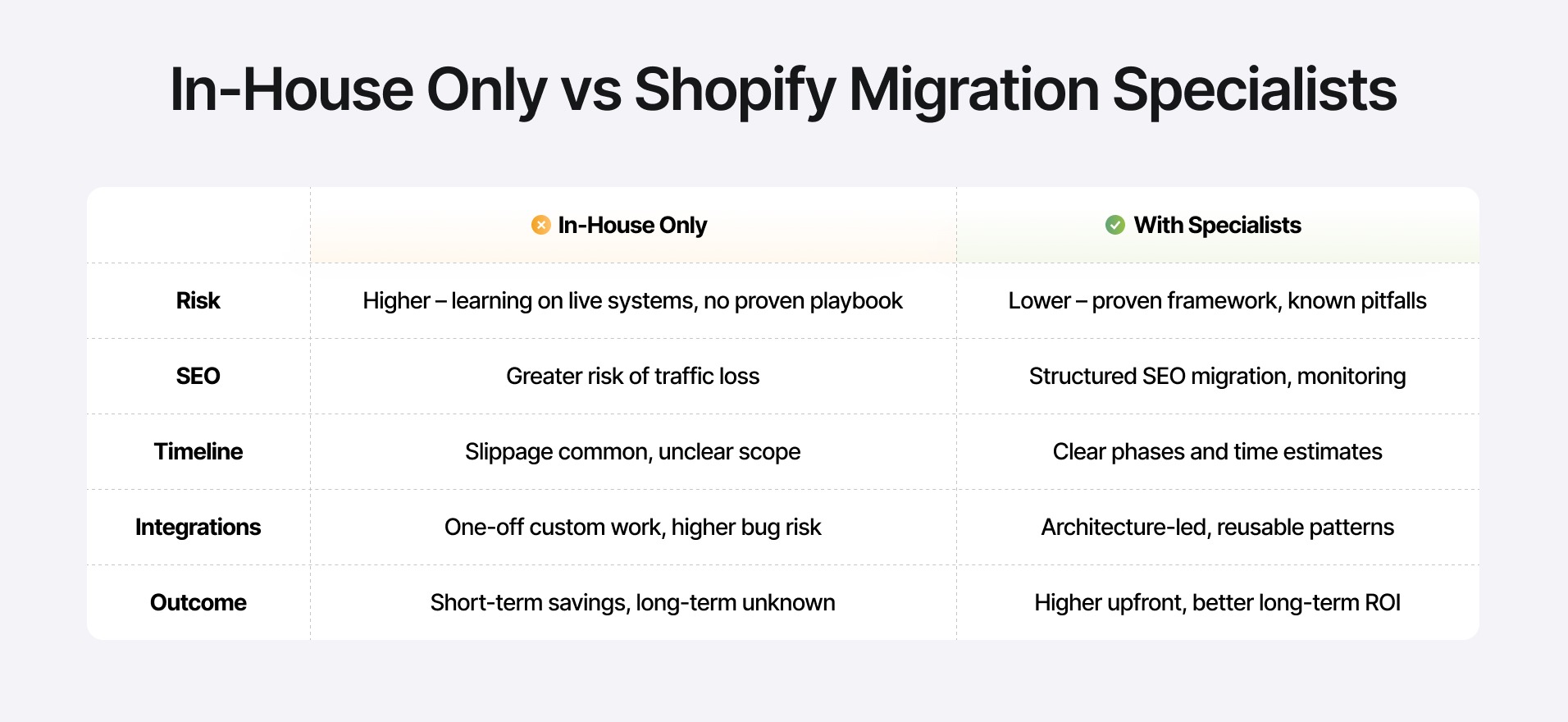
Let me give you a composite example based on real projects we’ve seen. A large UK retailer decided to replatform from Magento to Shopify Plus using only their in-house dev team and a generic IT integrator. The launch date slipped twice, the redirect mapping was incomplete, and within a week of going live they’d lost around 30% of organic traffic and were manually fixing orders that never reached the ERP.
Contrast that with another brand of similar size that chose to work with dedicated shopify migration specialists. They invested more upfront, but the project followed a structured framework with multiple pre-launch crawls, integration tests and dress rehearsals. Post-launch, they saw only a minor, temporary dip in organic traffic, recovered within weeks, and actually improved their checkout conversion by over 20% thanks to a better UX and Shopify’s optimised checkout.
The difference wasn’t that one team was smarter and the other less so. It was that one group had done this dozens of times before, with specific experience in Shopify Plus migration, and the other was learning live on a production business. When the cost of getting it wrong runs into six or seven figures, live learning is an expensive hobby.
Are Shopify Migration Specialists Worth the Investment?
This is the ROI question, and it’s the right one to ask. If your annual online revenue is in the millions, the cost of a serious migration partner will almost always be a small fraction of revenue – but the impact of failure can be huge. Remember that 83% statistic for data migrations that fail or overshoot their budgets, and the reality that many sites lose half their organic traffic for months after a poor migration.
A specialist Shopify Plus agency doesn’t just reduce the likelihood of catastrophe; it also increases the likelihood of upside. A well-run migration is a rare chance to fix years of technical debt, improve UX, streamline integrations, and bake in the automation and AI capabilities you actually want for the next five years. In that context, their fee is less “extra cost” and more “risk insurance plus growth accelerator”.
If you want a rule of thumb, ask yourself this: what would a 20–30% drop in revenue for six months cost the business, and what would it be worth to avoid that scenario. That number usually makes the case for bringing in shopify migration specialists much more clearly than any agency pitch ever could.
When You Might Not Need Full Specialist Support
Not every business needs the full bells-and-whistles treatment. If you’re running a relatively simple store with a small catalogue, limited integrations and modest organic traffic, a leaner migration approach or partial advisory support might be enough. In those cases, you might still want a Shopify expert to design the architecture and SEO plan, but your internal team can handle more of the implementation.
However, once you are in “enterprise” territory – multiple regions, complex pricing, B2B and B2C, ERP integrations, serious organic visibility – the calculus changes. The complexity and risk profile go up sharply, and the benefits of a specialist partner become much clearer. Most of the horror stories you read about migration failures are from this mid-market and enterprise band, not from small side-projects.
It’s perfectly reasonable to scope the support you need rather than outsourcing everything. Some of our favourite projects are collaborations where the client’s internal team owns parts of the build, and we handle the critical path items like data migration, SEO, and integration architecture.
How Fourmeta Handles Shopify Migration Services in the UK
At Fourmeta, we position ourselves unapologetically as shopify migration specialists. Our team has experience migrating from Magento, WooCommerce, BigCommerce and custom platforms into Shopify Plus, and we’ve built a repeatable framework for doing it with minimal disruption. We’re based in the UK, but we work with brands globally, which means we understand the nuances of local tax, payment and logistics setups too.
Our process always starts with a deep discovery and audit phase. We map your current architecture, catalogue, data, SEO footprint and integrations, and we stress-test assumptions before we touch a single line of code. From there we design a Shopify Plus architecture that doesn’t just replicate your existing stack but improves it, particularly in areas like automation, performance and content management.
AI is woven through this process. We use AI for content seeding, data anomaly detection, test-case generation and, increasingly, for helping clients design smarter merchandising and experimentation strategies once they’re live on Shopify Plus. That’s part of why we can deliver migrations faster and with fewer post-launch issues than a traditional manual-only approach.
Final Thoughts: Make Your Replatforming Boring (in a Good Way)
The best compliment you can give a migration project is that it was boring. No midnight firefighting, no panicked rollback, no “what happened to our Google traffic” crisis meetings, just a carefully planned cut-over and a smooth continuation of growth on a better platform. That’s what working with the right Shopify Plus agency should feel like.
If you’re planning a move to Shopify and wondering whether you really need shopify migration specialists, my honest answer is this. If your online revenue is material to the business and your setup is even moderately complex, the cost of doing it wrong will almost always dwarf the cost of doing it right. Bringing in experts is less about outsourcing work and more about buying experience, structure and peace of mind.
If you’d like to see what that looks like in practice, I’d be happy to talk. Book a consultation with our team, and we’ll walk you through how Fourmeta approaches shopify migration services UK, what a realistic roadmap for your business might be, and where AI and Shopify Plus can give you an unfair advantage once you’re there. Your platform shouldn’t be the thing that keeps you up at night – let’s make it the thing that helps you sleep.