

I am Alex, CEO at Fourmeta, and I spend a lot of my time speaking with teams who have outgrown their current ecommerce stack. Many still see Shopify as “the platform for small brands”, yet in 2025 Shopify Plus is quietly powering thousands of high-growth retailers, global wholesalers and even parts of the Fortune 500. With Shopify now holding around 10.3 per cent of the global ecommerce platform market and more than 4.8 million active stores, it is very clearly not just a hobbyist tool any more.
The real question I hear from CTOs and ecommerce directors is not “Is Shopify Plus big enough for us” but “Does it have the enterprise features we actually need”. They want to know whether Shopify Plus can handle complex operations, B2B, multiple regions, and the kind of automation and integration that keeps teams sane. In this article I will walk through seven Shopify Plus enterprise features that we see making the biggest difference for large and fast-growing brands, plus a short bonus section on AI.
As a migration and Shopify Plus implementation agency, we have seen these features pay off in real numbers for our clients. They reduce technical overhead, support global expansion and help teams move faster without burning out. If you are evaluating a migration or upgrading from standard Shopify, this is the lens I recommend using.
1. Unlimited Scalability and Reliability for Serious Spikes
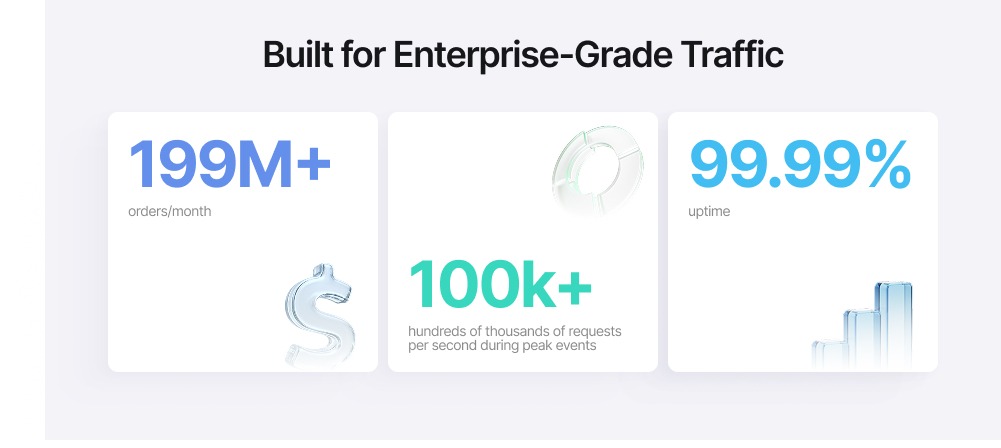
At enterprise scale, “the site is down” is not just an IT problem, it is a board-level issue. Shopify Plus is designed so that you simply do not spend your days talking about servers, capacity planning and cache invalidation. In 2023 the platform processed an average of 199 million orders per month and handled peak events like Black Friday with up to 967,000 requests per second, which gives you a sense of the underlying horsepower.
For high-growth brands this translates into predictable performance on the days that really matter. You can run flash sales, influencer drops or international campaigns knowing that the underlying infrastructure and global content delivery network are built to absorb extreme traffic. Instead of asking “Will the platform survive this promotion” your team can focus on making the promotion itself a success.
Shopify reports 99.99 per cent uptime across the network, and recent infrastructure improvements have sped up the platform by around 35 per cent. That kind of reliability is hard to replicate with self-hosted stacks, where you are responsible for scaling and patching everything yourself. For enterprises, the benefit is simple but powerful, because performance risk moves from your internal ops team to a platform whose entire business depends on staying fast and available.
2. Advanced Automation with Shopify Flow and Enterprise Logic
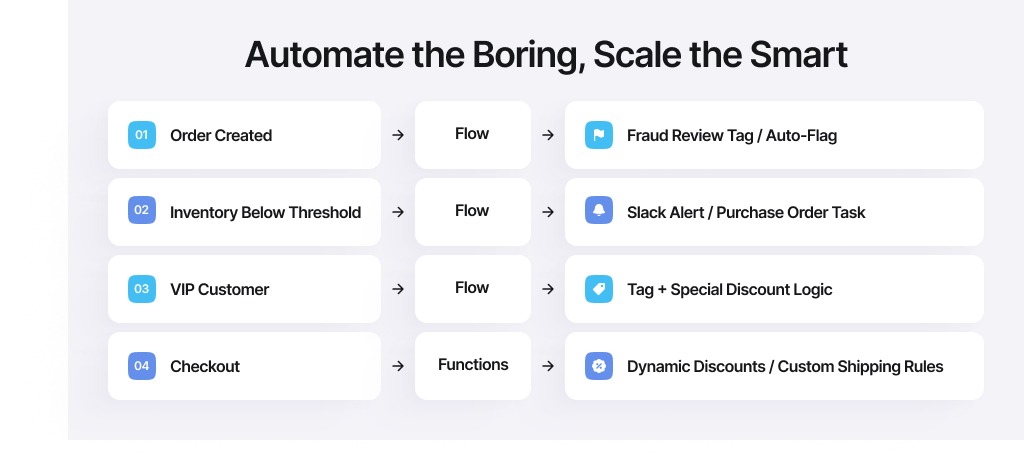
Most enterprise ecommerce teams are drowning in manual tasks that technically “work” but do not scale. Shopify Plus tackles this with automation tools like Shopify Flow, which lets you build visual workflows for things such as fraud review, VIP tagging, replenishment alerts and back-office processes without writing code. Instead of an intern living in spreadsheets, you get rules that fire automatically when orders, customers or inventory meet certain conditions.
On top of Flow, Plus merchants can use advanced discounting and checkout logic through features like Functions. This allows you to create tiered pricing, complex promotions and custom shipping rules that would be impossible or very clunky on standard plans, and it all runs close to the checkout where performance matters. In practice that means you can run sophisticated offers for different segments without making your marketing or engineering teams cry.
At Fourmeta we build on these native tools with our own automation patterns and AI-assisted workflows. For one client we replaced a messy tangle of scripts and back-office hacks with Flow-driven rules, which cut manual order handling time by over 50 per cent in peak periods. When you combine Shopify Plus enterprise features with AI that can suggest or optimise flows, automation stops being a side project and becomes a core efficiency lever.
3. Shopify Plus B2B and Wholesale on the Same Platform
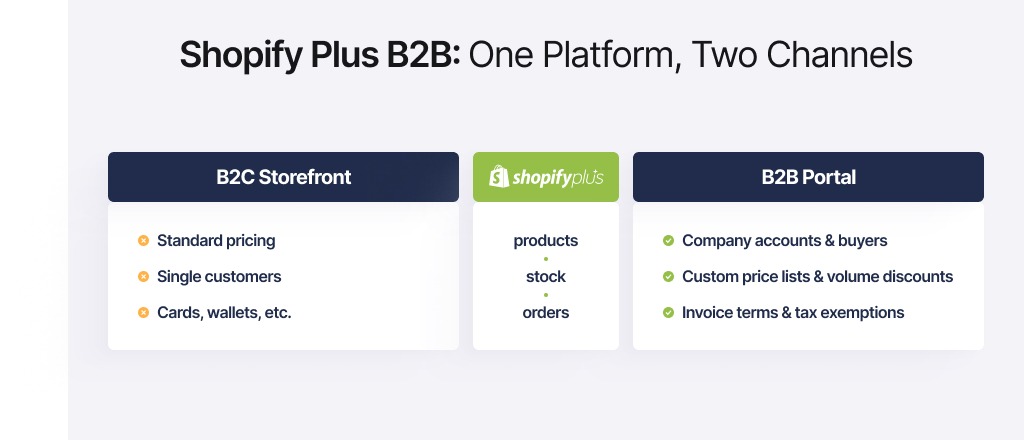
Historically, B2B and wholesale have forced brands into separate platforms or clunky add-ons. Shopify Plus has changed that with a native B2B suite that sits inside the same platform as your direct-to-consumer store, which is a big shift for enterprises who want to consolidate. You can now create company accounts, define multiple buyers and locations per company, and attach tailored catalogues, payment terms and tax rules to each.
These Shopify Plus B2B features allow you to run private storefronts or B2B purchasing experiences with custom price lists, volume discounts and invoice terms. For example, a retailer chain can log in, see its own negotiated prices across multiple locations, order in bulk and pay on agreed terms while your retail customers see normal prices on the same underlying platform. That means less duplication, fewer integrations to maintain and better visibility across all revenue streams.
For brands that have been juggling a consumer site, a separate wholesale portal and maybe even manual ordering, this consolidation is huge. It simplifies data, reporting and stock management, because your team gets one core system instead of three slightly broken ones. From a technology leadership point of view, Shopify Plus benefits here are as much about organisational clarity as they are about shiny features.
4. Multi-Store and Internationalisation for Global Growth
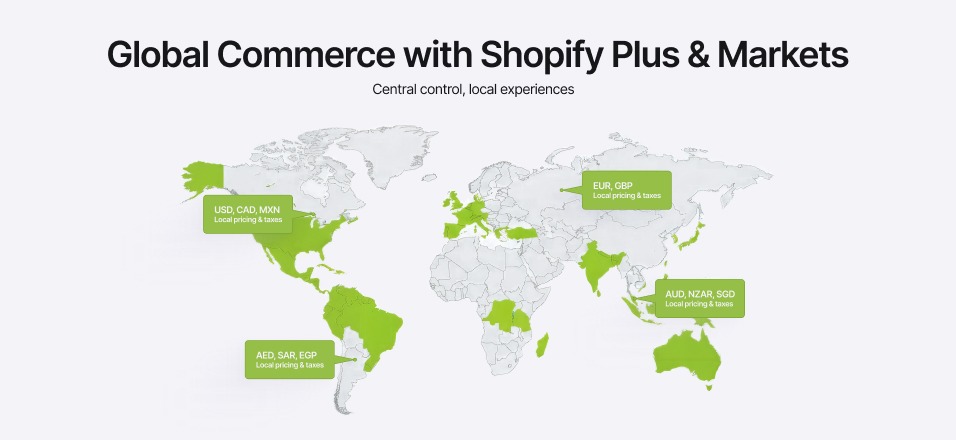
International growth is where many platforms start to creak. Shopify Plus combines a multi-store structure with Shopify Markets, which lets you localise currencies, languages and domains from a central place, so you can build a global presence without ending up with twelve totally separate websites. Markets allows you to set local currencies, domains or subfolders and tailored price lists per region, which matters for both customer experience and international SEO.
In practical terms one Shopify Plus store can present itself differently in the United Kingdom, Europe and the Middle East, with local currencies, taxes, languages and content tuned for each. If you need truly separate admin experiences or radically different catalogues, Plus also lets you add multiple stores under one contract and manage them from a central organisation view. We have seen enterprise clients use one pattern for owned brands and another for franchise or regional partners, while keeping everything plugged into the same back-office systems.
Compared with traditional multi-store setups on older platforms, the Shopify approach is opinionated but pragmatic. You trade a single ultra-complex backend for a set of more focused stores, stitched together with Markets and shared integrations. For many high-growth brands this is a better fit, because it balances control with simplicity, rather than asking the team to maintain a monolithic configuration that nobody fully understands.
5. Headless Commerce with Hydrogen and the Storefront API
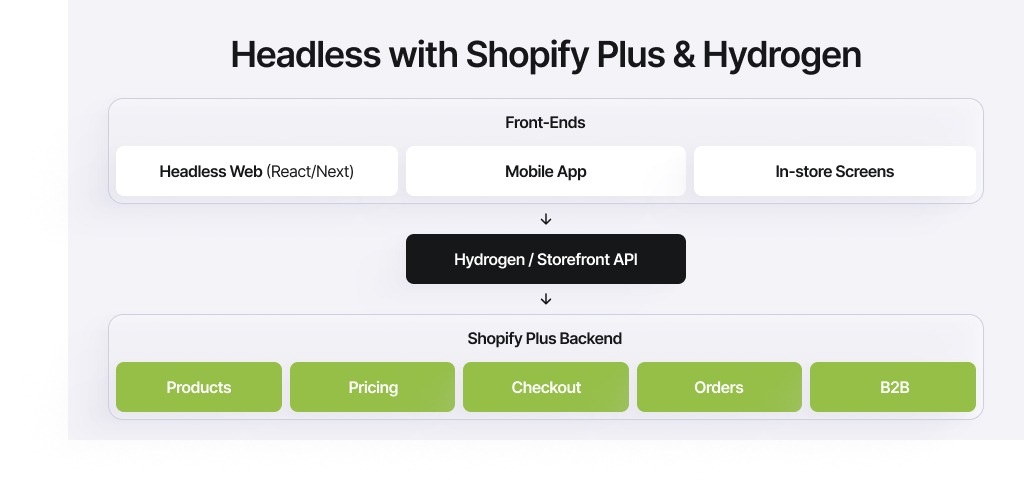
Many enterprise leaders ask whether Shopify Plus can support a fully custom front end without giving up the stability of a proven commerce engine. The answer is yes, through headless architectures built on the Storefront API and Hydrogen, Shopify’s React-based framework for headless commerce. These tools let you build bespoke web or app experiences that talk to Shopify for catalogue, cart and checkout, while giving your design and product teams near-total freedom on the front end.
Headless Shopify Plus is particularly attractive when you need a very specific design language, advanced content experiences or tight integration with custom back-office systems. You can think of Shopify as the transaction and data core, and Hydrogen or other React stacks as the presentation layer that sits on top. That way you avoid rebuilding ecommerce fundamentals like checkout and taxes from scratch, which is where many headless projects burn time and money.
At Fourmeta we have delivered headless builds where page loads feel almost instant, while still using standard Shopify Plus administration for products, orders and B2B. One fashion client saw engagement on key pages increase significantly after moving to a headless front end, because the UX finally matched the ambition of the brand. For teams who want both control and reliability, Shopify Plus enterprise features in the headless space are a very compelling middle path.
6. An Ecosystem of Integrations Instead of Endless Custom Builds
Another reason enterprises choose Shopify Plus is the sheer size and maturity of its ecosystem. The Shopify App Store now features well over thirteen thousand apps, covering everything from subscriptions and loyalty to tax, shipping, analytics and deep ERP connectors. That means your default question shifts from “Can this integrate” to “Do we buy an app or build something bespoke”.
For large brands the time savings can be dramatic. We have seen teams launch new loyalty programs, upsell engines or returns flows in days by integrating existing apps, where similar functionality on older platforms would have required months of custom development and testing. Pre-built connectors from major enterprise vendors also mean your CRM, finance and logistics tools are more likely to have a supported path into Shopify Plus.
Of course, not every app is suitable for a high-scale environment, and this is where a partner who lives in the ecosystem is valuable. We help clients evaluate which apps are enterprise-ready and where it still makes sense to build custom services on top of the Shopify APIs. Used thoughtfully, the ecosystem becomes one of the biggest Shopify Plus benefits, because it lets you evolve the stack quickly without reinventing every wheel.
7. Security and Compliance Handled by the Platform
Security is one of those topics everyone cares about but nobody wants to own. With hosted platforms you are still responsible for configuration, but you are no longer responsible for patching the core software or keeping up with every new exploit that hits the news. Shopify Plus comes with Level 1 PCI DSS compliance, built-in SSL for all stores and a platform that has invested heavily in certifications and secure infrastructure, so your team is not constantly firefighting.
For many enterprises the biggest win is in what you no longer have to do. You do not need to schedule emergency patch windows for the ecommerce core, run penetration tests on your own checkout code or maintain a patchwork of security plugins. Instead, Shopify monitors and updates the platform, and you focus on securing your own integrations, staff access and customer support processes where your unique risks actually live.
The financial impact of this is easy to underestimate. When you add up the internal security time, third-party services and potential downtime costs associated with self-managed platforms, the “fully hosted and patched” model becomes a major line item in the Shopify Plus benefits column. It is not glamorous, but it is one of the reasons risk-aware enterprises are comfortable trusting the platform with billions in annual GMV.
8. AI and Continuous Innovation on Shopify Plus
No discussion of Shopify Plus enterprise features in 2025 would be complete without mentioning AI. Shopify Magic is a suite of AI-powered tools built into the platform that can generate and rewrite product descriptions, assist with email content and help with other routine tasks, which takes some of the content burden off your team. Sidekick, Shopify’s AI assistant, lives directly in the admin and can help merchants interpret their data, configure features and even carry out tasks through conversational prompts.
These tools are not just gimmicks. For example, merchants can have product copy drafted automatically from a handful of attributes and then edited by humans, which speeds up catalogue launches dramatically. As AI expands to search, merchandising and support, Shopify’s acquisitions and investments in AI search and automation suggest that Plus merchants will keep seeing new capabilities roll into the platform without needing separate projects for every improvement.
At Fourmeta we build on this foundation with our own AI layer, which we call our AI formula internally. We use AI for data QA during migrations, for content seeding across large catalogues and for identifying optimisation opportunities that might be invisible in manual reports. For enterprise brands this combination of Shopify Plus benefits and agency-side AI is where the real leverage appears, because you get a platform that keeps evolving plus a partner focused on turning that evolution into commercial outcomes.
Conclusion: Shopify Plus as an Engine for Growth, Not Just a Platform
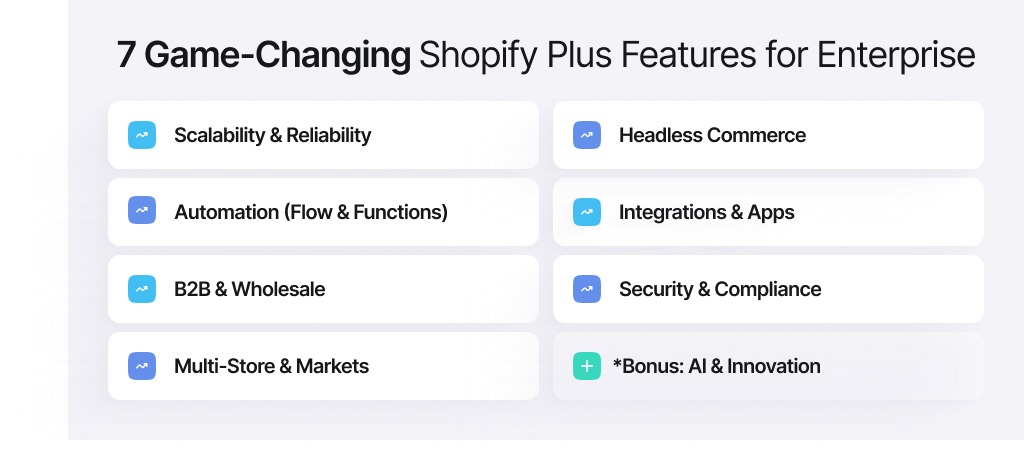
When you put all of these capabilities together, a pattern emerges. Shopify Plus is not just “Shopify but bigger”, it is a commerce operating system designed for brands that want to launch fast, operate lean and expand globally without sinking under their own technical weight. Features like automation, B2B, Markets, headless support, a massive ecosystem, built-in security and AI innovation all exist for one reason, which is to let your teams spend more time on growth and less time on firefighting.
If your current platform leaves you anxious before every peak, slow to roll out changes or stuck maintaining multiple systems for different channels, it is worth asking whether that is really the foundation you want for the next three years. A move to Shopify Plus is never just a “lift and shift”, it is an opportunity to simplify architecture, consolidate channels and rethink how your teams work. That is exactly why we focus so much of our work at Fourmeta on migrations and replatforming, because done well they become genuine growth projects rather than just technical upgrades.
If you are curious how these Shopify Plus enterprise features could apply to your own roadmap, we would be happy to talk. Our team specialises in helping high-growth brands migrate, modernise and take full advantage of the platform, from B2B to headless to AI-driven automation. Book a conversation with our Shopify Plus specialists, and we can map out what a migration or upgrade would look like for your business, including the numbers and risks behind the decision rather than just the buzzwords.